In a single day in 1938, one shooting party killed 4,273 birds here. The same wetland is now a UNESCO World Heritage Site, and the shift from hunting ground to protected sanctuary was not peaceful.


 MCQ Questions
IndGeo0109
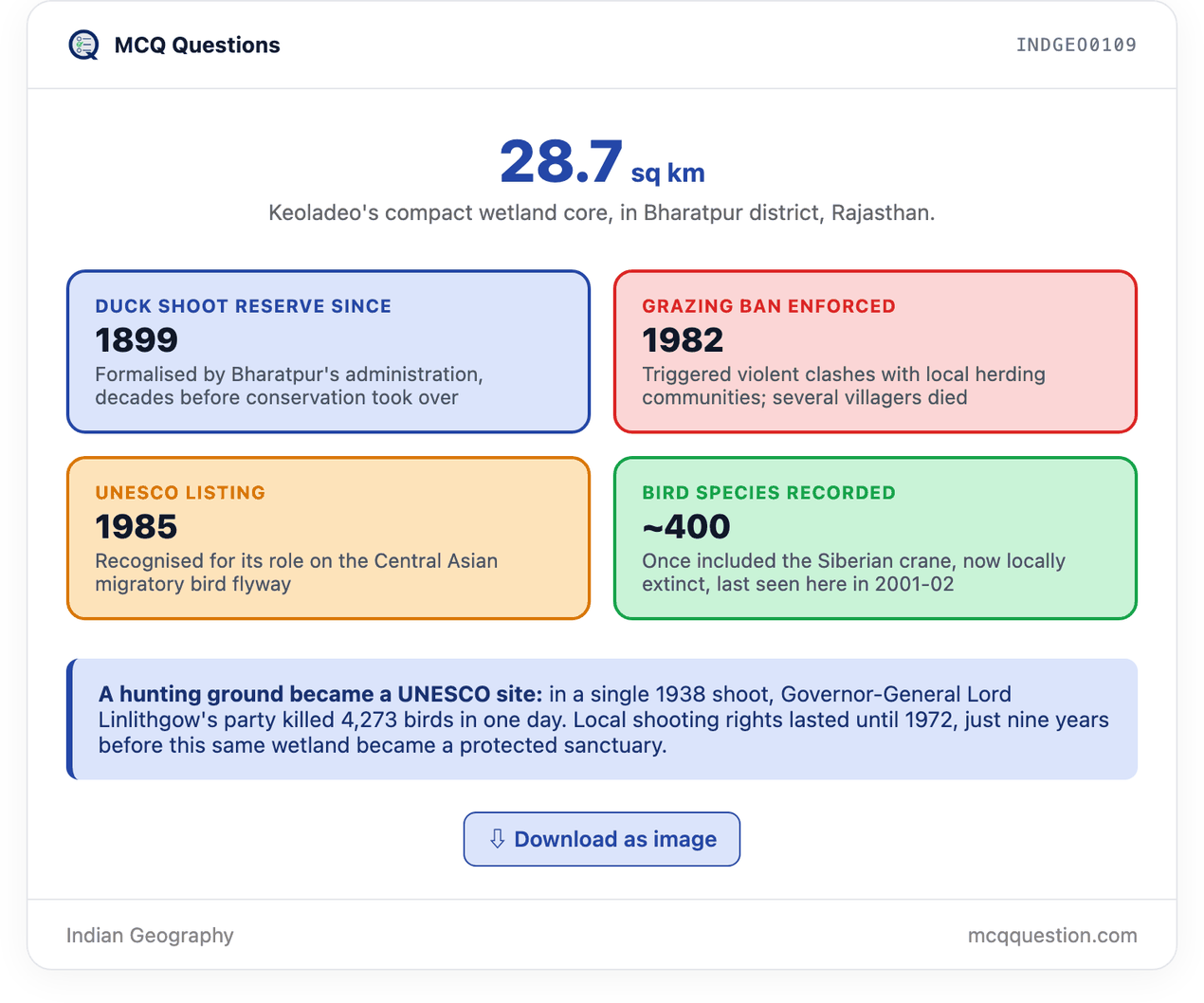
28.7 sq km
Keoladeo’s compact wetland core, in Bharatpur district, Rajasthan.
Duck Shoot Reserve Since
1899
Formalised by Bharatpur’s administration, decades before conservation took over
Grazing Ban Enforced
1982
Triggered violent clashes with local herding communities; several villagers died
UNESCO Listing
1985
Recognised for its role on the Central Asian migratory bird flyway
Bird Species Recorded
~400
Once included the Siberian crane, now locally extinct, last seen here in 2001-02
A hunting ground became a UNESCO site: in a single 1938 shoot, Governor-General Lord Linlithgow’s party killed 4,273 birds in one day. Local shooting rights lasted until 1972, just nine years before this same wetland became a protected sanctuary.
Must Know
- Keoladeo National Park lies in Bharatpur district, Rajasthan, about 2 km from Bharatpur town.
- Its core covers just 28.7 sq km, making it one of India’s smallest national parks.
- The wetland was created in the 18th century, when Maharaja Suraj Mal built the Ajan Bund at the meeting point of the Gambhir and Banganga rivers.
- It was formalised as a duck-shooting reserve in 1899. Local rulers kept shooting rights even after independence, until 1972.
- It became a bird sanctuary in 1956, largely through the efforts of ornithologist Salim Ali.
- It was designated a Ramsar wetland on 1 October 1981, and declared a national park on 10 March 1982.
- UNESCO listed it as a World Heritage Site in 1985.
Good to Know
- The name “Keoladeo” comes from a Shiva temple inside the park. Keoladeo is one of Shiva’s names. “Ghana,” the park’s older local name, means “dense,” referring to its thick vegetation.
- Duck shoots here were a fixture of colonial life. In a single 1938 shoot, Governor-General Lord Linlithgow’s party killed 4,273 birds in one day.
- When grazing was banned in November 1982, local Gujjar and farming communities protested. The crackdown that followed left several villagers dead. Sources give the toll as either 8 or 9.
- The park sits on the Central Asian migratory flyway, making it a key wintering ground for birds from Siberia and Central Asia.
- The Siberian crane once wintered here every year. The last recorded sighting was in 2001-02; the species is now considered locally extinct at the site.
Test Yourself

Great to Know
- Keoladeo’s story runs backwards from most conservation histories. Most protected areas start as wilderness that gets fenced off. Keoladeo started as an engineered wetland, built by a maharaja to flood land for duck hunting, and only later became a conservation priority.
- The 1982 grazing ban shows the real cost of strict protection. Local communities had grazed livestock there for generations. The Wildlife Protection Act’s no-human-activity rule for national parks left no room for that use to continue, and the clash turned violent.
- Along with Chilika Lake, Keoladeo was one of India’s first two Ramsar sites, both designated on the same day, 1 October 1981.
Beyond the answer
Browse all indian-geography topics →
📚 Keep reading
IndGeo0099 — Desert National Park: Fossils and the Great Indian BustardGK0051 — Shooting Sports in IndiaIndGeo0102 — Jim Corbett National ParkIndGeo0100 — Kaziranga National ParkIndGeo0053 — Ramsar Wetlands of India❓ Practice this topic
D0311 — Consider the following statements: 1. Filling a lake removes natural flood storage. 2. Wetlands recharge groundwater aquifers. 3. Reclaimed water bodies increase local heat island effects. How many of the statements are correct?D0310 — Which of the following directly governs wetland conservation in India?D0309 — Why is the East Kolkata Wetlands ecologically valuable?D0308 — Which of the following is a direct environmental effect of filling an urban lake?🎲 Take a Indian Geography Quiz
Leave a Reply