A handloom weaver in a Telangana village and a jute mill worker in West Bengal are both proof of the same idea: build the factory where the raw material and the workers already are.

 MCQ Questions
✅ Must Know
What resource-based manufacturing means
- Resource-based manufacturing builds industry around locally available raw material: agricultural produce, minerals, or forest products. Food processing, textiles, and leather are classic examples.
Why it suits employment goals
- These industries tend to be more labour-intensive than heavy, capital-intensive industry. The same investment typically creates more jobs when it goes into resource-based manufacturing.
Jobs where the resource and labour already are
- Locating manufacturing near the raw material also puts it near the rural labour force that produced or handles it. This avoids costly relocation of either.
The scale of the opportunity
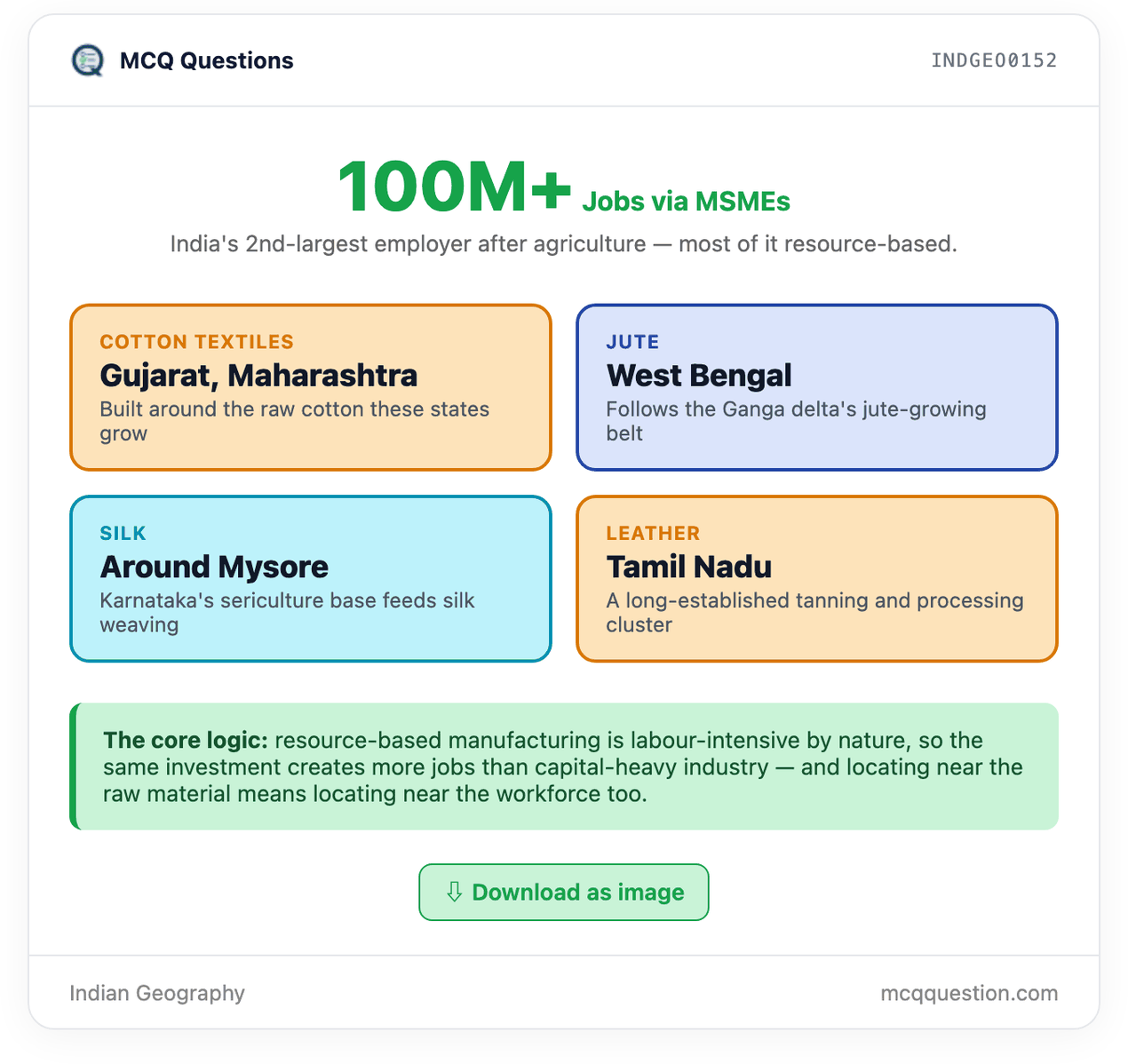
- India’s MSME sector includes most resource-based manufacturing. It is the country’s second-largest employer after agriculture, supporting well over 100 million jobs.
💡 Good to Know
Rural, non-farm income
- Resource-based manufacturing near agricultural zones can employ rural workers directly. It offers non-farm income and reduces pressure to migrate to distant cities for work.
One District One Product (ODOP)
- The ODOP initiative identifies and promotes a resource-based product unique to each district. The aim is a recognisable, exportable specialty built around what that district already produces well.
SFURTI for traditional industries
- The Scheme of Fund for Regeneration of Traditional Industries (SFURTI) supports khadi, coir, and handicraft clusters. These industries are inherently resource-based and traditionally rural.
Why clustering helps small units
- Grouping small producers into clusters lets them share costly infrastructure. Common facility centres and testing labs become affordable that no single small unit could manage alone.
Test Yourself


🌟 Great to Know
Seasonal raw material means seasonal work
- Many resource-based industries depend on seasonal harvests, like sugarcane or cotton. This can create seasonal underemployment even where annual job numbers look strong on paper.
Low value addition caps income growth
- Many units process raw material only lightly before selling on. This captures less value than more sophisticated processing would, limiting how much worker incomes can rise over time.
Credit and technology access remains uneven
- Small, resource-based units often struggle to access formal credit and modern technology. Many stay stuck at a small, low-productivity scale despite genuine demand for their output.
A geography of established clusters
- India already has real resource-based clusters to build on. Cotton textiles cluster in Gujarat and Maharashtra, jute in West Bengal, silk around Mysore, and leather in Tamil Nadu, alongside handloom weaving across many states.
📝 Previous Year Questions
UPSC Mains 2019 GS Paper I, Q6
Beyond the answer
Browse all indian-geography topics →
📚 Keep reading
IndEco0005 — IndustryModHist0351 — The Founding of the Hind Mazdoor SabhaIndEco0018 — Employment Types and Measurement in IndiaIndEco0003 — Poverty, Employment and Income DistributionIndEco0006 — Service Sector❓ Practice this topic
D0311 — Consider the following statements: 1. Filling a lake removes natural flood storage. 2. Wetlands recharge groundwater aquifers. 3. Reclaimed water bodies increase local heat island effects. How many of the statements are correct?D0310 — Which of the following directly governs wetland conservation in India?D0309 — Why is the East Kolkata Wetlands ecologically valuable?D0308 — Which of the following is a direct environmental effect of filling an urban lake?🎲 Take a Indian Geography Quiz
Leave a Reply