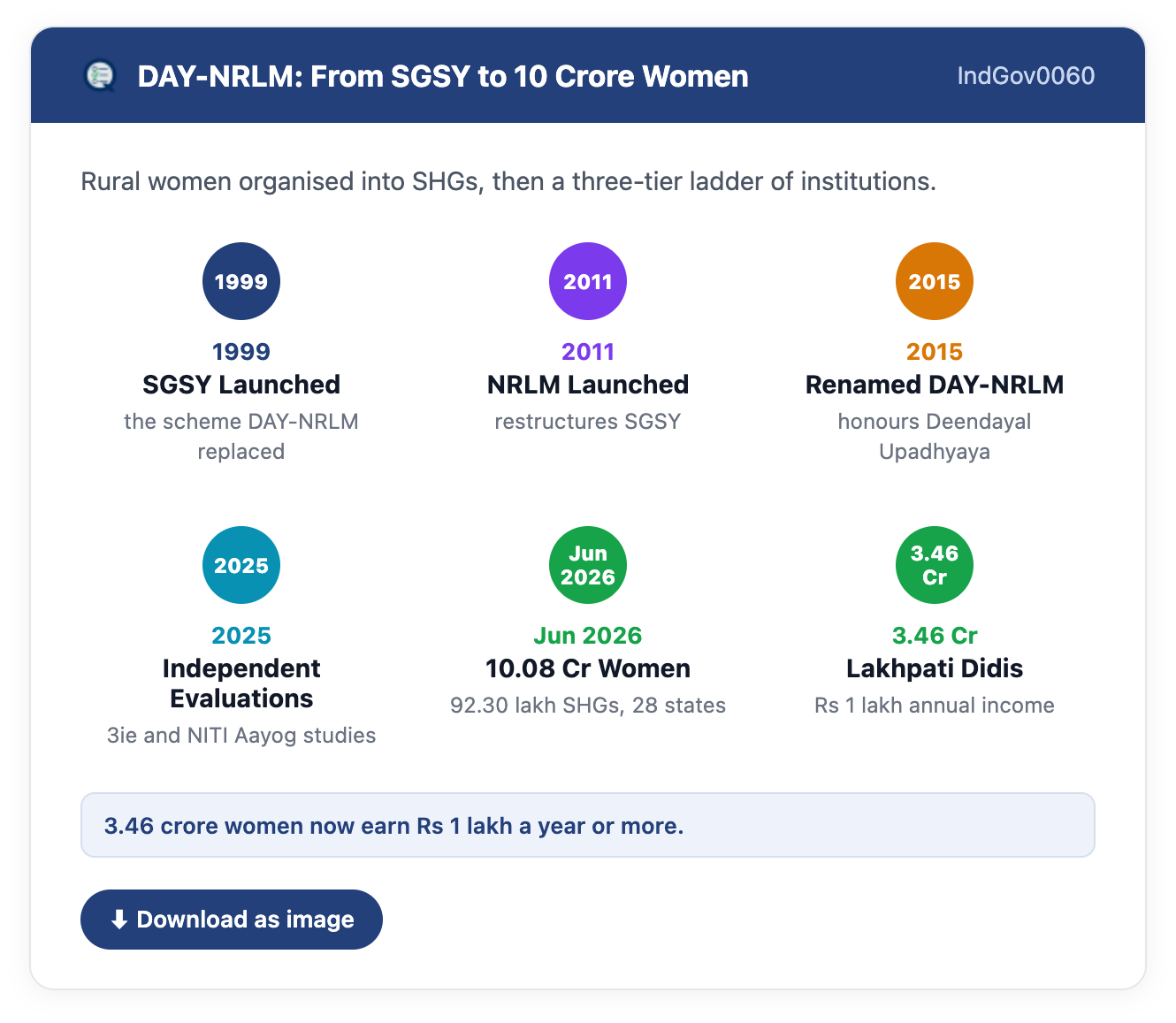
One rural welfare scheme now reaches over 10 crore Indian women. DAY-NRLM organises them into Self Help Groups, then builds those groups into a three-tier ladder of institutions. By mid-2026, more than 3 crore of those women had crossed an annual income of Rs 1 lakh.


Must Know
DAY-NRLM: The Basics
What is DAY-NRLM?
- Full formDAY-NRLM stands for Deendayal Antyodaya Yojana – National Rural Livelihoods Mission.
- WhatIt is the Ministry of Rural Development’s flagship rural poverty alleviation scheme.
- HowIt organises rural households, mainly women, into Self Help Groups (SHGs).
- Full formSHG stands for Self Help Group — a small group of neighbours who save and work together.
- WhyThe Mission keeps supporting these groups until their incomes rise sustainably.
- GoalThe aim is to fight poverty through livelihoods, not just one-time doles.
From SGSY to DAY-NRLM: the name trail, and The three-tier SHG ladder, and Four core components
- Full formSGSY stands for Swarnajayanti Gram Swarozgar Yojana.
- 1999SGSY launches and becomes DAY-NRLM’s direct predecessor.
- Full formNRLM stands for National Rural Livelihoods Mission.
- 2011The Ministry of Rural Development restructures SGSY into NRLM.
- 2015NRLM is renamed DAY-NRLM, honouring the thinker Deendayal Upadhyaya.
- IdeaOne idea has run continuously since 1999: organising rural women into Self Help Groups.
- Full formSHG stands for Self Help Group, the base of the ladder.
- Tier 1SHGs sit at the village level.
- Full formVO stands for Village Organisation.
- Tier 2Village Organisations sit above the SHGs.
- Full formCLF stands for Cluster Level Federation.
- Tier 3Cluster Level Federations sit at the panchayat or block level.
- StructureTogether they form a three-tier federated structure.
- MeaningFederated means each tier is built from the groups below it.
- Component 1Strong community institutions — the SHG ladder that organises women.
- Component 2Financial inclusion — linking groups to banks and credit.
- Component 3Sustainable livelihoods — helping members build steady incomes.
- Component 4Social inclusion — reaching the poorest and most marginalised.
- HowThe components work together: institutions organise women, finance funds them, livelihoods use the money, and inclusion brings everyone in.
Good to Know
Sub-schemes and Milestones
DDU-GKY and RSETIs: training rural youth
- Full formDDU-GKY stands for Deen Dayal Upadhyaya Grameen Kaushalya Yojana.
- WhatDDU-GKY gives placement-linked skill training to rural youth aged 15-35.
- MeaningPlacement-linked means the training is designed to end in a job.
- Full formRSETI stands for Rural Self Employment Training Institute.
- WhatRSETIs are bank-sponsored centres that train youth aged 18-50.
- FocusTheir focus is self-employment and entrepreneurship.
MKSP and SVEP: farming and enterprise, and Lakhpati Didi: the Rs 1 lakh milestone, and Collateral-free credit for SHGs
- Full formMKSP stands for Mahila Kisan Sashaktikaran Pariyojana.
- WhatMKSP supports women farmers — “Mahila Kisan” means woman farmer.
- Full formSVEP stands for Start-up Village Entrepreneurship Programme.
- WhatSVEP backs rural micro-enterprises.
- TogetherThey cover farming and small business, two big rural livelihood paths.
- WhatThe Lakhpati Didi initiative tracks SHG women who cross an annual household income of Rs 1 lakh.
- MeaningLakhpati means “earning a lakh” — the name marks the milestone itself.
- 2026By mid-2026, 3.46 crore women had reached that mark.
- WhyThe milestone counts household income, so the whole family benefits.
- WhatUnder DAY-NRLM, women SHGs can take loans from banks without collateral.
- MeaningCollateral is security you pledge against a loan; these loans need none.
- ScaleCumulative credit disbursed to SHGs has crossed Rs 11 lakh crore.
- TrustThe repayment rate stands above 98%.
- WhyHigh repayment builds trust, so banks keep lending to the groups.
Test Yourself
Question 1 of 1
Great to Know
Evidence and Mechanisms
The 2025 NITI Aayog evaluation
- Full formNITI Aayog stands for the National Institution for Transforming India.
- WhatA 2025 NITI Aayog evaluation assessed the Mission’s impact on rural incomes.
- IncomeIt found DAY-NRLM raised average household incomes by 49%.
- ConfidenceIt found 58% of women reporting greater confidence.
- SkillsIt found 46% of women managing bank transactions independently.
- Bottom lineThe gains are economic and social: money, confidence, and skills together.
The 2025 3ie impact study, and Why the ladder works: the mechanism
- Full form3ie is the International Initiative for Impact Evaluation.
- ScopeIts 2025 study covered about 23,000 households across 9 states.
- FindingIncome gains of 12-33% appeared in areas with the most mature community institutions.
- MeaningMature institutions are those most fully built up through the Mission’s ladder.
- PatternThe clearer the institutional ladder, the larger the income gains.
- LinkThe 3ie study ties mature institutions to larger income gains.
- ScaleA single SHG is small; a federation represents many groups at once.
- BargainThat scale lets banks deal with one strong network instead of many tiny groups.
- ProofBanks have disbursed over Rs 11 lakh crore to SHGs, with repayments above 98%.
- LoopTrust and scale feed each other: responsible groups keep credit flowing.
- DesignThat is why DAY-NRLM builds institutions first, then attaches finance and livelihoods to them.
Current Affairs
The Latest Developments
DAY-NRLM at a glance: 30 June 2026
- MobilisedAs of 30 June 2026, DAY-NRLM has mobilised 10.08 crore women.
- GroupsThose women are organised into 92.30 lakh Self Help Groups.
- ReachThe Mission operates across 28 states and 6 Union Territories.
- NoteThese are the latest figures reported for the scheme.
The VB-G RAM G Act: in force from 1 July 2026
- Full formVB-G RAM G stands for Viksit Bharat – Guarantee for Rozgar and Aajeevika Mission (Gramin).
- WhenThis new law took legal effect on 1 July 2026.
- WhatIt adds a statutory 125-day rural employment guarantee.
- MeaningStatutory means the guarantee is written into law, not just a policy promise.
- RelationThe Act runs alongside DAY-NRLM as a complementary rural scheme.
Exam Point of View
How to Answer in Exams
CDS II 2025: SM&ID Sits Inside DAY, Not a Separate Mission
- QuestionCDS asked which scheme Social Mobilisation and Institution Development (SM&ID) is a component of. The answer: the Deendayal Antyodaya Yojana umbrella, which covers both DAY-NRLM (rural) and DAY-NULM (urban).
- WhySM&ID is the process of organising the poor into SHGs, then federating them upward — exactly the ladder this article covers.
- LinkSource: CDS II 2025, General Knowledge (see Q120).
CDS I 2026: SVEP Works With SHGs, Not Around Them, and MCQ Questions, and Written Answer Questions
- QuestionCDS asked whether SVEP supports “all women except those engaged with Self-Help Groups.” This is false — STRY and DAY-NRLM’s SHG-women focus were both correctly stated in the same question.
- WhySVEP is a sub-scheme run within the DAY-NRLM ecosystem. SHGs and their federations are central to how it identifies and supports rural entrepreneurs, not excluded from it.
- LinkSource: CDS I 2026, General Knowledge (see Q108).
- TipUPSC and other competitive exams often test the exact year a scheme was launched or renamed.
- YearsRemember the name trail: SGSY (1999), NRLM (2011), DAY-NRLM (2015).
- LadderRemember the tier order: SHG, then Village Organisation, then Cluster Level Federation.
- NumbersRemember the headline figures: 10.08 crore women, 92.30 lakh SHGs, credit above Rs 11 lakh crore, repayment above 98%.
- Full formsRevise the full forms: DAY-NRLM, SGSY, DDU-GKY, RSETI, MKSP, SVEP, and VB-G RAM G.
- Full formGS stands for General Studies, the paper where this theme appears.
- DesignA strong GS answer explains the design: institutions first, then finance and livelihoods.
- StructureExplain the three-tier federated structure and why federating builds scale and trust.
- EvidenceSupport the answer with data: 49% income gains in the NITI Aayog study and 12-33% gains in the 3ie study.
- LinkTie DAY-NRLM to the newer VB-G RAM G Act and its 125-day employment guarantee.
Was this helpful?
Leave a Reply