In 1990, Prime Minister V.P. Singh revived a report that three governments had left untouched for a decade. His decision to reserve jobs and college seats for OBCs set off deadly protests, toppled his own government within months, and reshaped Indian politics around caste in ways still felt today.
OBC: Other Backward Classes — castes the Mandal Commission found held back mainly by their caste, not just poverty, covering about 52% of India’s population.
Creamy layer: The richer, more advanced families within OBC groups, whom the Supreme Court excluded from reservation benefits in 1992.
- What was the Mandal Commission, and why was it delayed a decade?
- How did V.P. Singh announce implementation, and why did it spark protest?
- How did the Rath Yatra bring down the government?
- What did the 1992 Indra Sawhney verdict decide?
- Why is the 50% cap back in court today?
- Exam Angle: How does CAPF test the creamy layer case?
1.What was the Mandal Commission, and why was it delayed a decade?
1.1What did the Commission find?
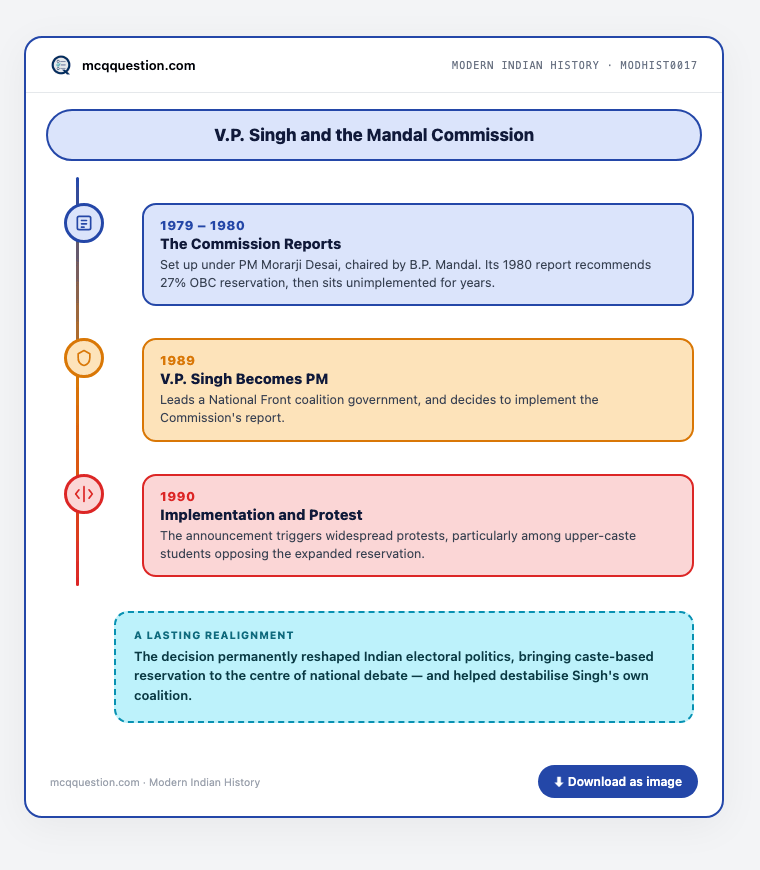
PM Morarji Desai set up a panel to study caste-based backwardness, and its findings were sweeping.
- The Second Backward Classes Commission, led by B.P. Mandal, was set up in December 1978 and began work on 1 January 1979.
- Its report, submitted 31 December 1980, identified 3,743 castes as “backward,” together about 52% of India’s population.
- Its core recommendation: reserve 27% of central government jobs, public-sector jobs, and college seats for these OBC groups, on top of existing SC/ST quotas.
1.2Why did it sit unused for a decade?
Two more Prime Ministers left the report untouched before anyone acted on it.
- Indira Gandhi’s and Rajiv Gandhi’s governments both left the Mandal report unimplemented through the 1980s.
- It took V.P. Singh’s government, a decade later, to finally act on its recommendations.
2.How did V.P. Singh announce implementation, and why did it spark protest?
2.1How did Singh make it official?
A weak government, needing outside support just to survive, moved fast once it moved.
- On 7 August 1990, PM V.P. Singh announced in Parliament that the Mandal Commission’s plan would finally be implemented.
- The government made the 27% OBC quota official six days later, on 13 August 1990.
- Singh’s government depended on outside support from the BJP and the Left; many historians see the move as aimed partly at outmanoeuvring a rival inside his own Janata Dal party.
2.2How did protests turn deadly?
The announcement triggered riots across north India, and a disturbing wave of self-immolation attempts.
- Delhi University student Rajiv Goswami tried to set himself on fire outside AIIMS hospital on 19 September 1990.
- He survived with severe burns but died years later, on 24 February 2004, from related health complications.
- His attempt became an iconic, widely reported image of the anti-Mandal protest movement.
True or false: The Mandal Commission’s report sat unused for about ten years before V.P. Singh’s government implemented it.
3.How did the Rath Yatra bring down the government?
3.1What was the Rath Yatra, and why did it matter?
A separate religious procession shifted public anger away from caste, toward religion instead.
- BJP leader L.K. Advani began the Ram Rath Yatra, a long religious procession, on 25 September 1990.
- Many historians view it as a deliberate move, redirecting public attention from the Mandal caste debate toward the Ayodhya religious dispute.
3.2How did Singh’s government actually fall?
An arrest broke the coalition, and a lost vote ended Singh’s term within days.
- Bihar police arrested Advani on 23 October 1990; the BJP withdrew its support from Singh’s government that same day.
- Singh lost a confidence vote in Parliament on 7 November 1990, and resigned three days later.
True or false: L.K. Advani’s Ram Rath Yatra and the Mandal announcement were entirely unrelated events that happened to occur in the same year.
4.What did the 1992 Indra Sawhney verdict decide?
4.1What did the Supreme Court rule?
A nine-judge bench upheld the quota, but attached two major limits.
- A nine-judge Supreme Court bench decided Indra Sawhney v. Union of India on 16 November 1992, upholding the 27% OBC reservation.
- It introduced the “creamy layer” rule, excluding wealthier, more advanced OBC families from the benefit.
- It capped total SC, ST, and OBC reservation at 50% of seats or jobs, crossable only in rare “extraordinary” situations.
- It also ruled reservation could apply to hiring, but not to job promotions.
4.2Why does this verdict still matter?
The ruling opened what historians now call the “Mandal era” of Indian politics.
- Caste-based identity and OBC representation became a lasting, central feature of Indian politics from this point on.
- The 50% cap and the creamy layer rule remain the two main legal limits on reservation policy today.
True or false: The Indra Sawhney verdict set a 50% cap on total reservation for SC, ST, and OBC combined, except in rare extraordinary situations.
5.Why is the 50% cap back in court today?
5.1What revived the debate in 2025?
A new census decision reopened exactly the kind of question that started the Mandal story.
- On 30 April 2025, the government agreed to count caste in India’s next census, the first such count since 1931.
- Madhya Pradesh had already passed a 2019 law raising its own OBC quota from 14% to 27%, pushing its total reservation past the 50% mark.
5.2Where does the case stand now?
The dispute has moved between courts, and is still unresolved.
- The Supreme Court sent Madhya Pradesh’s case back to the state’s High Court, which began final hearings on 27 April 2026.
- The case was still being heard in Jabalpur as of early August 2026.
6.Exam Angle: How does CAPF test the creamy layer case?
CAPF (ACs) 2017, General Ability and Intelligence, Question 13
Asked which Supreme Court case first dealt with the “creamy layer” issue among backward classes. The answer: Indra Sawhney v. Union of India, the exact case explained above. The exam listed three other real but unrelated cases as wrong options — a reminder not to pick a name just because it sounds official.
MCQ on the Mandal Commission
Question 1 of 1
Question 1 of 1
Question 1 of 1
Question 1 of 1
Question 1 of 1
Question 1 of 1
Question 1 of 1
Question 1 of 1
Related:
Leave a Reply