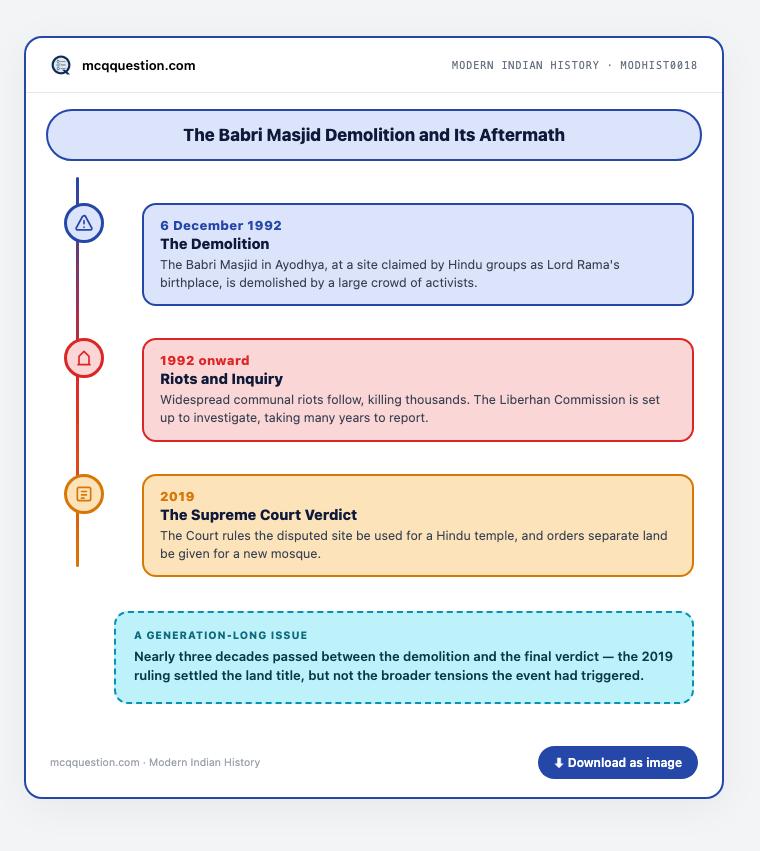
A dispute over one site in Ayodhya, argued over for generations, reached a violent turning point on 6 December 1992. Working out what that moment meant, legally and politically, took more than three decades and two entirely separate court cases.
Kar sevak: A Hindu volunteer who takes part in religious service or activism, here referring to those who gathered at Ayodhya and demolished the mosque.
Shilanyas: A foundation-stone-laying ceremony, performed by the Vishva Hindu Parishad at the disputed site in 1989, years before the demolition.
- How did the dispute over the Ayodhya site run for generations?
- What happened on 6 December 1992?
- Why does this lesson keep saying “two cases, not one”?
- What did the Liberhan Commission find?
- How did the verdict lead to the temple, and where do both sites stand now?
- Exam Angle: How does CDS test the temple’s architect?
1.How did the dispute over the Ayodhya site run for generations?
1.1What was the site, and how did the dispute begin?
A mosque and a claimed birthplace of a deity sat on the same ground, and each new event sharpened the conflict.
- The Babri Masjid was a mosque in Ayodhya, traditionally dated to around 1528-29 CE. Hindu groups claimed the land as the birthplace of Lord Rama.
- On the night of 22-23 December 1949, an idol of Ram appeared inside the mosque. Authorities then locked the site’s gates, and it stayed closed for decades.
1.2How did events escalate through 1990?
A court order, a ceremony, and a political march each pushed the dispute further, without resolving it.
- A Faizabad district judge ordered the site’s locks removed on 1 February 1986, letting Hindu worship resume there.
- The Vishva Hindu Parishad performed a shilanyas at the site on 9 November 1989.
- L.K. Advani led a Rath Yatra toward Ayodhya in September-October 1990, to build support for a temple. He was arrested in Bihar on 23 October 1990, before reaching the site.
2.What happened on 6 December 1992?
2.1How was the mosque demolished?
A huge crowd gathered for a rally, then tore the structure down within hours.
- Nearly 150,000 kar sevaks gathered at the site on the morning of 6 December 1992 for a rally.
- They stormed the mosque and pulled it down within a few hours. That broke an assurance the Uttar Pradesh government had given the Supreme Court just days earlier, that the structure would be protected.
2.2What violence followed?
The demolition triggered nationwide riots, and later, a bombing campaign framed as revenge.
- Communal riots across India in the following weeks killed roughly 2,000 people, including in Mumbai.
- In Ayodhya itself, kar sevaks killed at least 18 Muslim residents and burned dozens of local mosques and homes.
- Courts later prosecuted the 1993 Mumbai serial bombings as revenge for the demolition and the riots that followed it.
True or false: Days before the 6 December 1992 demolition, the Uttar Pradesh government had assured the Supreme Court the structure would be protected.
3.Why does this lesson keep saying “two cases, not one”?
3.1What did the 2019 civil case decide?
A land-title dispute reached the Supreme Court after a lower court’s three-way split.
- The Allahabad High Court split the disputed 2.77 acres three ways between Hindu and Muslim parties on 30 September 2010.
- A five-judge Supreme Court bench unanimously overturned that split on 9 November 2019. It gave the whole site to a trust for temple construction, and ordered 5 acres elsewhere for a new mosque, to the Sunni Central Waqf Board.
- The Court noted evidence of an earlier non-Islamic structure beneath the mosque. But it based its decision on who held and worshipped at the site over time, not on how the mosque came to be built.
3.2What did the separate 2020 criminal case decide?
A different court, years apart, ruled on a different question: whether the demolition was planned.
- The CBI had charged 32 people, including several senior political figures, with conspiring to plan the demolition.
- A special CBI court in Lucknow acquitted all 32 defendants on 30 September 2020. It ruled the demolition was not proven to be planned ahead of time.
True or false: The 2020 CBI court case and the 2019 Supreme Court verdict were part of the same legal case.
4.What did the Liberhan Commission find?
4.1How long did the inquiry take, and who did it blame?
A one-man inquiry took nearly 17 years to report, and named a single organisation as the main driver.
- The government set up a one-man inquiry under retired judge M.S. Liberhan just days after the demolition, in December 1992.
- It finally submitted its report in June 2009, nearly 17 years later, one of the longest-running inquiries in Indian history.
- The report held 68 people responsible for planning and inciting the demolition. It named the RSS as the main group that organised and moved kar sevaks on the ground.
- It called senior BJP leaders L.K. Advani and A.B. Vajpayee “pseudo-moderates,” arguing their calm public image hid knowledge of the Sangh Parivar’s real plans.
5.How did the verdict lead to the temple, and where do both sites stand now?
5.1How did the temple get built?
Construction followed the 2019 verdict directly, reaching completion 32 years after the demolition.
- PM Narendra Modi performed the bhoomi pujan for the Ram Mandir on 5 August 2020, and led its Pran Pratishtha (consecration) on 22 January 2024.
- Nearly 32 years passed between the 1992 demolition and the 2024 opening. That gap shows how slowly one contested site can move through commissions, courts, and shifting politics.
5.2What about the mosque the verdict also ordered?
The temple finished on schedule; the mosque allotted in the same verdict has not.
- The Shri Ram Janmabhoomi Teerth Kshetra Trust announced on 27 October 2025 that the temple complex’s construction was finished.
- The Dhannipur mosque, on the 5 acres the 2019 verdict allotted the Sunni Central Waqf Board, had not begun construction as of late 2025. Its trust cites a rejected design, shrunken usable land, and a funding gap.
True or false: As of late 2025, construction of the Dhannipur mosque was already complete, matching the temple’s progress.
6.Exam Angle: How does CDS test the temple’s architect?
CDS (II) 2020, General Knowledge, Question 58
Asked who the architect of the Ram Temple at Ayodhya is. The answer: Chandrakant Sompura, from a family that has designed temples for 15 generations, including the rebuilt Somnath Temple. His own grandfather, P.O. Sompura, designed that Somnath rebuild — the exam pairs the two names to test which generation did which project.
MCQ on the Babri Masjid Demolition
Question 1 of 1
Question 1 of 1
Question 1 of 1
Question 1 of 1
Question 1 of 1
Question 1 of 1
Question 1 of 1
Question 1 of 1
Related:
Leave a Reply