Independence in 1947 did not automatically bring over 500 princely states into the new Indian union. Some joined smoothly. Others needed persuasion, military action, or decades of diplomacy. This lesson follows the hardest holdouts — Kashmir, Hyderabad, Goa, and Junagadh — and how each was finally settled.
Instrument of Accession: The legal document a princely ruler signed to join India or Pakistan, handing over defence, external affairs, and communications.
Razakars: A private militia loyal to Hyderabad’s Nizam, led by Qasim Razvi, that used violence against people who wanted Hyderabad to join India.
- How did Kashmir’s Instrument of Accession happen?
- What was Operation Polo, and why did India call it a “police action”?
- Why did Goa stay under Portugal for 14 more years?
- What made Junagadh the third holdout state?
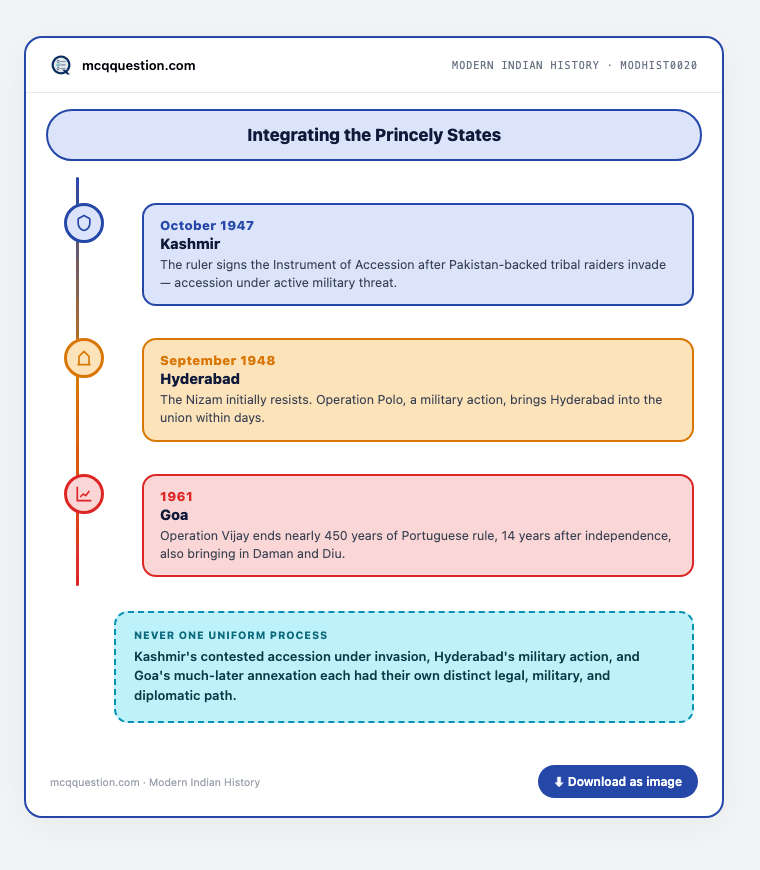
- Why was integrating the princely states never one uniform process?
- Exam Angle: How does UPSC Mains test this integration?
1.How did Kashmir’s Instrument of Accession happen?
1.1Why did Kashmir’s ruler hesitate, and what forced his hand?
A king who wanted to stay independent faced an invasion he could not stop alone.
- Jammu and Kashmir’s ruler, Maharaja Hari Singh, was a Hindu king over a mostly Muslim population. He wanted his state to stay independent of both India and Pakistan.
- On 22 October 1947, thousands of Pakistan-backed tribal raiders, armed and organised by Pakistan’s own army, crossed into Kashmir.
- The raiders stopped at Baramulla for three days to loot it instead of pushing on to Srinagar, a delay that bought Hari Singh precious time.
1.2How was the accession finally signed?
Help arrived just in time, with troops landing hours ahead of the raiders.
- A panicked Hari Singh appealed to India; V.P. Menon flew to Srinagar on 25 October, and Hari Singh signed the Instrument of Accession the next night.
- Indian troops landed at Srinagar’s airfield on the morning of 27 October, hours before the raiders could reach the city.
2.What was Operation Polo, and why did India call it a “police action”?
2.1How long did Hyderabad’s Nizam stall?
He signed a short-term agreement, then quietly prepared for a longer fight.
- Hyderabad’s Nizam, Osman Ali Khan, wanted full independence, and signed only a one-year Standstill Agreement with India in November 1947.
- Behind the scenes he kept negotiating with Pakistan and buying weapons. The Razakar militia meanwhile used violence against local people who wanted Hyderabad to join India.
2.2How did India end the standoff, and why that label?
India moved fast once it acted, and chose careful wording for why.
- India launched Operation Polo on 13 September 1948; troops entered Hyderabad from five directions under Major General J.N. Chaudhuri, and the Nizam surrendered by 17 September.
- India called it a “police action,” not a war, since Hyderabad was legally part of India already. That framed it as restoring internal order, not invading a foreign state.
True or false: Hyderabad’s Nizam signed only a one-year Standstill Agreement in 1947, while secretly negotiating with Pakistan and buying weapons.
3.Why did Goa stay under Portugal for 14 more years?
3.1Why didn’t the usual approach work on Goa?
Goa was a colony, not a kingdom, and Portugal refused to even discuss it.
- Goa was never a princely state ruled by an Indian king. It was a Portuguese colony, and Portugal refused to treat it as up for negotiation at all.
- India proposed a UN-supervised referendum in 1950, which Portugal’s PM Salazar rejected outright, insisting Goa was part of Portugal itself.
- India withdrew its diplomats from Lisbon in 1953 and imposed sanctions. Unarmed satyagrahis who tried to march into Goa in 1955 were met with Portuguese police gunfire.
3.2What finally triggered Operation Vijay?
One incident at sea tipped years of refusal into direct military action.
- Portuguese forces fired on the Indian passenger vessel Sabarmati on 24 November 1961, the final straw after a decade of refused negotiation.
- Operation Vijay launched on 17 December 1961. A roughly 36-hour campaign involving about 45,000 Indian troops ended nearly 450 years of Portuguese rule, killing 22 Indian and 30 Portuguese soldiers.
- The operation also brought the nearby territories of Daman and Diu into India, alongside Goa itself.
True or false: Goa remained under Portuguese colonial control for 14 years after India’s own independence.
4.What made Junagadh the third holdout state?
4.1What choice did its Nawab make?
A ruler famous for his pampered dogs chose the opposite path of Kashmir, then fled when it failed.
- Junagadh’s Nawab, Muhammad Mahabat Khanji III, a Muslim ruler over an overwhelmingly Hindu state, chose to accede to Pakistan on 15 August 1947.
- As his government collapsed under public anger, he chartered a plane and fled to Pakistan. He loaded it with treasury cash, jewels, his wives, and his favourite dogs.
4.2How was Junagadh’s accession finally settled?
India let the people decide directly, and the result was lopsided.
- Indian troops took administrative control of Junagadh in November 1947; a plebiscite in February 1948 confirmed accession to India by a huge margin.
- That one-sided result gave India a real precedent: accession should reflect people’s wishes. India later applied that same argument to the more disputed case of Kashmir.
True or false: Junagadh’s Nawab was a Hindu ruler presiding over a mostly Muslim population, the same pattern as Kashmir.
5.Why was integrating the princely states never one uniform process?
5.1What role did V.P. Menon and the States Department play?
Most states joined through paperwork alone, with force reserved for only the hardest cases.
- V.P. Menon, secretary of the States Department under Sardar Patel, personally drafted accession paperwork for hundreds of princely states.
- Over 500 princely states existed at independence. The department settled almost all through Instruments of Accession, Standstill Agreements, and privy purses, using force only against Hyderabad and Junagadh.
5.2Why is Sardar Patel’s 150th anniversary relevant here?
A recent national commemoration ties directly back to the same integration work this lesson covers.
- 31 October 2025 marked Sardar Vallabhbhai Patel’s 150th birth anniversary, observed as Rashtriya Ekta Diwas at the Statue of Unity in Kevadia, Gujarat.
- A national 152 km march from Patel’s birthplace in Karamsad to Kevadia ran from 26 November to 6 December 2025. It marked the man most responsible for bringing hundreds of princely states into India.
6.Exam Angle: How does UPSC Mains test this integration?
UPSC Mains 2021, General Studies Paper I, Question 3
Asked candidates to assess the main administrative issues and socio-cultural problems in integrating India’s princely states. Model answers point to the scale of the task: over 560 states, each with its own ruler and revenue system. They also point to Junagadh, Hyderabad, and Kashmir as the three holdouts. Each needed a different approach: referendum, police action, and a contested accession, exactly as this lesson explains.
MCQ on Integrating the Princely States
Question 1 of 1
Question 1 of 1
Question 1 of 1
Question 1 of 1
Question 1 of 1
Question 1 of 1
Question 1 of 1
Question 1 of 1
Related:
Leave a Reply