Kashmir’s accession dispute is still unresolved after decades. Junagadh faced the exact opposite problem, and it was settled in months. This lesson follows a Muslim ruler’s failed bid to join Pakistan, over a Hindu-majority state with no land border to it. That bid collapsed into exile, a people’s rebellion, and a lopsided vote.
Arzi Hukumat: The “provisional government” Junagadh’s own people set up in exile to fight the Nawab’s accession to Pakistan, led by Samaldas Gandhi.
Plebiscite: A direct vote asking a state’s people, not its ruler, which country they want to join.
1.Why did Junagadh’s Nawab choose Pakistan despite the odds?
1.1What made Junagadh’s situation so unusual?
Geography and population both argued against the Nawab’s own choice.
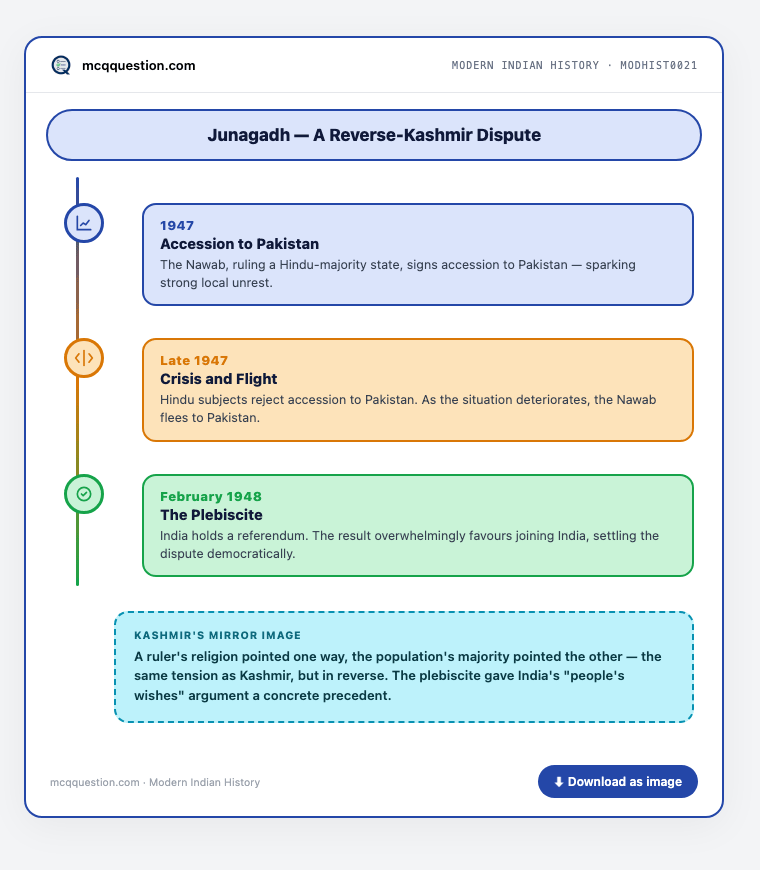
- Junagadh’s ruler, Nawab Muhammad Mahabat Khanji III, was Muslim, but roughly 80 percent of his subjects were Hindu.
- Junagadh sat on the Kathiawar peninsula in present-day Gujarat, with no land border to Pakistan at all. For how Kashmir and other princely states were integrated more broadly, see ModHist0020. Reaching Karachi meant crossing the sea.
- On 15 August 1947, the Nawab signed the Instrument of Accession to Pakistan anyway, a decision his own council of ministers had advised against.
1.2Who pushed the Nawab toward Pakistan, and what happened to him?
One advisor’s family ties ran all the way to Pakistan’s founding leadership.
- Junagadh’s dewan (chief minister), Shah Nawaz Bhutto, was a strong advocate for acceding to Pakistan. His son, Zulfikar Ali Bhutto, later became Pakistan’s prime minister.
- As public anger spread and neighbouring Indian troops moved to the state’s borders, the Nawab’s government lost control within weeks.
- In late October 1947, the Nawab fled by plane to Pakistan with his family and the state treasury, never to return.
2.What was the Arzi Hukumat, and how did it take over?
2.1Who led the rebellion, and how fast did it spread?
A relative of Gandhi led ordinary villagers to seize territory in weeks, not years.
- Samaldas Gandhi, Mahatma Gandhi’s nephew, led the Arzi Hukumat, a provisional government formed by Junagadh’s own people in September 1947.
- The Arzi Hukumat captured roughly 160 of Junagadh’s villages in about 40 days, moving faster than the Nawab’s administration could respond.
- India backed the effort with an economic blockade of Junagadh, cutting off fuel and supplies before any troops were sent in.
2.2How did India formally take control?
Indian troops moved in only after the Nawab’s own government had already collapsed.
- Indian troops entered Junagadh on 9 November 1947, at the invitation of the state’s own administration, which by then could no longer govern.
- Some violence against Junagadh’s Muslim minority followed the takeover, a troubling side of the transition that the plebiscite months later did not erase.
True or false: Samaldas Gandhi, Mahatma Gandhi’s nephew, led the Arzi Hukumat. This provisional government seized roughly 160 villages from Junagadh’s administration in about 40 days.
3.How did India settle the dispute, and why a plebiscite?
3.1Why did India choose a vote instead of just annexing the state?
India wanted a result that could not be challenged later as mere conquest.
- India argued accession should reflect the people’s wishes, not just a ruler’s signature, since Junagadh’s own Nawab had already fled.
- A plebiscite let India settle the matter with a result that looked procedurally fair, not just militarily imposed.
3.2How lopsided was the actual result?
The numbers left almost no room for dispute, unlike Kashmir’s case.
- The plebiscite was held on 20 February 1948. Out of roughly 190,870 votes cast, only 91 favoured Pakistan.
- Junagadh formally became part of India, and was later merged into Saurashtra State in 1949, which itself merged into Gujarat in 1956.
True or false: Junagadh’s 1948 plebiscite produced a close, closely contested result, similar to how divided Kashmir’s accession has remained.
4.How does Junagadh compare with Kashmir’s unresolved case?
4.1What pattern did the two states mirror and invert?
Each state flipped the other’s religion-versus-ruler mismatch exactly.
- Kashmir had a Hindu ruler over a mostly Muslim population who acceded to India. Junagadh had a Muslim ruler over a mostly Hindu population who acceded to Pakistan.
- India used Junagadh’s plebiscite as a precedent. It argued Kashmir’s accession should also eventually be tested by the people’s will, a demand Pakistan still presses today.
4.2Why is Junagadh’s fort back in the news now?
A recent tourism push has put the state’s old capital back in the spotlight.
- Gujarat announced a heritage-tourism upgrade for Junagadh’s Uparkot Fort in 2026. It is part of a broader ₹28.68 crore state heritage development project, reported by All India Radio News.
- The fort predates the Nawab’s rule by centuries. It is now being developed as a tourist draw tied to the region’s layered history, including its brief chapter as a disputed princely state.
- Uparkot Fort sits on Junagadh’s old citadel hill, with rock-cut structures, stepwells, and Buddhist caves dating back over two thousand years, long before any Nawab ruled the region.
- The upgrade plan covers better visitor access, signage, and conservation work, aimed at drawing more tourists to Saurashtra’s older Gujarat heritage circuit alongside the Statue of Unity.
True or false: Travancore’s accession to India, like Junagadh’s, was settled through a public plebiscite.
5.Exam Angle: How does UPSC test Junagadh specifically?
CAPF (ACs) 2022, General Ability and Intelligence, Question 79.
This question asked which statement about princely states was NOT correct. The options mixed in several true claims about accession options, Junagadh, and Hyderabad. One option wrongly claimed Travancore’s accession was settled by plebiscite. In fact Travancore joined India through ordinary negotiation, unlike Junagadh, which genuinely was settled by one. Mixing up these two cases is the exact trap this question sets.
MCQ on Junagadh’s Integration
Question 1 of 1
Question 1 of 1
Question 1 of 1
Question 1 of 1
Question 1 of 1
Question 1 of 1
Question 1 of 1
Question 1 of 1
Related:
Leave a Reply