Not every Congress leader in the 1930s trusted Gandhi’s methods alone. A younger, more radical group wanted socialism written into the freedom struggle itself. In 1934 they formed their own party, but stayed inside Congress rather than splitting away. This lesson follows the Congress Socialist Party: why it formed, what it believed, and why it eventually did split in 1948.
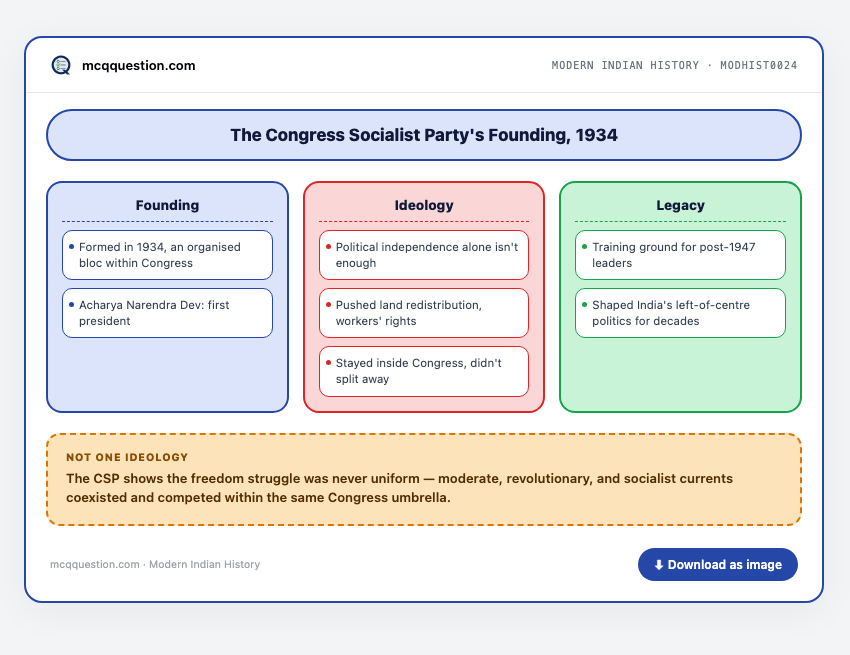
Congress Socialist Party (CSP): A left-leaning group founded in 1934 that operated as an organised faction inside the Indian National Congress, not a rival party, pushing it toward socialist economic goals.
Dictatorship of the proletariat: A Marxist idea where the working class holds total political power after a revolution. The CSP studied Marxism but formally rejected this specific idea for India.
- Who founded the Congress Socialist Party, and why in 1934?
- What did the CSP actually believe, and why stay inside Congress?
- How did the CSP shape India’s left during the 1930s?
- What happened to the CSP during Quit India, and why did it later split?
- Exam Angle: How do CDS and UPSC test the Congress Socialist Party?
1.Who founded the Congress Socialist Party, and why in 1934?
1.1Who led the new party at the start?
Two men shaped the party from its very first meeting.
- The Congress Socialist Party was founded in 1934 in Bombay, as an organised left-wing bloc working inside the Indian National Congress.
- Acharya Narendra Dev became its first president, and Jayaprakash Narayan, often called “JP,” became its general secretary.
1.2Why did younger Congress members feel they needed a new group?
A global mood of economic crisis pushed a younger generation further left.
- Younger Congress members, shaped by the worldwide Great Depression and anti-colonial movements elsewhere, felt that political freedom alone would not fix India’s poverty.
- They wanted land reform, workers’ rights, and planned economic policy written into the Congress programme itself, not just independence from Britain.
2.What did the CSP actually believe, and why stay inside Congress?
2.1What economic changes did the CSP demand?
Its programme went well beyond simply ending British rule.
- The CSP argued that political independence alone was not enough. It pushed for land redistribution, nationalisation of key industries, and adult franchise to accompany freedom from British rule.
- It also demanded basic civil liberties for ordinary citizens, seeing these as essential to any genuine democracy after independence.
2.2Why work inside Congress instead of running against it?
Staying inside gave the CSP a reach it could never have built alone.
- The CSP operated as a pressure group within the wider Congress, using its platform and mass base to pull Congress economic policy leftward from within.
- A separate small socialist party would have struggled for the attention and following that Congress already commanded nationwide.
True or false: The Congress Socialist Party formally adopted the dictatorship of the proletariat as its goal for India.
3.How did the CSP shape India’s left during the 1930s?
3.1How did the CSP push Congress itself leftward?
Its influence reached all the way to the Congress presidency.
- In 1936, under CSP pressure, Jawaharlal Nehru urged Congress to formally accept socialism as a goal and to build closer ties with peasants and industrial workers.
- That same year, the CSP deepened its own engagement with Marxist theory, sharpening its internal debates over land and labour policy.
3.2Who else worked alongside Narendra Dev and JP?
The leadership was never just two men.
- Ram Manohar Lohia was another leading CSP figure, active throughout the 1930s and 1940s in the party’s socialist wing.
- Minoo Masani and Achyut Patwardhan also co-founded the party alongside Narendra Dev in 1934, broadening its base beyond any single leader.
True or false: Jawaharlal Nehru, under pressure from the CSP, urged Congress in 1936 to formally accept socialism as a goal.
4.What happened to the CSP during Quit India, and why did it later split?
4.1What role did CSP leaders play in 1942?
Quit India pushed the CSP’s leaders underground, not into silence.
- During the Quit India Movement of 1942, CSP leaders went underground and organised resistance while the top Congress leadership sat in jail.
- Ram Manohar Lohia ran a secret radio station broadcasting from hidden transmitters, staying free for nearly two years before his eventual arrest.
4.2Why did the CSP expel the Communists from its ranks?
One internal split in 1940 showed the CSP was socialist, but not Communist.
- In 1940, the CSP expelled Communist Party members from its organisation, rejecting the Communist line of supporting Britain’s war effort against fascism.
- This distinguished the CSP clearly from India’s Communist Party, even though both drew on similar Marxist language and ideas.
4.3Why did the CSP finally break away in 1948?
Independence removed the one goal that had kept it inside Congress.
- In 1948, the Congress Socialist Party split away entirely from the Indian National Congress to become the independent Socialist Party of India.
- With British rule now over, the shared goal that had held socialists inside Congress disappeared, and the CSP’s leaders chose to pursue their economic programme as a separate party instead.
True or false: The Congress Socialist Party split away from the Indian National Congress in 1948 to become the independent Socialist Party of India.
5.Exam Angle: How do CDS and UPSC test the Congress Socialist Party?
CDS (II) 2025, General Knowledge, Question 20.
This question asked who became the Congress Socialist Party’s first president among its founding figures. The answer is Acharya Narendra Dev. The question tests whether students can separate his role as president from Jayaprakash Narayan’s role as general secretary, a distinction the two names are easy to mix up.
UPSC Civil Services Prelims 2015, General Studies Paper I, Question 26.
This was a “which statements are correct” trap question about what the CSP stood for. It listed boycotting British goods, wanting a dictatorship of the proletariat, and backing separate electorates for minorities. None of these three statements is actually correct. The CSP never campaigned on tax boycotts as its defining goal, rejected the dictatorship of the proletariat, and did not push for separate electorates.
UPSC Mains 2020, General Studies Paper I, Question 13.
This Mains question asked students to examine the ideology and programme of the Congress Socialist Party within the national movement. See mcqquestion.com’s dedicated breakdown of this exact question for a full model answer.
UPSC Mains 2017, General Studies Paper I, Question 13.
This Mains question asked students to discuss the socialist and Communist strands within the Indian national movement in the 1930s. See mcqquestion.com’s dedicated breakdown of this exact question for a full model answer.
MCQ on the Congress Socialist Party
Question 1 of 1
Question 1 of 1
Question 1 of 1
Question 1 of 1
Question 1 of 1
Question 1 of 1
Question 1 of 1
Question 1 of 1
Related:
Leave a Reply