A Berlin doctorate, a secret radio station, and a defiant speech in Portuguese Goa all belong to one man’s story. Ram Manohar Lohia fought the British underground, then kept fighting for social justice for twenty more years after independence. This lesson follows him from a quiet childhood in Akbarpur to Parliament itself.

Congress Radio: A secret nationalist radio station broadcasting from hidden transmitters in Bombay and Calcutta during Quit India, August-November 1942, run with Usha Mehta and others.
Sapta Kranti: Lohia’s “Seven Revolutions,” his socialist blueprint calling for simultaneous struggles against inequality of gender, race, caste, colonial rule, wealth, civil-liberty threats, and violence itself.
1.From Akbarpur to Berlin: how did Lohia’s early life unfold?
1.1What shaped his early education and travels?
A hard childhood did not stop him from reaching Europe for his doctorate.
- Lohia was born on 23 March 1910 in Akbarpur, in present-day Uttar Pradesh, and lost his mother in 1912 when he was only two years old.
- He studied at Banaras Hindu University, earned a degree from Calcutta University in 1929, then moved to Berlin, completing a doctorate in economics around 1932.
1.2What did his doctoral thesis actually examine?
His academic work connected directly back to Gandhi’s own economic ideas.
- His doctoral thesis examined salt taxation in India, engaging directly with Gandhi’s economic thinking on the subject.
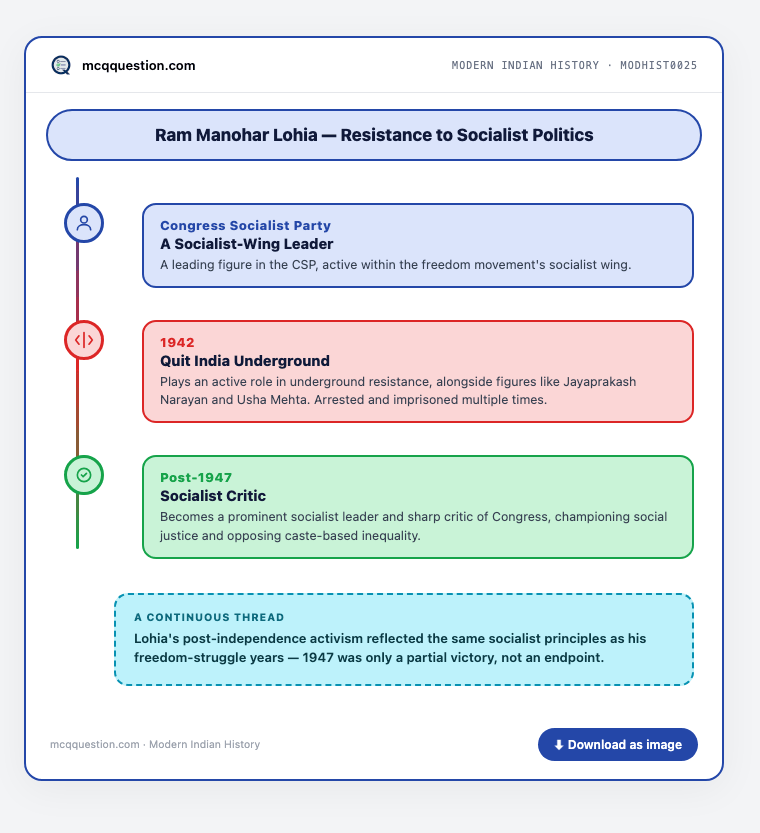
- Back in India, Lohia became a leading figure in the Congress Socialist Party, active within the freedom movement’s own socialist wing.
- British authorities arrested him multiple times over the years for his nationalist activities.
2.How did Lohia run a secret radio station and dodge capture?
2.1What was Congress Radio, and who ran it with him?
A hidden transmitter let him keep resisting even while most leaders sat in jail.
- During the Quit India Movement of 1942, Lohia went underground and helped organise the secret Congress Radio.
- It broadcast from hidden transmitters in Bombay and Calcutta between August and November 1942.
- He worked alongside Usha Mehta and other activists, keeping a defiant nationalist voice on air while Britain hunted for the transmitter.
True or false: Lohia helped run a secret radio station during the Quit India Movement and evaded capture for nearly two years.
2.2Why did British authorities see him as a serious threat?
His repeated arrests reveal exactly how seriously Britain took him.
- Lohia evaded capture for nearly two years before his arrest in May 1944, then spent time in Lahore Fort and Agra Jail.
- His underground activity placed him alongside Jayaprakash Narayan and Usha Mehta, part of a coordinated resistance effort while mainstream Congress leaders sat in prison. His multiple arrests show British authorities treated him as a real danger, not a minor participant.
3.Why did Lohia defy a ban to speak in Portuguese Goa?
3.1What happened at Margao on 18 June 1946?
A recuperation trip turned into the spark for an entirely separate freedom struggle.
- In June 1946, Lohia travelled to Portuguese-ruled Goa to recuperate at a friend’s home. On 18 June 1946, he defied a government ban and addressed a public meeting at Margao.
- More than 5,000 Goans reportedly gathered at Municipal Chowk to hear him speak that day, directly defying Portuguese colonial authority.
True or false: Lohia’s 18 June 1946 speech in Margao was authorised in advance by the Portuguese colonial government.
3.2What did that single speech set in motion?
One defiant afternoon grew into a sustained movement across the territory.
- Further satyagrahas followed that October and November, leading to over 1,500 arrests across Goa.
- The date is now marked as Goa Revolution Day, seen as the start of Goa’s own separate freedom struggle against Portuguese rule.
4.Why didn’t 1947 end Lohia’s fight, and what is his legacy today?
4.1What did he keep fighting for after independence?
He treated 1947 as only a partial victory, not a finish line.
- After independence, Lohia continued his political career, becoming a prominent socialist leader and a sharp critic of Congress’s post-independence policies.
- He is remembered for his strong stand on social justice, including his opposition to caste-based inequality within Indian society, a continuation of the same socialist principles that shaped his freedom-struggle years.
4.2What was “three annas a day”?
One sharp parliamentary line captured his entire economic critique.
- Lohia founded the Socialist Party in 1955 and won his first Lok Sabha seat from Farrukhabad in a 1963 by-election.
- In Parliament that year, he famously said that 27 crore Indians lived on just three annas a day, sharpening his critique of Congress-era poverty. He died in 1967, and Delhi’s Ram Manohar Lohia Hospital was later named in his honour.
True or false: In Parliament in 1963, Lohia famously said that 27 crore Indians lived on just three annas a day.
4.3Which modern parties trace their roots back to him?
His break from pure class-based socialism still shapes North Indian politics today.
- Leaders and parties describing themselves as “Lohiaite” include the Samajwadi Party, founded by Mulayam Singh Yadav, and the Rashtriya Janata Dal, led by Lalu Prasad Yadav.
- Both parties trace their ideology directly back to Lohia’s own brand of socialism.
- The Janata Dal (United), led by Nitish Kumar, also descends from the same broader socialist-movement lineage. His caste-based social-justice focus is often cited as the intellectual root of later Mandal-era politics.
4.4Why was Goa Revolution Day 2026 held at a ground named after him?
A permanent physical memorial now marks the exact spot where this lesson’s own story began.
- Goa marked Revolution Day on 18 June 2026, with a state-level programme at Azad Maidan, Panaji, and a local observance at Lohia Maidan, Margao, the very ground where his defiant 1946 speech happened.
- Margao’s meeting ground is now officially named Lohia Maidan. Eighty years on, the Goa government still marks this exact date annually as the formal start of the territory’s own freedom movement.
5.Exam Angle: How does CDS test Sapta Kranti?
CDS (II) 2020, General Knowledge, Question 49.
This question asked who proposed the socialist idea of Sapta Kranti, or Seven Revolutions. The answer is Ram Manohar Lohia. The other three options, Nehru, Ranade, and Jayaprakash Narayan, are all real socialist-adjacent figures, but none of them proposed this specific seven-part idea.
MCQ on Ram Manohar Lohia
Question 1 of 1
Question 1 of 1
Question 1 of 1
Question 1 of 1
Question 1 of 1
Question 1 of 1
Question 1 of 1
Question 1 of 1
Related:
Leave a Reply