In 1930, Kamaladevi Chattopadhyay looked at Gandhi’s volunteer list for the Salt Satyagraha. She found no women on it at all. She confronted him on the spot, and he agreed to let women join. Two decades later, she was still building India, this time through cultural institutions rather than protest marches.

All India Women’s Conference (AIWC): founded in 1927 to campaign for women’s education, legal rights, and social reform. Chattopadhyay co-founded it and served as its first Organising Secretary.
Sangeet Natak Akademi: India’s national academy for music, dance, and drama. Chattopadhyay became its first chairperson in 1953.
1.How did she win women a seat at Gandhi’s table?
1.1What was missing from Gandhi’s volunteer list?
One missing group turned out to matter a great deal.
- Gandhi’s first list of volunteers for the 1930 Salt Satyagraha had no women on it at all.
- Chattopadhyay went straight to him and argued that women deserved an equal part in the struggle.
1.2How did she respond, and what did Gandhi do?
Gandhi did not just agree in words. He changed his plan.
- Gandhi agreed with her and issued a formal call for women to join the movement. This opened the door for thousands who followed.
- He then picked Chattopadhyay for the small team that led salt-making on the Bombay beachfront, alongside fellow activist Avantikabai Gokhale.
True or false: Gandhi’s original list of Salt Satyagraha volunteers had no women on it, until Chattopadhyay confronted him.
2.How was she widowed young, and first to run for office?
2.1How was she widowed young, and educated anyway?
A progressive family shaped her path from early childhood.
- Chattopadhyay was born on 3 April 1903 in Mangalore, in the Madras Presidency, into a progressive family. As a child, she met leaders like Gopal Krishna Gokhale and Annie Besant.
- She was married in 1917, at just fourteen. Her husband died within a year, leaving her a child widow with no children.
- Her father-in-law held liberal views, and he encouraged her to keep studying despite the stigma widows faced at the time.
2.2How was she first to run, and first to be arrested?
She broke new ground twice within a few years.
- She studied at Queen Mary’s College in Madras, where she met poet Harindranath Chattopadhyay, her future husband. They married in 1923. He was the brother of freedom fighter and poet Sarojini Naidu.
- She later earned a diploma in sociology from Bedford College, University of London.
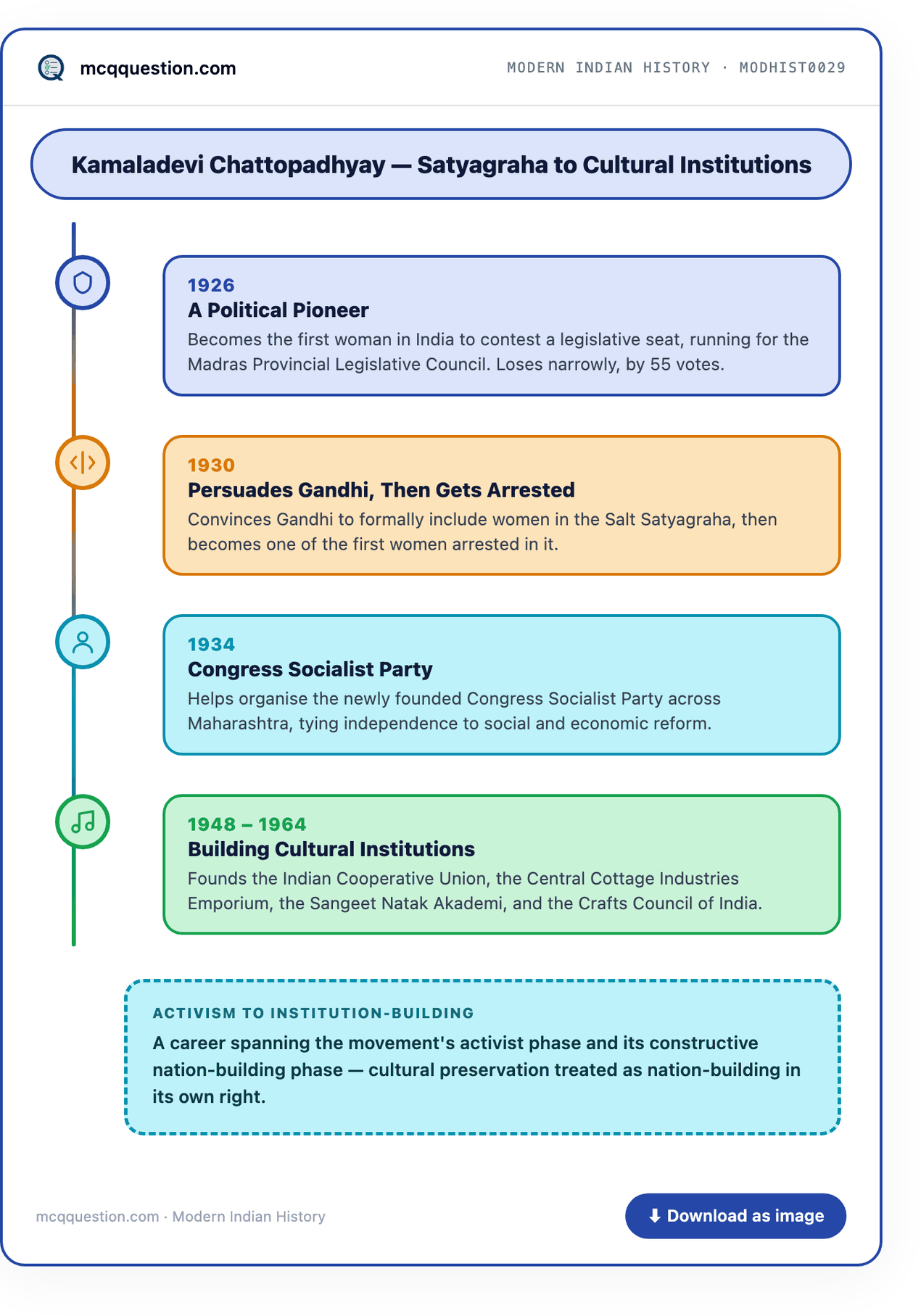
- In 1926, she became the first woman in India to contest a legislative seat, running for the Madras Provincial Legislative Council. She lost narrowly, by just 55 votes.
- After confronting Gandhi over the Salt Satyagraha, she became one of the first women arrested in the movement. In 1927, she had already co-founded the All India Women’s Conference, serving as its first Organising Secretary.
3.How did she rebuild a nation through craft and the arts?
3.1How did she rebuild a nation through craft?
After independence, her attention shifted from protest to construction.
- In 1948, she founded the Indian Cooperative Union to resettle refugees displaced by Partition. The Union helped establish the township of Faridabad.
- In 1952, the Union took over the Central Cottage Industries Emporium at Jawaharlal Nehru’s own request, and Chattopadhyay became its founding president.
- That same year, she helped set up the All India Handicrafts Board and served as its first chairperson. In 1964, she went on to found the Crafts Council of India.
3.2How did she give the performing arts a home?
Her institution-building reached music and theatre too, not just handicrafts.
- In 1953, she became the first chairperson of the Sangeet Natak Akademi, India’s national academy for music, dance, and drama.
- She had already set up the Indian National Theatre in Bombay in 1944. Its work fed directly into today’s National School of Drama, which she later chaired.
- In December 1945, she helped draft the Indian Women’s Charter of Rights and Duties, alongside Hansa Mehta and Renuka Ray.
True or false: Kamaladevi Chattopadhyay’s work in independent India was limited to the handicrafts sector alone.
4.What was her life beyond politics, and how does her legacy live on today?
4.1What happened with the freedom salt auction, and her life on stage and screen?
Her activism and her artistic life often ran side by side.
- After her arrest, Chattopadhyay auctioned home-made “freedom salt” right outside the Bombay Stock Exchange. It made her one of the Salt Satyagraha’s most visible women activists.
- With Harindranath, she performed folk theatre and regional drama across India. She also acted in Vasantsena, a 1930 silent film adapted from the Sanskrit play Mricchakatika.
- She later appeared in two 1943 Hindi films, Tansen and Shankar Parvati, and in the 1945 Hindi film Dhanna Bhagat.
4.2What honours did she receive, and what was her lasting idea?
Her honours spanned both decades and both phases of her career.
- She received the Padma Bhushan in 1955 and the Ramon Magsaysay Award for Community Leadership in 1966.
- In 1974, the Sangeet Natak Akademi gave her its Fellowship, its highest honour. India awarded her the Padma Vibhushan in 1987.
- Chattopadhyay died on 29 October 1988, in Bombay, at the age of 85. For her, cultural preservation was itself a form of nation-building, not something separate from it.
True or false: Kamaladevi Chattopadhyay believed cultural preservation was itself a form of nation-building, not something separate from it.
4.3How does her legacy live on today?
More than seven decades on, her institution is still handing out honours.
- President Droupadi Murmu presented the National Handicrafts Awards for 2023 and 2024 at Vigyan Bhawan, New Delhi, on 9 December 2025, as part of National Handicrafts Week.
- Winners included artisans working in metal craft, hand-painted textiles, and handmade carpets. These awards have run since 1965, inside the institutional structure Chattopadhyay built.
- She chaired the All India Handicrafts Board from its founding in 1952. More than seven decades on, the machinery she set up to protect Indian crafts is still recognising artisans by name.
5.Exam Angle: How does CDS test Kamaladevi Chattopadhyay?
CDS (I) 2021, General Knowledge, Question 59.
This question asked which socialist activist persuaded Gandhi not to restrict the salt march protest to men alone, with options Kamaladevi Chattopadhyay, Sarojini Naidu, Matangini Hazra, and Mithuben Petit. The correct answer is Kamaladevi Chattopadhyay. All four names are real freedom fighters, so the trap is confusing four different women, rather than not recognising any of them. Only Chattopadhyay is tied to this specific act of persuading Gandhi.
MCQ on Kamaladevi Chattopadhyay
Question 1 of 1
Question 1 of 1
Question 1 of 1
Question 1 of 1
Question 1 of 1
Question 1 of 1
Question 1 of 1
Related:
Leave a Reply