Independent India needed its own answer to local self-governance. A 1957 committee report gave it a three-tier structure. That structure first launched in a single state, then spread nationwide, but it took over three decades to win real constitutional protection.

Gram Panchayat: the village-level tier of Panchayati Raj, with members elected directly by villagers.
Zila Parishad: the district-level tier, chaired in the original Balwant Rai Mehta design by the district collector.
1.What was the three-tier blueprint?
1.1What was the committee asked to do, and what did it recommend?
One committee’s report set the pattern India’s villages still follow today.
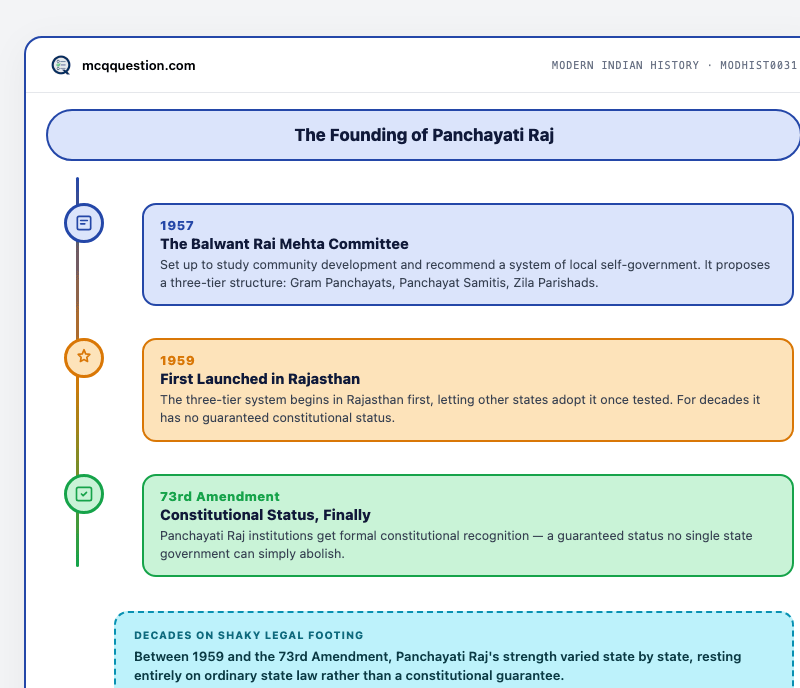
- The government appointed the Balwant Rai Mehta Committee on 16 January 1957 to study community development programmes and recommend a system of local self-government.
- It submitted its final report on 24 November 1957, recommending a three-tier structure: village-level Gram Panchayats, block-level Panchayat Samitis, and district-level Zila Parishads.
1.2How were members chosen, and who led the top tier?
Only the bottom tier answered directly to voters.
- Villagers elected Gram Panchayat members directly. Panchayat Samiti and Zila Parishad members were chosen indirectly, through these elected representatives.
- The committee wanted the district collector to chair the Zila Parishad, keeping district administration closely linked to the new elected bodies.
- This three-tier system first launched in 1959. It began in Rajasthan on 2 October, then in Andhra Pradesh just nine days later.
2.Why did Panchayati Raj go decades without a constitutional home?
2.1What did the system lack for over three decades?
A good structure on paper still needed legal protection it did not have.
- For decades after launch, Panchayati Raj institutions had no guaranteed constitutional status. Their existence and powers depended entirely on individual state laws.
- Without that protection, a state government could weaken or even scrap its panchayats at will, and several did exactly that over time.
True or false: Panchayati Raj institutions had constitutional protection from the moment they were first launched in 1959.
3.Why did Rajasthan go first, and what did the second committee propose?
3.1Why did Rajasthan go first?
Testing the idea in one place first was a deliberate choice, not an accident.
- Choosing Rajasthan as the very first state let the government test the whole three-tier idea in practice, before asking other states to commit.
- This pilot-first approach let planners fix problems early, on a small scale, before rolling the system out nationwide.
3.2What did the second committee propose, and why was its fix shelved?
A second committee studied the system’s decline, but its fix never went anywhere.
- By the late 1970s, Panchayati Raj had weakened in many states. The Janata Government appointed the Ashok Mehta Committee in December 1977 to study this decline.
- It submitted its report in August 1978, with 132 recommendations. These included a two-tier model pairing a district-level Zila Parishad with a Mandal Panchayat, each covering 15,000 to 20,000 people.
- The committee also wanted Nyaya Panchayats kept separate from development panchayats, presided over by a qualified judge rather than an elected member. It further recommended compulsory taxation powers, so panchayats could raise their own funds.
- The central government did not act on this recommendation at the time. Without constitutional protection, Panchayati Raj’s strength kept varying from state to state, depending entirely on each government’s own political will.
True or false: The Ashok Mehta Committee’s two-tier revival proposal was not acted on by the central government at the time.
4.How does a 1950s idea still shape today’s Constitution?
4.1What finally gave the system constitutional protection?
One amendment closed a gap that had lasted over three decades.
- The 73rd Amendment took effect on 24 April 1993, under Prime Minister P.V. Narasimha Rao, finally giving Panchayati Raj institutions formal constitutional recognition and status.
- It made Panchayat elections mandatory every five years, run by independent State Election Commissions. It also reserved one-third of seats for women, and seats for SC/ST members in proportion to their population.
- This date is now marked every year as National Panchayati Raj Day. The Balwant Rai Mehta Committee’s original three-tier design directly shaped the structure that later got this constitutional backing.
4.2How did National Panchayati Raj Day 2026 mark the 73rd Amendment turning 33?
This year’s anniversary came with a new tracking tool, not just ceremony.
- The Ministry of Panchayati Raj marked National Panchayati Raj Day at Vigyan Bhawan, New Delhi, on 24 April 2026. The theme was “Sashakt Panchayat, Sarvangeen Vikas” (Empowered Panchayats, Holistic Development).
- The day commemorates the 73rd Amendment, which finally gave Panchayati Raj its constitutional home, and 2026 marked 33 years since it took effect.
- The Ministry also released the Panchayat Advancement Index 2.0 report at the same event. It is a tool that ranks and tracks Gram Panchayats against localised Sustainable Development Goal themes.
True or false: National Panchayati Raj Day, marked every 24 April, commemorates the 73rd Amendment taking effect.
4.3What is Panchayati Raj’s real condition today?
Representation has nearly reached parity, but funding still has real limits.
- India has over 2.5 lakh panchayats and around 24 lakh elected representatives. Women make up 49.75% of them, close to full parity with the constitutionally reserved one-third minimum.
- Funding still flows mostly through the Finance Commission’s tied and untied grants. Of the funds recommended by the 15th Finance Commission (2021-26), about 70% had been released to states by November 2024.
- A July 2025 Parliamentary Standing Committee report flagged a real problem: tied grants can only be spent on sanitation and drinking water. Once a panchayat meets those targets through other schemes, the money simply stops flowing.
- Under the Sashakt Panchayat-Netri Abhiyan, over 7.18 lakh women elected representatives were trained in 2025-26 alone. 744 Model Women-Friendly Gram Panchayats have also been identified, across 32 states and union territories.
5.Exam Angle: How do CAPF papers test Panchayati Raj’s committees?
CAPF (ACs) 2025, General Ability and Intelligence, Question 30.
This question asked you to match four committees to their key recommendations in one go. Balwantrai Mehta goes with the three-tier structure, Ashok Mehta with the two-tier Zila Parishad and Mandal Panchayat model, G.V.K. Rao with the District Development Commissioner post, and L.M. Singhvi with constitutional status for Panchayati Raj. Knowing one committee’s work is not enough; this format tests whether you can keep all four straight at once.
CAPF (ACs) 2018, General Ability and Intelligence, Question 122.
This question asked which issue the Ashok Mehta Committee was constituted to study. Options included tax revenue division, the Panchayati Raj System, Governor appointments, and Presidential and Vice-Presidential elections. The correct answer is the Panchayati Raj System. Exams often test whether you can tell the Balwant Rai Mehta Committee (three-tier, 1957) apart from the Ashok Mehta Committee (two-tier, 1977-78). Don’t mix them up.
MCQ on Panchayati Raj
Question 1 of 1
Question 1 of 1
Question 1 of 1
Question 1 of 1
Question 1 of 1
Question 1 of 1
Question 1 of 1
Related:
Leave a Reply