India entered the nuclear age with a single test in the Rajasthan desert. Its codename disguised a decisive strategic milestone. This lesson follows the test itself, the device behind it, and the years of pressure that followed.

CIRUS reactor: a 40-megawatt Canadian-supplied research reactor at Trombay, operating from 1960, which produced the plutonium used in Pokhran-I.
Nuclear Suppliers Group (NSG): the international body founded in 1975, directly in response to Pokhran-I, that still governs global trade in nuclear materials and technology.
- What was Pokhran-I, and why time it to Buddha Purnima?
- What backlash followed this first, and how was it kept secret?
- Why was “peaceful” a label chosen with care, and what were the device and its fuel?
- Why did the “peaceful” framing not fully work, and where did it lead?
- Exam Angle: How does CDS place Pokhran-I in the timeline?
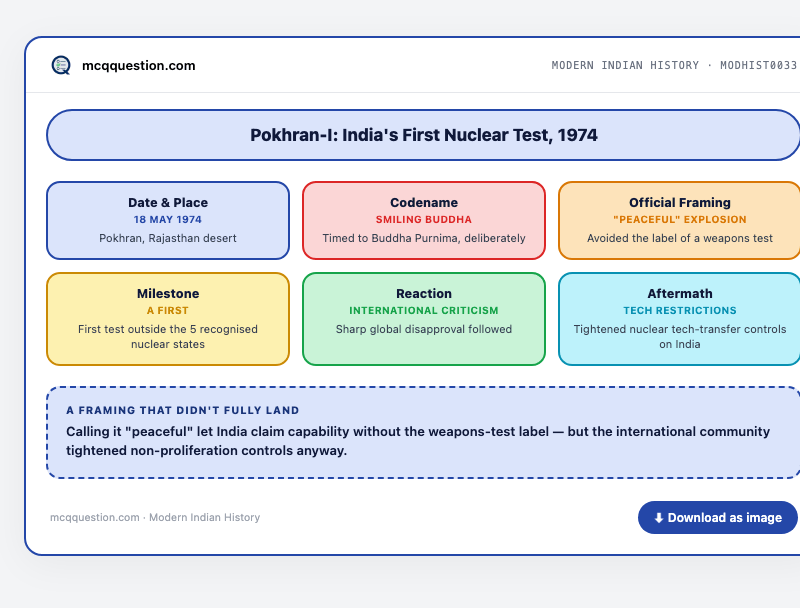
1.What was Pokhran-I, and why time it to Buddha Purnima?
1.1What happened on 18 May 1974?
A single test, and a coded phone call, marked India’s entry into the nuclear age.
- India conducted its first nuclear test at Pokhran, Rajasthan, on 18 May 1974, at 8:05 am, with the codename “Smiling Buddha.”
- Physicist Raja Ramanna led the scientific team behind the device. Right after the test, he called Prime Minister Indira Gandhi with a coded message: “The Buddha has smiled.”
1.2Why time the test to a religious day?
The date itself carried a deliberate, quieter message.
- Its timing on Buddha Purnima, a Buddhist religious day, was deliberate. The Indian government officially called the test a “peaceful nuclear explosion,” setting it apart from an openly military weapons programme.
- Choosing Buddha Purnima added a layer of symbolic meaning on top of the science, linking a major strategic milestone to a significant religious occasion.
2.What backlash followed this first, and how was it kept secret?
2.1What backlash followed this first?
Being first outside the five recognised nuclear states came at a real cost.
- Pokhran-I made India the first country outside the five recognised nuclear weapons states to conduct a nuclear test. The test drew sharp international criticism.
- Canada froze nuclear cooperation with India soon after, saying Indian scientists had misused reactor technology it had supplied. Homi Sethna, chairman of the Atomic Energy Commission, oversaw the wider effort.
- India did not test again for 24 years, conducting its next tests only in May 1998 under Pokhran-II. Western nations built a technology denial regime around India after 1974, and many of these restrictions lasted until the India-US civil nuclear deal of 2008.
True or false: India did not conduct another nuclear test for 24 years after Pokhran-I, until Pokhran-II in May 1998.
2.2How was this a secret kept from almost everyone?
Even India’s own ministers learned of it only at the very last moment.
- Only about 75 scientists at the Bhabha Atomic Research Centre worked on the project. Indira Gandhi kept tight control over who knew.
- India’s Defence Minister was told only a few days before the test, and the Foreign Minister got just 48 hours’ notice. This secrecy shows how carefully the government managed both the science and the politics of the test.
True or false: India’s Foreign Minister and Defence Minister were informed of the test months in advance, so they could prepare a diplomatic response.
3.Why was “peaceful” a label chosen with care, and what were the device and its fuel?
3.1Why was “peaceful” a label chosen with care?
One word let India show capability while dodging a harsher label.
- Calling the test “peaceful” was a deliberate diplomatic choice, not an accident of language.
- The word let India show off real nuclear capability, while officially avoiding the label of a weapons test.
3.2What were the device and its fuel?
Behind the codename sat a specific, carefully engineered device.
- The device had a hexagonal cross-section, measured about 1.25 metres across, and weighed roughly 1,400 kilograms, using an implosion-type design built around a plutonium core.
- The plutonium came from the CIRUS reactor, a 40-megawatt research reactor supplied by Canada. CIRUS began operating in 1960, using heavy water supplied by the United States as its neutron moderator.
- Indigenous PUREX reprocessing at BARC separated the plutonium from the reactor’s spent fuel. Engineers lowered the assembled device into a shaft roughly 107 metres below the Pokhran desert test range.
- Estimates of the explosion’s yield vary widely across sources, ranging from about 6 to 12 kilotons.
True or false: The plutonium used in the Pokhran-I device came from the CIRUS reactor, a Canadian-supplied research reactor.
4.Why did the “peaceful” framing not fully work, and where did it lead?
4.1Why did the “peaceful” framing not fully work?
The label avoided one word, but it could not avoid the world’s reaction.
- Pokhran-I’s “peaceful nuclear explosion” framing did not fully convince the world. The test still triggered a tightening of global non-proliferation controls, aimed at limiting nuclear technology access for countries outside the five recognised states.
- International pressure after Pokhran-I led directly to the founding of the Nuclear Suppliers Group in 1975. That group still governs global trade in nuclear materials and technology today.
4.2What happened after Pokhran-I, and where did it lead?
India stayed quiet about its nuclear status for 24 years, then changed course completely.
- India did not test again for 24 years. On 11 and 13 May 1998, India conducted five more nuclear tests, code-named Operation Shakti (Pokhran-II), and this time formally declared itself a nuclear weapons state.
- In 2003, India adopted a formal Nuclear Doctrine, built around a policy of No First Use and credible minimum deterrence, promising massive retaliation only if struck first with nuclear weapons.
5.Exam Angle: How does CDS place Pokhran-I in the timeline?
CDS (II) 2025, General Knowledge, Question 1.
This question asked for the correct chronological order of four milestones: the Simla Agreement, India’s first nuclear test, the SAARC Charter’s signing, and the Agra Summit. Simla came in July 1972, the first nuclear test in May 1974, the SAARC Charter in December 1985, and the Agra Summit in July 2001. Pokhran-I sits second in that 29-year span. The trap is treating these as loosely related “sometime in the 1970s-2000s” events; the question tests each exact year, not a rough sense of order.
MCQ on Pokhran-I
Question 1 of 1
Question 1 of 1
Question 1 of 1
Question 1 of 1
Question 1 of 1
Question 1 of 1
Question 1 of 1
Related:
Leave a Reply