One man served in the Union Cabinet for over 30 years, longer than anyone else in Indian history. He was also India’s most prominent Dalit political leader.

 MCQ Questions
ModHist0267
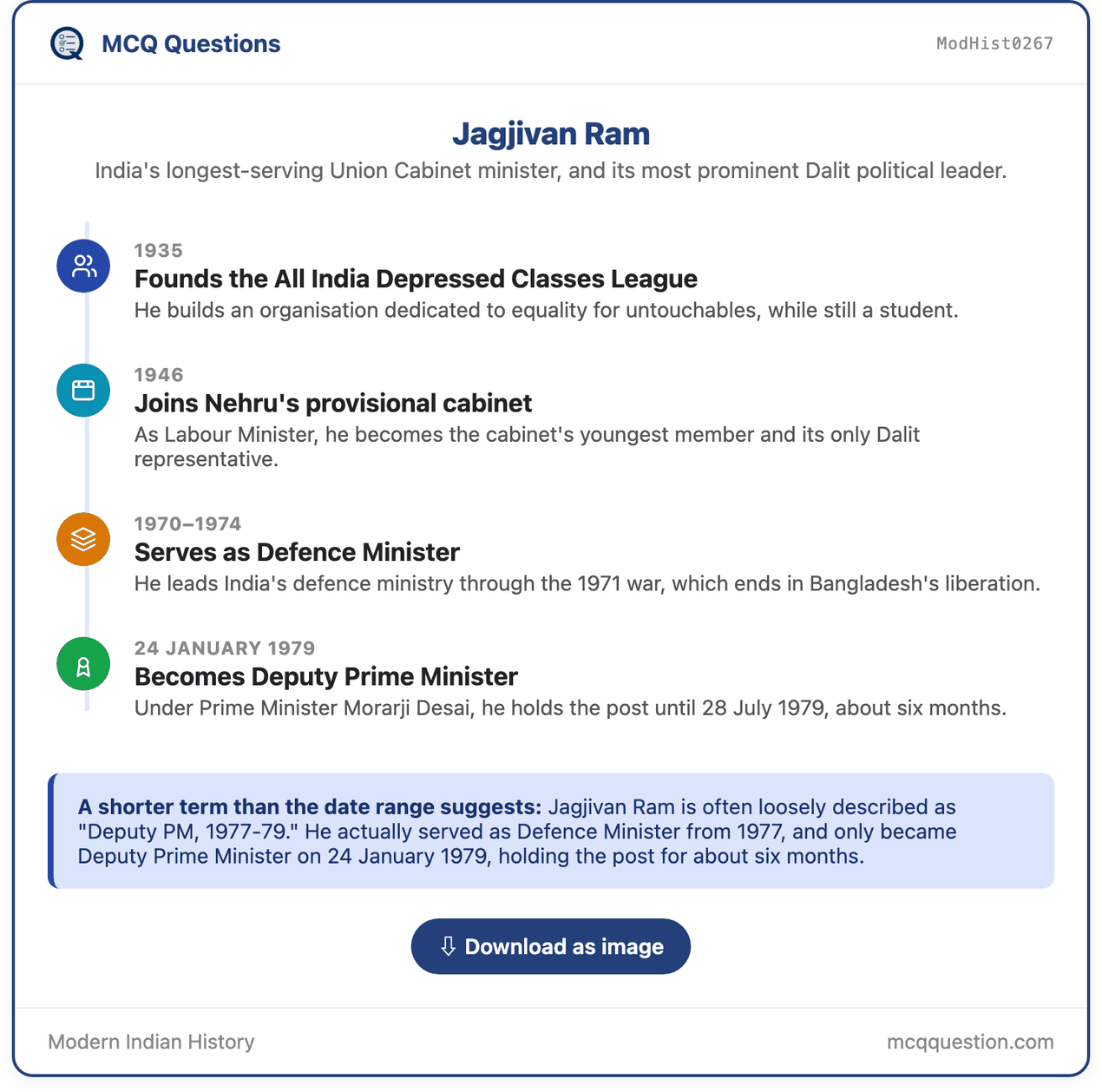
Jagjivan Ram
India’s longest-serving Union Cabinet minister, and its most prominent Dalit political leader.
1935
Founds the All India Depressed Classes League
He builds an organisation dedicated to equality for untouchables, while still a student.
1946
Joins Nehru’s provisional cabinet
As Labour Minister, he becomes the cabinet’s youngest member and its only Dalit representative.
1970–1974
Serves as Defence Minister
He leads India’s defence ministry through the 1971 war, which ends in Bangladesh’s liberation.
24 January 1979
Becomes Deputy Prime Minister
Under Prime Minister Morarji Desai, he holds the post until 28 July 1979, about six months.
A shorter term than the date range suggests: Jagjivan Ram is often loosely described as “Deputy PM, 1977-79.” He actually served as Defence Minister from 1977, and only became Deputy Prime Minister on 24 January 1979, holding the post for about six months.
Modern Indian Historymcqquestion.com
A Record-Long Cabinet CareerNeed to Know
- Jagjivan Ram was born on 5 April 1908, in Chandwa village, near Arrah, in the Bengal Presidency.
- He studied at Banaras Hindu University, then earned a BSc from the University of Calcutta in 1931.
- He was jailed for his role in the Quit India Movement in the early 1940s.
- In 1935, he founded the All India Depressed Classes League, working for equality for untouchables.
- In 1946, he joined Jawaharlal Nehru‘s provisional cabinet as Labour Minister, its youngest member and only Dalit representative.
- As Labour Minister, he helped lay the foundation of India’s social security laws, including the Minimum Wages Act.
- He served as Defence Minister from 1970 to 1974, leading through the 1971 war and Bangladesh’s liberation.
- He left the Congress party in 1977, and formed his own party, the Congress for Democracy, on 2 February that year. It later merged into the Janata alliance for that year’s general election.
- He became Deputy Prime Minister on 24 January 1979, under Morarji Desai.
- He served as a Union Cabinet minister for over 30 years, the longest tenure in Indian history.
- He died on 6 July 1986, in New Delhi.
Policy Legacy and FamilyGood to Know
- During his terms as Agriculture Minister, he helped steer India’s Green Revolution, addressing severe food shortages.
- Mahatma Gandhi is widely quoted as calling him “gold tempered in fire,” in recognition of his role in the freedom movement.
- His Defence Ministry oversaw the surrender of about 93,000 Pakistani soldiers, at the end of the 1971 war.
- He held his second Defence Minister term from 24 March 1977 to 28 July 1979, spanning his time as both Defence Minister and later Deputy Prime Minister.
- His daughter, Meira Kumar, later became the first woman Speaker of the Lok Sabha.
Test Yourself

Two Facts Worth Keeping DistinctGreat to Know
- Don’t cite “Deputy Prime Minister, 1977-79” as his exact term. He was Defence Minister from 1977, and Deputy Prime Minister only from 24 January to 28 July 1979, a much shorter window than the loose date range suggests.
- His 30-plus years as a Union Cabinet minister is not the same claim as being Deputy Prime Minister for that whole period. The cabinet-tenure record and the Deputy PM title are two separate facts, worth keeping distinct.
- See IndGov0003 — Welfare Schemes for SC, ST and Backward Classes, which references a scheme named after him, for the broader welfare-policy landscape his career fed into.
Beyond the answer
Browse all modern-indian-history topics →
📚 Keep reading
ModHist0014 — The Janata Party Interlude, 1977-1979Polity0028 — The Executive: PMO, Cabinet and Central SecretariatUPSC CSP 2024 — General Studies Paper I (Full Question Paper)ModHist0002 — Indira Gandhi: A Turbulent Life in Power (1917-1984)UPSC CSP 2022 — General Studies Paper I (Full Question Paper)❓ Practice this topic
On 21 October 1965, Shastri coined the slogan 'Jai Jawan, Jai Kisan' at a public gathering near Allahabad. What was that village called?Lal Bahadur Shastri resigned as Railways Minister after a second train accident in November 1956. Where did that accident happen?Bengal National College and Bengal Technical Institute eventually merged to form which university, formally set up on 24 December 1955?At its December 1906 Calcutta session under Dadabhai Naoroji, the Indian National Congress passed four resolutions. Which one of these was NOT among them?🎲 Take a Modern Indian History Quiz
Leave a Reply