Narayan Meghaji Lokhande
Narayan Meghaji Lokhande quit his clerk’s job at a Bombay cotton mill to fight for the men working the looms around him. In 1890, that fight produced India’s first labour association. Historians now call him the father of India’s trade union movement.
- How did Lokhande found India’s first labour association?
- What reforms did he actually win for mill workers?
- How did a clerk become a full-time labour organiser?
- How did a memorandum become the Factories Act of 1891?
- How did the 1891 Act actually differ from the 1881 one?
- Why was Lokhande a social reformer as well as a labour leader?
- Exam Angle
How did Lokhande found India’s first labour association?
Lokhande founded the Bombay Mill Hands Association in 1890, drawing over 10,000 mill workers to its founding meeting — work that earned him the title father of India’s trade union movement.
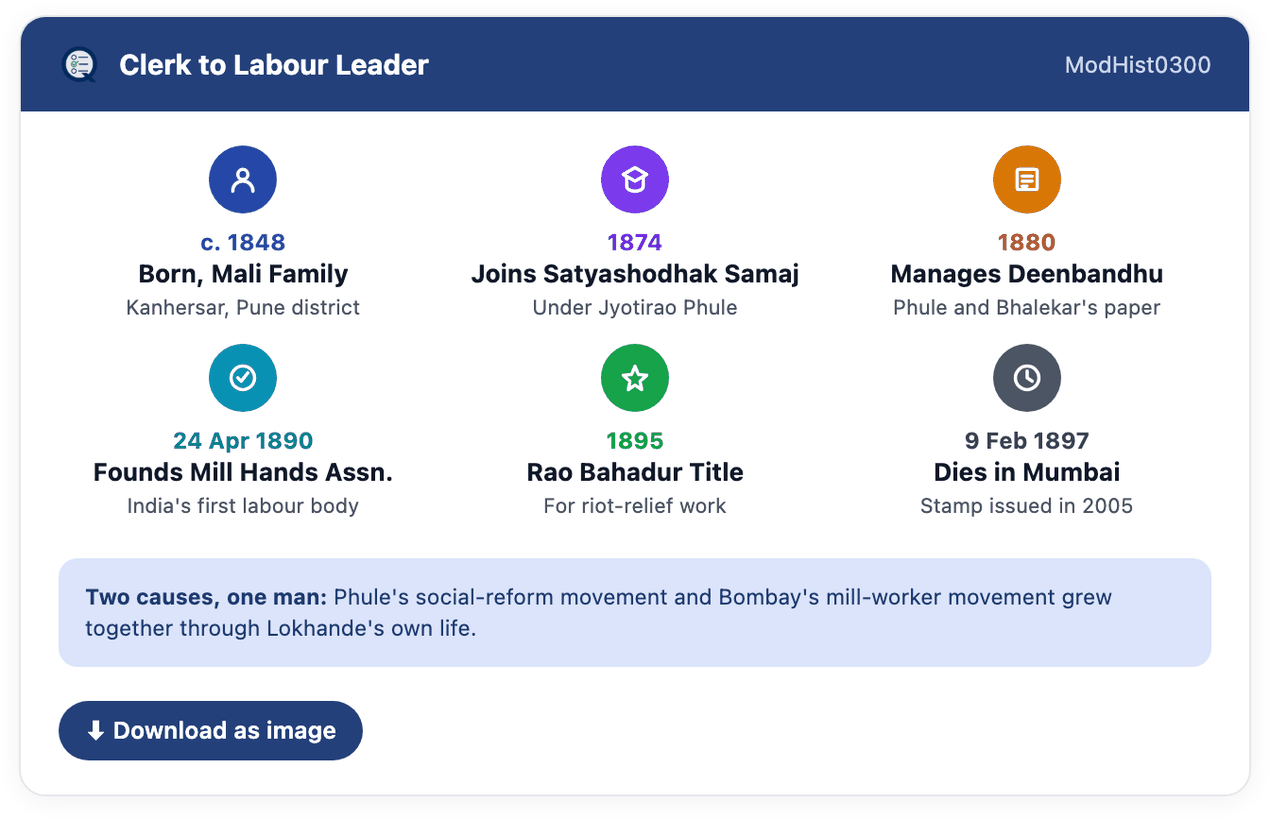
Narayan Meghaji Lokhande was born around 1848 into a Mali family from Kanhersar, in Pune district.
He founded the Bombay Mill Hands Association on 24 April 1890. Over 10,000 mill workers attended his founding meeting at Bombay’s Race Course Ground.
Historians call him the father of India’s trade union movement for this work.
Source: standard biographical record of Narayan Meghaji Lokhande.
Pause and decide · 1 of 8
Over 10,000 mill workers attended the founding meeting of Lokhande’s Bombay Mill Hands Association in 1890. True or false?
True. The meeting was held at Bombay’s Race Course Ground on 24 April 1890 — work that earned Lokhande the title father of India’s trade union movement.


What reforms did he actually win for mill workers?
Lokhande’s association won mill workers their first weekly rest day, a daily break, regular pay dates, and injury compensation — basic protections Bombay’s mills had never offered before.
His association won mill workers a weekly Sunday holiday, a first for Bombay’s mills.
Workers also gained a half-hour recess each afternoon under the new rules.
Mills agreed to pay wages regularly, by the 15th of every month.
The association also pushed mill owners to compensate workers hurt on the job.
Source: standard record of the Bombay Mill Hands Association’s reforms.
Pause and decide · 2 of 8
Before Lokhande’s association, Bombay’s mill workers already had a weekly holiday and regular pay dates. True or false?
False. The weekly Sunday holiday was a first for Bombay’s mills — his association also won a daily half-hour recess, wages paid by the 15th of every month, and injury compensation.
How did a clerk become a full-time labour organiser?
Lokhande worked as a railway and postal clerk before joining the mills, then gave up his own mill job entirely to run the association full-time.
Lokhande worked first with the railways, then the postal department, before joining the mills.
He joined Mandavi Textile Mills as Store Keeper in 1870.
He quit his job as a mill clerk to run the Mill Hands Association full-time.
He married Gopikabai and had a son named Gopinath.
Source: standard record of Lokhande’s early career.
Pause and decide · 3 of 8
Lokhande worked as a railway and postal clerk before ever joining the mills, and later joined Mandavi Textile Mills as Store Keeper in 1870. True or false?
True. He later quit his own mill clerk’s job entirely to run the Mill Hands Association full-time.
How did a memorandum become the Factories Act of 1891?
Lokhande turned thousands of mill workers’ signatures into a formal memorandum, presented it to a government commission, and helped shape the resulting national law.
Lokhande collected signatures from about 5,300 mill workers for a formal memorandum.
He presented this memorandum to the government’s Factory (Labour) Commission in 1890.
He worked with reformer Sorabji Shapurji Bengallee to help shape the resulting law.
Their combined efforts fed directly into the Factories Act of 1891.
Source: standard record of the memorandum behind the Factories Act, 1891.
Pause and decide · 4 of 8
Lokhande’s memorandum, backed by about 5,300 mill worker signatures, was presented to the Factory (Labour) Commission and fed into the Factories Act of 1891. True or false?
True. He worked with reformer Sorabji Shapurji Bengallee to help shape the resulting law.
How did the 1891 Act actually differ from the 1881 one?
An earlier 1881 law already regulated child labour, but it took Lokhande’s 1891 campaign to win adult workers a weekly holiday and limit women’s working hours.
An earlier Factories Act, passed in 1881, already regulated Indian mills.
That Act set a minimum working age of nine for child workers, and capped child workers’ daily hours at nine hours.
The Factories Act of 1891, shaped by Lokhande’s campaign, added a weekly holiday for all workers.
The 1891 Act also limited women mill workers to eleven working hours a day.
Source: standard record of the Factories Act, 1881 and 1891.
Pause and decide · 5 of 8
The 1881 Factories Act already gave all workers a weekly holiday, before Lokhande’s campaign even began. True or false?
False. The 1881 Act only regulated child labour (minimum age nine, capped at nine hours daily) — it took Lokhande’s campaign to win the weekly holiday, added only in the 1891 Act.
Why was Lokhande a social reformer as well as a labour leader?
Lokhande’s labour organising grew directly out of Phule’s anti-caste reform movement, and his own peace-making work during Hindu-Muslim riots earned him a formal government title.
Lokhande joined Jyotirao Phule’s Satyashodhak Samaj in 1874, its second year of existence.
From 1880, he managed Deenbandhu, a Marathi paper for Bombay’s working people. Phule had founded Deenbandhu in 1877 with fellow reformer Krishnarao Bhalekar.
In 1895, the government gave him the title Rao Bahadur for calming Hindu-Muslim riots.
He died on 9 February 1897; India issued a postage stamp honouring him in 2005.
His mentor Phule shaped both his early reform work and his later labour organising. See Jyotirao Phule: Education and Anti-Caste Reform for that fuller story.
Source: standard record of Lokhande’s reform work and the Satyashodhak Samaj.
Pause and decide · 6 of 8
Lokhande joined Jyotirao Phule’s Satyashodhak Samaj in 1874, well before he founded the Bombay Mill Hands Association in 1890. True or false?
True. His social-reform work and his later labour organising grew together throughout his life — he also managed Phule’s Deenbandhu newspaper from 1880.
Exam Angle: A Real PYQ Trap — “First Trade Union” vs “First Labour Association”
CDS (II) 2020 asked which body was India’s first trade union in the proper sense of the term.
The official answer was the Madras Labour Union, founded in 1918.
Lokhande’s 1890 Bombay Mill Hands Association is usually called India’s first labour organisation, not its first formal trade union.
The same paper asked who founded the All India Trade Union Congress in 1920; the answer was N.M. Joshi, a separate reformer.
Expect questions that test whether you can tell Lokhande’s association apart from these later, more formal trade unions.
Source: CDS (II) 2020.
Pause and decide · 7 of 8
Lokhande’s 1890 Bombay Mill Hands Association is officially recognised as India’s first formal trade union. True or false?
False. It is usually called India’s first labour organisation — CDS (II) 2020’s official answer for the first formal trade union was the Madras Labour Union, founded in 1918.
Pause and decide · 8 of 8
N.M. Joshi, a separate reformer from Lokhande, is credited with founding the All India Trade Union Congress in 1920. True or false?
True. Exams often test whether you can tell Lokhande’s 1890 association apart from these later, more formal trade unions.
Check your understanding
Answer the eight checks above. You will see each explanation after choosing.
Primary sources
- Standard biographical record of Narayan Meghaji Lokhande.
- CDS (II) 2020.
Practice what you learned
Question 1 of 1
Leave a Reply