Tatya Tope
Tatya Tope grew up at Bithur playing alongside a boy named Nana Saheb and a girl named Manu. Manu became Rani Lakshmibai of Jhansi. In 1858, the three childhood friends fought the British together at Gwalior. Only one of them lived to see 1860.
- How did a childhood friendship at Bithur lead to the Siege of Cawnpore?
- What happened at Bibighar, and how did the rebels lose Kanpur?
- How did Tatya Tope end up fighting beside Rani Lakshmibai at Gwalior?
- How did an untrained officer outrun seven British columns for ten months?
- How was Tatya Tope finally betrayed and captured?
- What does Tatya Tope’s story reveal about the wider revolt?
- Exam Angle
How did a childhood friendship at Bithur lead to the Siege of Cawnpore?
Tatya Tope’s role as Nana Saheb’s close aide, forged in a shared Bithur childhood, put him at the centre of the rebel command that besieged Cawnpore in 1857.
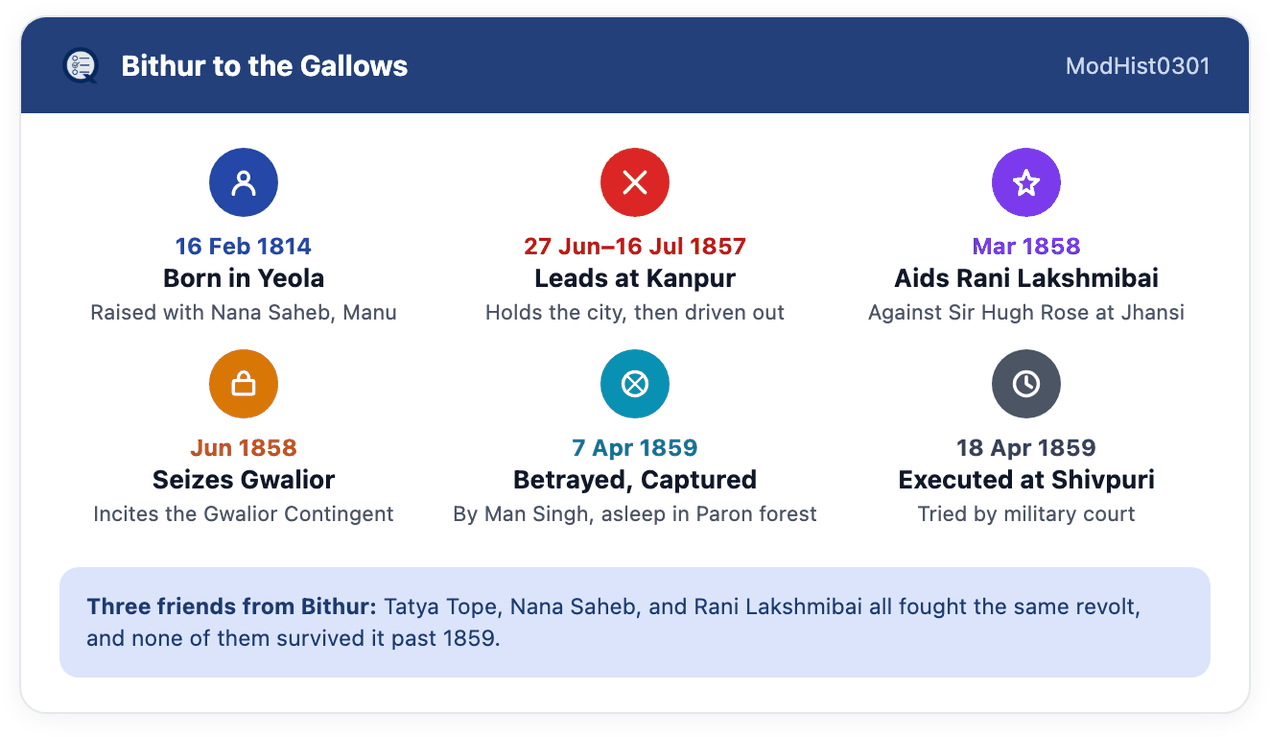
Tatya Tope was born Ramchandra Pandurang, on 16 February 1814 at Yeola.
He grew up at Bithur alongside Nana Saheb and the girl who became Rani Lakshmibai of Jhansi.
He served as a close aide and field commander for Nana Saheb during the 1857 revolt.
He was among the rebel leaders at the Siege of Cawnpore, which began on 5 June 1857.
After early rebel setbacks, he began issuing orders in Nana Saheb’s name from Bithur, and led resistance at Kanpur through the summer of 1857, holding the city for weeks.
Source: standard record of Tatya Tope’s early life and the Siege of Cawnpore, 1857.
Pause and decide · 1 of 8
Tatya Tope, Nana Saheb, and Rani Lakshmibai all shared a childhood together at Bithur, decades before the 1857 revolt. True or false?
True. That same Bithur childhood shaped all three of their roles in the revolt — Tatya Tope became Nana Saheb’s close aide and field commander at Kanpur.


What happened at Bibighar, and how did the rebels lose Kanpur?
After the Satichaura Ghat massacre, captured women and children were killed at Bibighar days before the British recaptured Kanpur, driving Tatya Tope and Nana Saheb out of the city.
On 27 June 1857, rebel forces killed British men at Satichaura Ghat during an evacuation.
Surviving women and children were then held at a house in Kanpur called Bibighar.
On 15 July, sepoys guarding Bibighar refused a kill order. Tatya Tope reportedly threatened them with execution for dereliction of duty.
The captives were killed soon after, though who gave the final order remains disputed among historians.
General Henry Havelock‘s relief column recaptured Kanpur on 16 July 1857, driving the rebels out. Both Nana Saheb and Tatya Tope escaped the city as British troops retook it.
Source: standard record of the Bibighar killings and the recapture of Kanpur, 1857.
Pause and decide · 2 of 8
Historians universally agree on exactly who gave the final order for the Bibighar killings. True or false?
False. Who gave the final order remains disputed among historians, though Tatya Tope reportedly threatened the sepoys guarding Bibighar after they initially refused a kill order.
How did Tatya Tope end up fighting beside Rani Lakshmibai at Gwalior?
A defeated relief force at Jhansi and a lost battle at Kalpi still led to the revolt’s boldest move: seizing the fortress city of Gwalior itself.
In March 1858, he brought a relief force of roughly 20,000 men to defend Jhansi.
Sir Hugh Rose defeated that relief force at the Battle of the Betwa on 31 March 1858.
He then fought beside Rani Lakshmibai and Rao Sahib at the Battle of Kalpi, which fell to the British on 22 May 1858.
After Kalpi fell, he pushed the rebel leadership to march on the fortress city of Gwalior instead.
In June 1858, he incited mutiny among the Gwalior Contingent and, with Lakshmibai, seized Gwalior. British forces recaptured Gwalior around 19 June 1858, days after Lakshmibai was killed defending it.
Source: standard record of the Jhansi, Kalpi, and Gwalior campaigns, 1858.
Pause and decide · 3 of 8
After the rebel defeat at Kalpi in May 1858, Tatya Tope pushed the leadership to march on Gwalior, where he and Rani Lakshmibai then seized the fortress. True or false?
True. British forces recaptured Gwalior around 19 June 1858, only days after Lakshmibai was killed defending it.
How did an untrained officer outrun seven British columns for ten months?
With no formal military training, Tatya Tope ran a mobile guerrilla campaign across central India that pinned down multiple British columns for nearly a year.
After fleeing Gwalior, he suffered a check at Jaora Alipur on 22 June 1858. Further defeats followed at Ranod and Sikar in the weeks after.
He then ran a sustained guerrilla campaign across Malwa, Bundelkhand, Rajasthan, and Khandesh.
For close to ten months, this mobile campaign pinned down as many as seven separate British columns.
He had no formal military training, yet moved so fast the British nicknamed him a “phantom.” He relied heavily on local knowledge of terrain and support from villagers across central India.
Source: standard record of Tatya Tope’s guerrilla campaign, 1858-59.
Pause and decide · 4 of 8
Tatya Tope had no formal military training, yet his mobile guerrilla campaign pinned down as many as seven separate British columns for close to ten months. True or false?
True. He moved so fast across Malwa, Bundelkhand, Rajasthan, and Khandesh that the British nicknamed him a “phantom.”
How was Tatya Tope finally betrayed and captured?
A trusted friend tipped off the British while Tatya Tope slept, ending a nearly year-long chase with a swift trial and execution.
He was betrayed by his friend Man Singh, Chief of Narwar, who tipped off British troops.
He was captured asleep in the Paron forest on 7 April 1859.
He was tried by a British military court at Sipri, near Shivpuri. He reportedly admitted the charges, but argued he answered only to his master, the Peshwa, not to a British court.
He was executed by hanging at Shivpuri on 18 April 1859, eleven days after capture.
A contested theory claims a different man was hanged in his place. Most historians reject this and accept the standard account.
Source: standard record of Tatya Tope’s betrayal, trial, and execution, 1859.
Pause and decide · 5 of 8
Tatya Tope denied all the charges against him at his military trial, refusing to acknowledge any role in the revolt. True or false?
False. He reportedly admitted the charges, but argued he answered only to his master, the Peshwa, not to a British court.
Pause and decide · 6 of 8
A contested theory claims a different man was hanged in Tatya Tope’s place, though most historians reject this. True or false?
True. Most historians accept the standard account — that he was executed at Shivpuri on 18 April 1859, eleven days after his capture.
What does Tatya Tope’s story reveal about the wider revolt?
His story is inseparable from Nana Saheb’s and Rani Lakshmibai’s, and his near-success at Gwalior shows how close the revolt came to lasting longer than it did.
His story is really three intertwined stories, shaped by the same Bithur childhood as Nana Saheb and Lakshmibai.
His Gwalior campaign shows how close the revolt came to lasting success, holding a key fortress for weeks.
A statue of Tatya Tope stands at Nana Rao Park in Kanpur, near the site linked to the 1857 killings. A second statue honours him at Yeola, his birthplace in present-day Maharashtra.
He is remembered today as a symbol of resistance to British rule during 1857.
Source: standard record of Tatya Tope’s legacy and memorials.
Pause and decide · 7 of 8
Tatya Tope is honoured with statues at both Nana Rao Park in Kanpur and at Yeola, his birthplace. True or false?
True. His story remains inseparable from his childhood friends Nana Saheb and Rani Lakshmibai, and his Gwalior campaign shows how close the revolt came to lasting success.
Exam Angle: What to Expect
No Previous Year Question in this site’s index has directly tested Tatya Tope yet, but examiners are likely to probe these traps.
Trap 1: do not confuse Tatya Tope with Nana Saheb. Nana Saheb was the political leader at Kanpur; Tatya Tope was his field commander.
Trap 2: do not confuse Tatya Tope with Bakht Khan, who commanded rebel forces at Delhi, not Kanpur or Gwalior.
Likely: Prelims-style questions could test his birth name, the place of his capture, or the place of his execution.
Expect this figure linked to Rani Lakshmibai’s last stand at Gwalior in any question on the 1857 revolt’s final phase.
Source: standard exam-angle analysis of Tatya Tope’s role in the Revolt of 1857.
Pause and decide · 8 of 8
Tatya Tope was Nana Saheb’s field commander at Kanpur, while Bakht Khan commanded a separate rebel force at Delhi. True or false?
True. Exams often test whether you can keep these two separate rebel commanders straight.
Check your understanding
Answer the eight checks above. You will see each explanation after choosing.
Primary sources
- Standard record of Tatya Tope’s life, the 1857 revolt, and his 1859 trial and execution.
Practice what you learned
Question 1 of 1
Leave a Reply