India didn’t just ban some plastic items. It set a deadline for every water bottle to reuse most of its own plastic, years in advance.

Must Know
- Plastic waste in India is governed by the Plastic Waste Management Rules, 2016, notified 18 March 2016. They replaced the earlier 2011 rules.
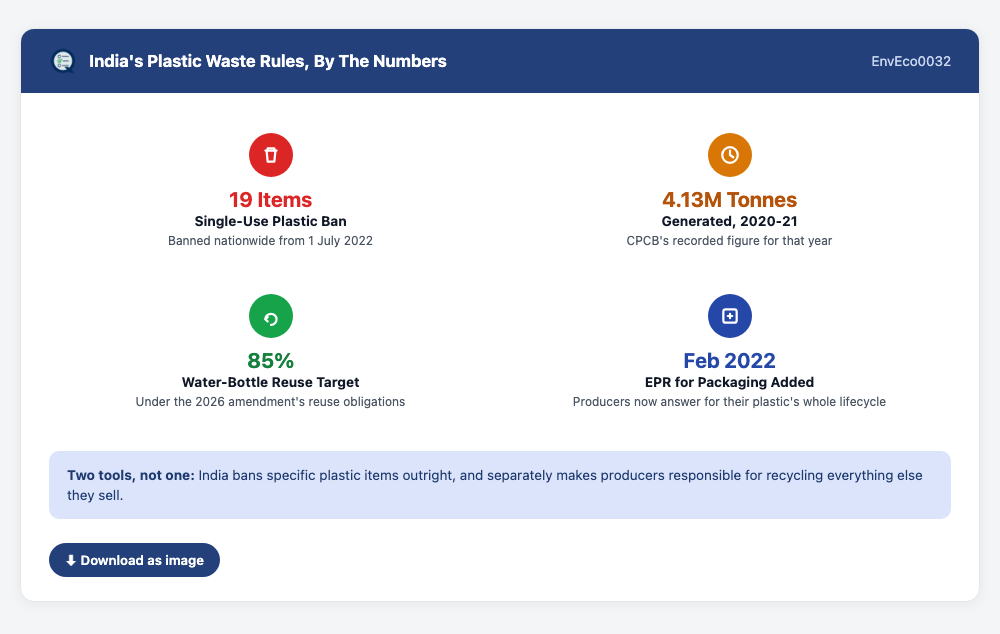
- A phased single-use plastic ban covers 19 identified items, effective from 1 July 2022 — earbuds, plates, cups, straws, and stirrers among them.
- EPR for plastic packaging was added to the rules in February 2022. It holds producers, importers, and brand owners responsible for collecting back what they put into the market.
- Plastic packaging is split into categories for EPR purposes. Multi-layered plastic sits in its own category, with targets applying only to its plastic component.
Good to Know
- Plastic carry bags carry their own minimum-thickness rules. Bags under 75 microns were banned from 30 September 2021. Bags under 120 microns were banned from 31 December 2022.
- The Central Pollution Control Board (CPCB) recorded about 4.13 million tonnes of plastic waste generated in India in 2020-21.
- As with most Indian recycling sectors, much of what actually gets recycled still passes through the informal sector, not large formal plants.
Test Yourself

Great to Know
- India uses two separate tools here, not one. It bans specific plastic items outright. It separately makes producers responsible for recycling everything else they sell, through EPR.
- For recycling across all sectors, and the EPR mechanism’s own origins, see EnvEco0030 — Recycling in India. For solid and hazardous waste regulation more broadly, see EnvEco0011 — Solid and Hazardous Waste.
- Everyday plastic pollution isn’t always obvious. Many chewing gums sold in the market use a plastic-based gum base, often polyvinyl acetate, instead of natural rubber. That plastic base doesn’t biodegrade, so discarded gum contributes real, lasting pollution.
Current Affairs
- On 23 July 2026, Parliament reviewed the broader Solid Waste Management Rules, 2026 — distinct from the plastic-specific rules above, covering all solid waste categories. They mandate four-stream segregation: wet, dry, sanitary, and special-care waste. (Source: PIB) The same rules also set new sanitary-landfill standards, covered in EnvEco0046 — CAQM.
- The rules carry special provisions for hilly areas and islands. Bulk Waste Generators face an “Extended Bulk Waste Generator Responsibility,” with every stage tracked via a Centralised Online Portal. (Source: PIB)
- Under Swachh Bharat Mission, the Centre funds solid waste management in Himalayan and Northeastern states at a 90:10 Centre-State split. Jammu & Kashmir received the largest 2024-25 rural allocation, at ₹245 crore. (Source: PIB)
- On 31 March 2026, the Ministry of Environment, Forest and Climate Change notified the Plastic Waste Management (Amendment) Rules, 2026.
- The amendment sets recycled-content targets that rise by packaging category. Category I rises from 30% (2025-26) to 60% (2028-29). Category II rises from 10% to 20%. Category III rises from 5% to 10%.
- It also sets new reuse targets for rigid plastic packaging: starting at 10% in 2025-26, rising to 25% by 2028-29.
- Drinking water packaging faces a stricter reuse requirement: 70% initially, rising to 85%.
Previous Year Question
Asked as: “Consider the following statements on chewing gums and environmental pollution.” (UPSC CSP 2024, GS Paper I). View this question.
Leave a Reply