India’s 1962 war with China exposed a gap: nobody was guarding the high Himalayan border the way it needed guarding. The force built to fix that gap now doubles as the country’s most capable high-altitude rescue team. This article covers the Indo-Tibetan Border Police.

Timeline
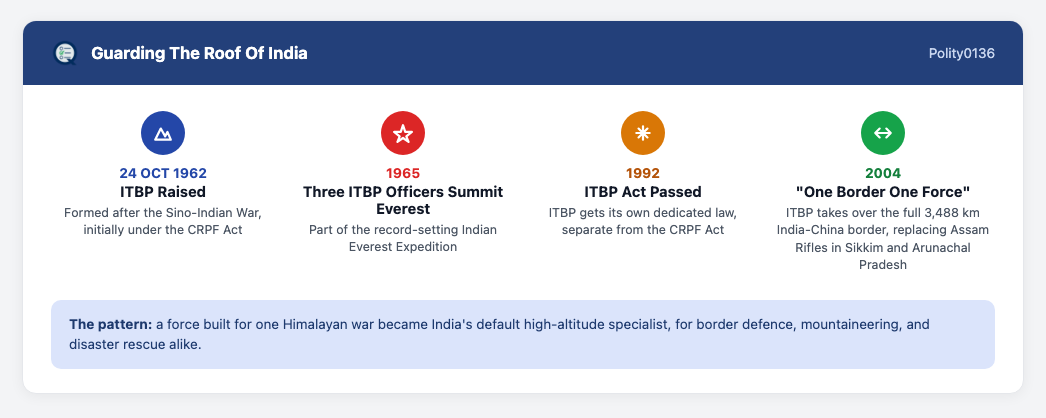
- On 24 October 1962, the Indo-Tibetan Border Police (ITBP) was raised, in the aftermath of the Sino-Indian War. It started under the CRPF Act, with four battalions.
- In 1965, three serving ITBP officers were among the nine climbers of the record-setting Indian Everest Expedition.
- In 1992, Parliament passed the ITBP Act, giving the force its own dedicated law, separate from the CRPF Act.
- In 2004, under the “One Border One Force” policy, ITBP took over the full 3,488 km India-China border. It replaced the Assam Rifles in Sikkim and Arunachal Pradesh.
Must Know
- The ITBP is one of the Central Armed Police Forces, surveyed together in Polity0116. Here, it gets standalone treatment.
- ITBP’s core mandate is guarding the India-China border (the LAC), from Ladakh to Arunachal Pradesh.
- ITBP’s Border Out Posts sit at altitudes of 9,000 to 18,800 feet, where winter temperatures can fall to minus 45°C.
- As of 2026, ITBP has around 89,000 personnel across 60 service battalions.
Good to Know
- During the June 2013 Uttarakhand floods, ITBP was among the first responders. Its personnel helped evacuate over one lakh people.
- ITBP provides security escort duty for pilgrims on the Kailash Mansarovar Yatra.
- ITBP’s mountaineering record includes multiple successful Mount Everest ascents by its own personnel, a legacy that traces back to the 1965 expedition.
Test Yourself

Great to Know
- ITBP replacing Assam Rifles in Sikkim and Arunachal Pradesh, under “One Border One Force,” shows a deliberate move toward specialist forces. Each terrain type got matched to the force best equipped for it, rather than spreading generalist units thin.
- ITBP officers reaching Everest just three years after the force’s founding is not a coincidence. A force explicitly built around high-altitude skill naturally produced world-class mountaineers.
- The same skills that guard a Himalayan border, extreme-altitude endurance and mountain rescue training, also make ITBP India’s default responder to Himalayan disasters. One capability, two very different uses.
Beyond the answer
Browse all indian-polity-and-constitution topics →
📚 Keep reading
Polity0116 — Central Armed Police Forces of IndiaWorldGeo0019 — Mount EverestUPSC CDS (I) 2018 — General Knowledge (Full Question Paper)GK0098 — Nawang Gombu: The First Person to Climb Everest TwiceIntlRel0161 — US–China Rivalry vs the Soviet Era: An Existential Comparison❓ Practice this topic
Which of the following Acts, receiving presidential assent on 24 December 2023, replaced the Indian Telegraph Act 1885, the Wireless Telegraphy Act 1933 and the Telegraph Wires (Unlawful Possession) Act 1950?Under Article 61 of the Constitution, by what majority must the resolution preferring the charge of impeachment against the President be passed in each House of Parliament?Which Article of the Constitution provides that it shall be the endeavour of every State to provide adequate facilities for instruction in the mother tongue at the primary stage to children belonging to linguistic minority groups?In which situation can a State Governor issue an ordinance under Article 213 of the Constitution?🎲 Take a Indian Polity And Constitution Quiz
Leave a Reply