India’s largest police force isn’t state police at all. This article covers the Central Armed Police Forces, seven organisations under one ministry, each with its own distinct job.
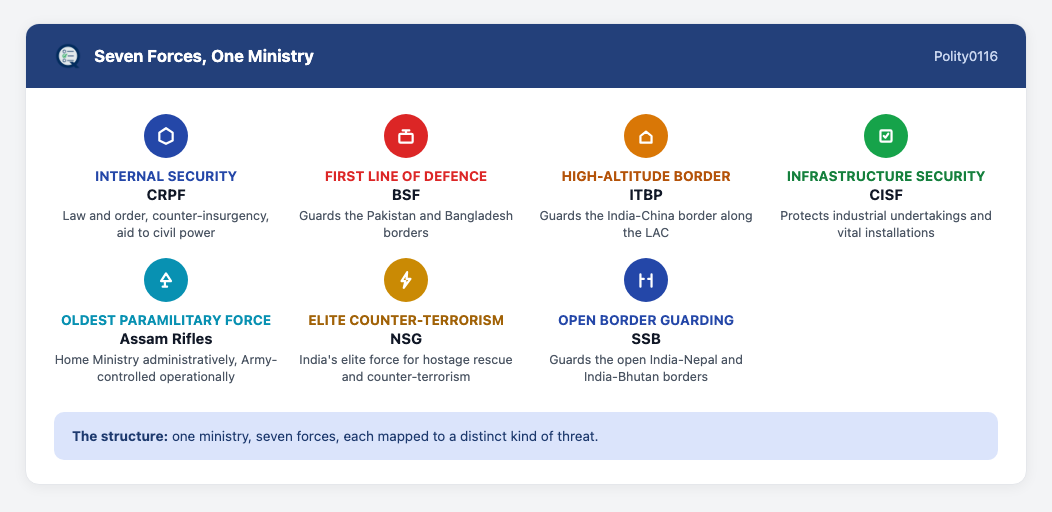
- Assam Rifles (AR) — the oldest paramilitary force in India. Under the Home Ministry administratively, but Army-controlled operationally.
- Border Security Force (BSF) — guards the India-Pakistan and India-Bangladesh borders.
- Central Industrial Security Force (CISF) — protects industrial undertakings and vital installations, like airports and power plants.
- Central Reserve Police Force (CRPF) — India’s largest CAPF, with about 3.25 lakh personnel. Deployed for internal security and counter-insurgency.
- Indo-Tibetan Border Police (ITBP) — guards the India-China border along the high-altitude Line of Actual Control (LAC).
- National Security Guard (NSG) — India’s elite counter-terrorism force, often called the “Black Cats.”
- Sashastra Seema Bal (SSB) — guards the open India-Nepal and India-Bhutan borders.

Must Know
- The Central Armed Police Forces (CAPFs) function under the Ministry of Home Affairs. They are distinct from both the Armed Forces and individual state police forces.
- The CAPFs split into two broad categories: Border Guarding Forces (BSF, ITBP, SSB, Assam Rifles) and Internal Security Forces (CRPF, CISF).
- The CRPF is deployed in aid of civil power for law and order, internal security and counter-insurgency operations.
- The BSF guards the India-Pakistan and India-Bangladesh borders, often called the country’s “First Line of Defence.”
- The ITBP guards the India-China border along the high-altitude Himalayan Line of Actual Control (LAC).
- The CISF provides security to industrial undertakings and vital installations, distinct from the border-guarding and internal-security forces.
Good to Know
- The Sashastra Seema Bal (SSB) guards the open India-Nepal and India-Bhutan borders. The National Security Guard (NSG) handles specialised counter-terrorism operations.
- For BSF, ITBP and SSB’s specific border-management roles and regional challenges, see Polity0013 — Border Security: Management, Organizations and Regional Challenges.
- Assam Rifles, though a Border Guarding Force administratively under the Home Ministry, is operationally controlled by the Army during counter-insurgency deployments, a genuine dual-command arrangement.
Current Affairs
- 22 June 2026: Union Minister of State for Home Affairs Bandi Sanjay Kumar laid the foundation stone of a new CISF headquarters building. It will stand at the CGO Complex, Lodhi Road, in New Delhi. (Source: PIB)
- The nine-storey building will cost ₹75.78 crore, built by CPWD. It will house the Director-General’s office, a control room, and an auditorium. (Source: PIB)
- The same event dedicated CISF infrastructure worth ₹136.03 crore in total. This included an Officers’ Mess and Training Building at NISA Hyderabad, and new personnel quarters in Sivagangai, Tamil Nadu. (Source: PIB)
- CISF also announced a ₹1 crore accident insurance payout for bereaved families of personnel. Disabled dependents of personnel received wheelchairs as part of the same event. (Source: PIB)
Test Yourself

Great to Know
- Splitting internal security and border guarding into separate force categories reflects a real operational distinction. A force built to guard a fixed international boundary needs different training and equipment than one built for flexible internal deployment.
- CISF’s narrow, infrastructure-specific mandate contrasts with CRPF’s broad, general-purpose one. Protecting airports and power plants calls for a different skill set than counter-insurgency operations, even though both fall under the same ministry.
- Assigning one force per border, BSF to Pakistan/Bangladesh, ITBP to China, SSB to Nepal/Bhutan, lets each force build deep, border-specific expertise. A single unified border force would lose that specialisation.
- The CAPFs collectively form one of the world’s largest paramilitary structures, yet operate with far less public visibility than the Armed Forces. Their work in counter-insurgency and internal security rarely attracts the same level of public attention as conventional defence.
Beyond the answer
Browse all indian-polity-and-constitution topics →
📚 Keep reading
Polity0363 — Home Guards and the Official Secrets Act: Auxiliary Forces and EnforcementPolity0007 — Internal Security Threats: Traditional, Non-Traditional and External ActorsUPSC CSP 2023 — General Studies Paper I (Full Question Paper)Polity0013 — Border Security: Management, Organizations and Regional ChallengesUPSC CSP 2026 — General Studies Paper I (Full Question Paper)❓ Practice this topic
Which of the following Acts, receiving presidential assent on 24 December 2023, replaced the Indian Telegraph Act 1885, the Wireless Telegraphy Act 1933 and the Telegraph Wires (Unlawful Possession) Act 1950?Under Article 61 of the Constitution, by what majority must the resolution preferring the charge of impeachment against the President be passed in each House of Parliament?Which Article of the Constitution provides that it shall be the endeavour of every State to provide adequate facilities for instruction in the mother tongue at the primary stage to children belonging to linguistic minority groups?In which situation can a State Governor issue an ordinance under Article 213 of the Constitution?🎲 Take a Indian Polity And Constitution Quiz
Leave a Reply