292. Borrowing by the Government of India.—The executive power of the Union extends to borrowing upon the security of the Consolidated Fund of India within such limits, if any, as may from time to time be fixed by Parliament by law and to the giving of guarantees within such limits, if any, as may be so fixed.
One line in the Constitution lets the Union Government borrow money. Article 292 is short, but it sits behind every rupee the Centre borrows. The catch: Parliament, not the Executive alone, decides how far that borrowing can go — and no fixed number is written into the Constitution itself.

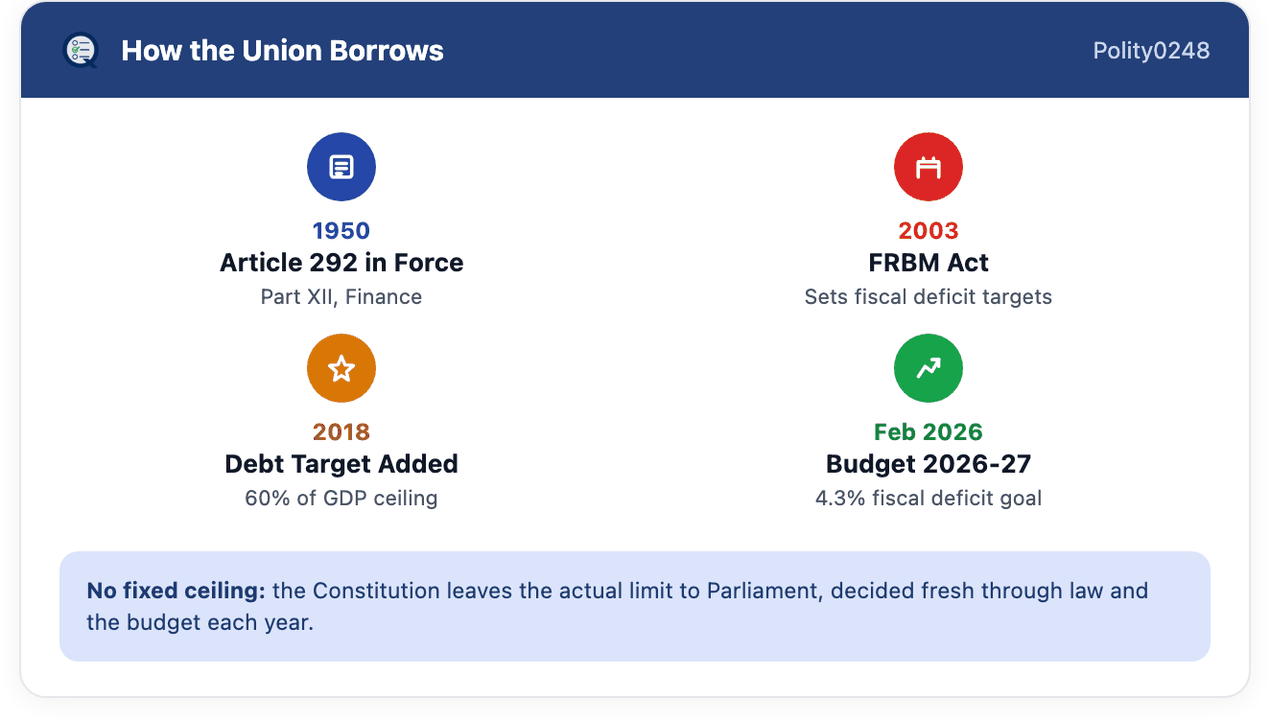
What Article 292 Does
- PowerArticle 292 gives the Union executive the power to borrow on the security of the Consolidated Fund of India.
- ScopeThe power covers both borrowing and giving guarantees — both are subject to limits.
- Who sets limitsThe Constitution sets no fixed numeric limit itself. Instead, it lets Parliament fix the limit by ordinary law whenever it chooses.
- Why it mattersParliament, not the Executive alone, decides the ceiling. This keeps the borrowing power democratically controlled rather than a purely executive choice.
Where Article 292 Sits
- Part XIIArticle 292 sits in Part XII of the Constitution, on Finance, Property, Contracts and Suits.
- CompanionsIt sits alongside Article 293 (the parallel provision for States) and Article 300 (suits by and against government).
- Domestic or foreignUnion borrowing can happen within India or abroad — both routes fall under the same constitutional power.
- TakeawayArticle 292 is the Centre’s borrowing clause; Article 293 is the States’. Together they anchor government finance in Part XII.
- Why it mattersBecause Part XII groups the government’s finance and liability rules, Article 292 is read together with 293 and 300 — understanding that cluster explains how borrowing, suing and taxing fit in one scheme.
The FRBM Act Connection
- ToolParliament’s main tool for fixing borrowing limits today is the FRBM Act, 2003 (Fiscal Responsibility and Budget Management Act), effective from July 2004.
- AmendmentsThe FRBM Act has been amended four times: in 2004, 2012, 2015 and 2018.
- 2018 targetThe 2018 amendment added a debt-sustainability target: total government debt at 60% of GDP, split 40% for the Centre and 20% for the States.
- WhyThe FRBM Act gives Article 292’s open-ended borrowing power a concrete, enforceable fiscal framework.
How the Union Borrows vs the States
- UnionUnder Article 292, the Union borrows with Parliament fixing the limit — it does not need a higher authority’s consent.
- StatesUnder Article 293, a State that already owes the Union money needs the Union’s consent before borrowing further.
- Why the differenceBecause the Union stands behind State debt, the Constitution gives the Centre a say in further State borrowing to protect fiscal discipline.
- So whatThis is the key asymmetry: the Union answers to Parliament; a States answers to both its legislature and (often) the Union.
Work through a 5-question chain on Article 292, then keep practising with a random Indian Polity question.
Why No Fixed Ceiling Is Written In
- DesignThe framers deliberately left the actual borrowing limit out of the Constitution, leaving it to Parliament to fix through ordinary law.
- WhyBecause the right borrowing limit changes with economic conditions — a rigid constitutional number could not adapt to recessions, wars or booms.
- MechanismEach year’s limit is set through ordinary budget-making and fiscal legislation, not a fixed constitutional figure.
- So whatArticle 292 is a framework clause: it grants the power and the democratic check, but leaves the number flexible.
- ResultThe practical effect is that borrowing is re-authorized every year through the budget, so Parliament can tighten or loosen the tap to suit the economy.
The Original FRBM Goals
- 2003 aimsThe original 2003 Act aimed to eliminate the revenue deficit by 2009 and cap the fiscal deficit at 3% of GDP.
- Later changeLater amendments dropped the revenue-deficit target and pushed the fiscal-deficit deadline further out.
- WhyEconomic shocks and changing fiscal priorities made the original deadlines unrealistic, so Parliament revised them.
- TakeawayThe FRBM trajectory shows Article 292’s limits being adjusted over time — exactly the flexibility the framers intended.
- OutcomeThough the original deadlines slipped, the FRBM framework made the annual deficit number a legal commitment rather than a mere announcement.
Article 292 and the Consolidated Fund
- SecurityThe Union borrows on the security of the Consolidated Fund of India — the pool of all Union revenues.
- WhyBacking loans with the Consolidated Fund gives lenders confidence that the Union can repay.
- Linked articleThe Consolidated Fund itself is established under Article 266, a separate Part XII provision.
- So whatUnderstanding the Fund helps you see why borrowing is tied to it: it is the Union’s credit base.
- ProtectionBecause repayment is backed by the full pool of Union revenues, the borrowing power is both powerful and credible in the eyes of lenders.
The Current Fiscal Context
- Budget 2026-27The Union Budget 2026-27 set the fiscal deficit target at 4.3% of GDP, down from the 4.4% revised estimate for 2025-26.
- Outstanding debtThe Government’s outstanding liabilities were estimated at 55.6% of GDP for 2026-27, down from 56.1% the year before.
- Long-term goalThe Government reaffirmed its goal of bringing total outstanding liabilities to around 50% of GDP by March 2031.
- Why it mattersThese are the real-world numbers that give Article 292’s borrowing power its annual, concrete shape.
- DirectionThe downward drift in both deficit and debt signals a deliberate consolidation path, which shapes how much headroom Article 292 allows each year.
Article 292 vs Article 293 in One View
- UnionArticle 292: Union borrows, Parliament sets the limit, no consent needed from anyone.
- StateArticle 293: State borrows within its legislature’s limit, but needs Union consent if it already owes the Union.
- PurposeThe pair keeps both tiers borrowing responsibly, with Parliament controlling the Centre and the Centre overseeing State debt.
- Exam angleA question contrasting the two is really testing who controls whom — Parliament over the Union, Union over indebted States.
- TakeawayRemember the pair as one clause for the Union (292) and one for the States (293), each with its own control mechanism.
UPSC CSP 2018: FRBM Debt Target
- QuestionUPSC asked about the FRBM Review Committee’s recommended debt-to-GDP target. The combined (Centre + States) target is 60% of GDP — 40% Centre + 20% States.
- WhyThis is the concrete limit Parliament works within under Article 292’s framework — the Union borrows on the Consolidated Fund within Parliament-set limits, operationalised through FRBM.
- LinkSource: UPSC CSP 2018 GS Paper I (see Q9).
The ‘Who Sets the Limit’ Question
- Fact testedUnder Article 292, the power to fix limits on Union borrowing rests with Parliament by law.
- TrapOptions that vest the ceiling in the Executive alone are wrong.
- TryParliament controls the borrowing ceiling.
FRBM and Debt-Target Recall
- Fact testedThe 2018 FRBM amendment set a 60% of GDP total-debt target — 40% Centre, 20% States.
- TrapOptions swapping the split or naming a different percentage are wrong.
- Try60/40/20: total 60, Centre 40, States 20.
Fiscal Deficit Trajectory
- DevelopmentThe fiscal deficit target has been steadily lowered — 4.4% (2025-26 revised) to 4.3% of GDP (2026-27).
- Why it mattersEach budget effectively fixes the year’s borrowing limit under Article 292, translating the open clause into a concrete number.
- So whatThe annual deficit target IS Article 292 in action — the Constitution’s framework, Parliament’s number.
The 50%-by-2031 Debt Goal
- DevelopmentThe Government aims to bring total outstanding liabilities to around 50% of GDP by March 2031.
- Why it mattersThis is a stated anchor for future borrowing — the direction Article 292’s annual limits are heading.
- So whatWatch fiscal-policy news for the path from today’s ~55.6% to the 50% target.
Beyond the answer
Browse all indian-polity-and-constitution topics →
📚 Keep reading
Polity0250 — Article 293: Borrowing Power of the StatesIndEco0011 — Public Finance and Fiscal PolicyIndEco0303 — Non-Financial Debt Classification in the Indian EconomyIndEco0061 — Budget, Tax and Fiscal PolicyIndEco0023 — Budget Objectives, Types and Federal Budgeting❓ Practice this topic
Which of the following Acts, receiving presidential assent on 24 December 2023, replaced the Indian Telegraph Act 1885, the Wireless Telegraphy Act 1933 and the Telegraph Wires (Unlawful Possession) Act 1950?Under Article 61 of the Constitution, by what majority must the resolution preferring the charge of impeachment against the President be passed in each House of Parliament?Which Article of the Constitution provides that it shall be the endeavour of every State to provide adequate facilities for instruction in the mother tongue at the primary stage to children belonging to linguistic minority groups?In which situation can a State Governor issue an ordinance under Article 213 of the Constitution?🎲 Take a Indian Polity And Constitution Quiz
Leave a Reply