India uses specific categories and delivery mechanisms to target its poverty programmes. This article covers the key ones, from BPL categorization to direct cash transfers.


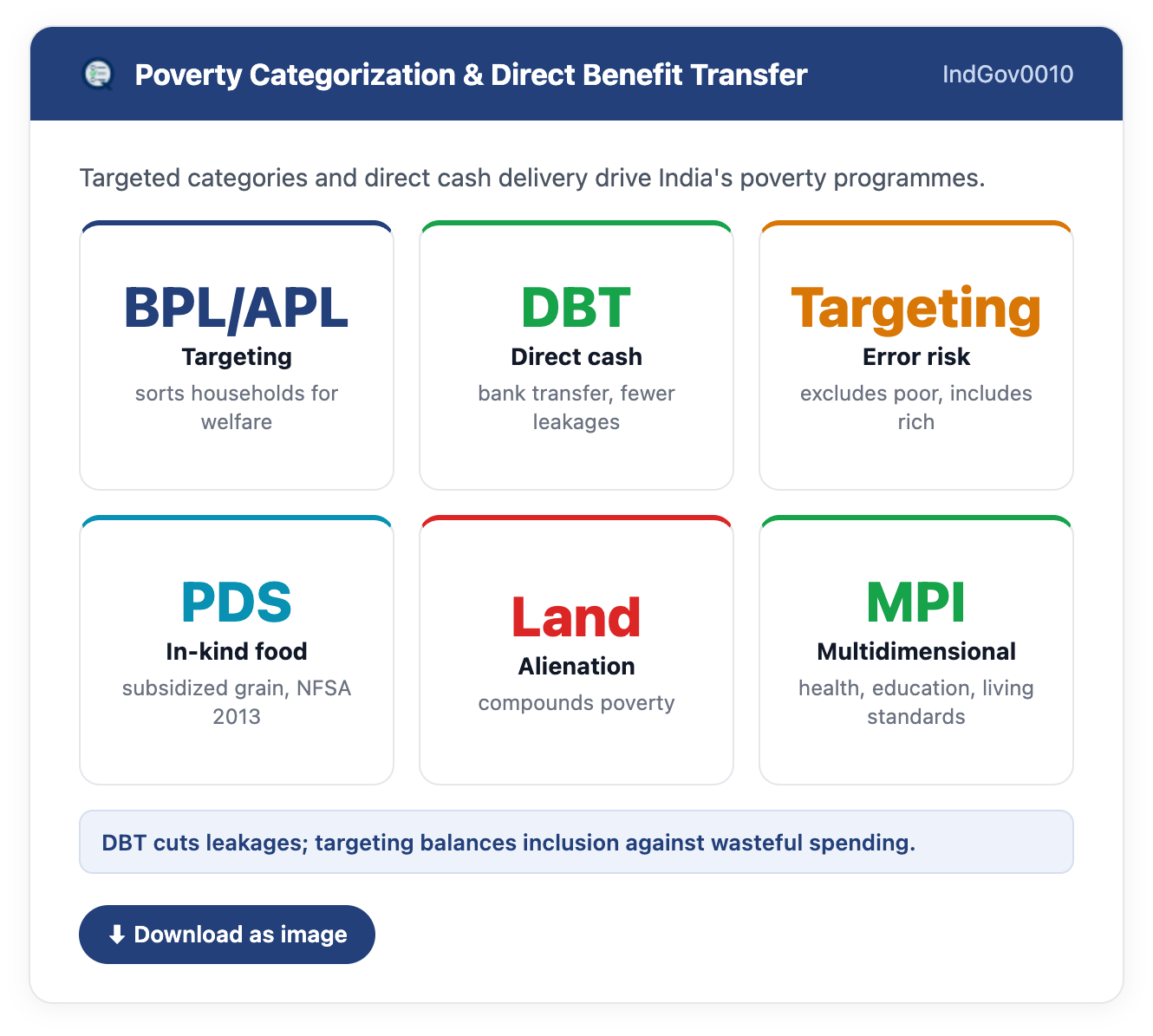
Must Know
Poverty Categorization and Direct Benefit Transfer
BPL and APL Categorization
- DefinitionBPL (Below Poverty Line) and APL (Above Poverty Line) classify households by whether their consumption falls below or above the official poverty line.
- MeasurementThe poverty line is an expenditure benchmark — households whose per-capita monthly consumption is below it are counted as BPL.
- TendulkarThe Tendulkar Committee set a consumption-based line (initially about Rs 27-33 per person per day).
- RangarajanThe Rangarajan Committee (2014) later revised this, setting a national line of about Rs 1,407 per month per person in urban areas and Rs 972 in rural areas (roughly Rs 47 and Rs 32 per day), putting the poor at 29.5% of the population.
- CurrentNo new government-backed poverty line has been adopted since Rangarajan; recent estimates update his line, e.g. a 2025 RBI study put it at about Rs 1,632 (rural) and Rs 1,944 (urban) monthly per capita.
- Ration cardIn the Public Distribution System, BPL households hold BPL ration cards and APL households hold APL cards, which determine subsidized-food eligibility.
- NFSA shiftThe National Food Security Act, 2013 replaced BPL/APL with priority and Antyodaya (AAY) household categories, targeting the poorest first.
- EligibilityEach state decides priority-household eligibility, usually by an exclusion-based survey (excluding income-tax payers, car owners, salaried government staff, large landholders) rather than one national income figure.
- CheckTo verify, a household can check its state’s NFSA/ration-card portal or Priority Household List, or apply at a local food-supply office or Common Service Centre with identity, address and income proof.
- DebateThe criteria used to set this line have been repeatedly debated and revised.
Direct Cash Benefit System
- What it isDirect Benefit Transfer sends money straight to a beneficiary’s bank account, rather than routing a subsidy through a physical good or a local intermediary first.
- Why it cuts leakageIt cuts out the leakages common in physical-goods delivery, since there is no truck of grain or middleman to divert along the way.
- The JAM trinityDBT relies on the “JAM trinity”: Jan Dhan bank accounts, Aadhaar identification, and Mobile connectivity. Together they let the government verify and pay a real, unique beneficiary.
- Why it mattersDBT does not replace every welfare scheme. Food subsidy through the PDS still largely moves as grain, not cash, in most states today.
Malnourishment and Land Alienation
- MalnourishmentMalnourishment remains a major concern even in states with strong economic growth, since income and nutrition do not always move together at the household level.
- Why they divergeA family earning above the poverty line can still feed children poorly, whether from limited nutritional knowledge or unequal food distribution within the household.
- Land alienationLand alienation is the loss of land rights by poor and tribal communities, often through debt, fraud, or forced acquisition without fair compensation.
- Why it compounds povertyLosing land means losing the primary means of livelihood for many rural and tribal households, pushing them deeper into poverty rather than out of it.
Good to Know
Delivery Challenges
Banking Access Assumptions
- The assumptionCash transfers assume beneficiaries can access banking and markets easily, withdrawing money and then actually spending it on what they need.
- The realityThis doesn’t always hold in remote or poorly connected areas, where the nearest bank branch or ATM can be a long, costly journey away.
- A concrete exampleA DBT payment sitting untouched in a rural bank account helps no one. That happens when the nearest working ATM is many kilometres away with no reliable transport.
- Why it mattersBusiness correspondents and mobile banking have narrowed this gap, but genuine last-mile access is still uneven across India’s more remote regions.
Targeting Error and Poverty vs Nutrition
- Targeting errorBPL/APL categorization can exclude genuinely poor households and include non-poor ones, an outcome known specifically as targeting error.
- Why it happensA single income cutoff cannot perfectly capture every household’s real circumstances, especially for informal or seasonal income that is hard to verify.
- Poverty and nutritionPoverty and malnourishment are linked but genuinely distinct problems, and targeting error compounds both when the wrong households get left out.
- A concrete caseA household can rise just above the income poverty line while its children still face real nutritional deficits. A small income gain does not fix every underlying gap.
PDS and Food Security
- The schemeThe Public Distribution System delivers subsidized foodgrain through a nationwide network of fair-price shops, one of the world’s largest food-distribution systems.
- The legal shiftThe National Food Security Act, 2013 gave a legal entitlement to subsidized food, turning what had been a policy benefit into an enforceable right.
- A real featureOne Nation One Ration Card lets a beneficiary claim their food entitlement from any fair-price shop in the country. It is not limited to the one near their registered home.
- Why it mattersThis portability directly helps migrant workers, who previously lost access to subsidized food the moment they moved for work.
Test Yourself
Loading practice…
Great to Know
Design Dilemmas
Cash vs. In-Kind Delivery
- The shiftIndia is gradually moving from in-kind delivery, like subsidized grain, toward direct cash, using DBT as the actual delivery channel.
- The logic for cashCash gives beneficiaries more genuine choice over what they buy, and cuts out corrupt middlemen who could otherwise divert physical goods.
- The real riskCash can be spent on anything, not just necessities, unlike a fixed quantity of subsidized grain that is harder to misuse.
- Why it mattersNeither approach is purely better. Food security schemes still mostly use in-kind delivery, while pension and scholarship schemes have moved almost entirely to cash.
Compounding Poverty and the Targeting Dilemma
- Compounding povertyLand alienation creates a compounding pattern of poverty. Losing land means losing the primary means of livelihood, pushing an already-poor household deeper into hardship.
- Why it compoundsWithout land, a family also loses collateral for credit, making it harder to recover even once other conditions improve.
- The targeting dilemmaA stricter poverty line reduces spending on the non-poor, but risks excluding genuinely needy households that fall just above the cutoff.
- The reverse trade-offA looser poverty line does the opposite. It protects more of the genuinely needy, but spends more on households that do not strictly need the help.
Current Affairs
📰 Current Affairs
DBT and Housing
- As of January 2026Cumulative DBT transfers have exceeded Rs 49.09 lakh crore, now covering more than 450 central and 1,200 state welfare schemes together.
- Real savings figureBy March 2026, DBT has generated savings of over Rs 3.48 lakh crore, mainly by eliminating duplicate and “ghost” beneficiaries from welfare rolls.
- A concrete exampleThese savings came partly from removing 5.2 crore fake ration cards and 4.1 crore duplicate LPG connections. Neither had a real, verified household behind them.
- Why it fits hereThis is the real, current scale behind this article’s own DBT card: not a stated design goal, but a measured reduction in actual leakage.
- LinkSource: PIB, India’s DBT: Boosting Welfare Efficiency.
Poverty Estimates
- 2013-14 to 2022-23NITI Aayog’s own discussion paper found multidimensional poverty fell from 29.17% to 11.28% of the population over this period, a drop of 17.89 percentage points.
- Real scaleAround 24.82 crore people escaped multidimensional poverty over that same nine-year span, per NITI Aayog’s tracking across its 12 MPI indicators.
- Where the gains concentratedUttar Pradesh, Bihar, Madhya Pradesh, and Rajasthan recorded the sharpest declines, with Uttar Pradesh alone accounting for 5.94 crore people escaping multidimensional poverty.
- Why it fits hereThis is the real, current measurement behind this article’s own MPI infographic figure: multidimensional poverty measured across health, education, and living standards together.
- LinkSource: PIB, 24.82 Crore Indians Escape Multidimensional Poverty in Last 9 Years.
PYQ
Exam Point of View
MCQ Questions
- PrelimsPoverty categorization and DBT appear in UPSC and other competitive exams.
Written Answer Questions
- ThemePoverty, targeting and direct benefit transfer are recurring GS-II/GS-III themes.
Beyond the answer
Browse all indian-polity-and-constitution topics →
📚 Keep reading
IndEco0003 — Poverty, Employment and Income DistributionIndEco0294 — NSSO Situation Assessment Survey of Agricultural HouseholdsIndGov0011 — Poverty in a Changing India: Urbanization, Globalization and the Sen-Bhagwati DebateIndEco0051 — Poverty and UnemploymentIndEco0138 — Pradhan Mantri Ujjwala Yojana (PMUY)❓ Practice this topic
A4337 — What problem does BPL/APL categorization face when it excludes poor households or includes non-poor ones?C9281 — With reference to the provisions made under the National Food Security Act, 2013, consider the following statements: 1. The families coming under the category of 'below poverty line (BPL)' only are eligible to receive subsidised food grains. 2. The eldest woman in a household, of age 18 years or above, shall be the head of the household for the purpose of issuance of a ration card. 3. Pregnant women and lactating mothers are entitled to a 'take-home ration' of 1600 calories per day during pregnancy and for six months thereafter. Which of the statements given above is/are correct?A4342 — Why can malnourishment persist even in households that have risen above the income poverty line?C4430 — DAY-NRLM's core strategy for rural poverty alleviation centres on organising rural households into which kind of institution?🎲 Take a Indian Polity And Constitution Quiz
Leave a Reply