In 2020, India tried a new way to court manufacturers: pay them for what they actually produce. Six years later, mobile phone imports have dropped by three-quarters. This article covers the Production-Linked Incentive Scheme, and what it’s delivered so far.

Timeline
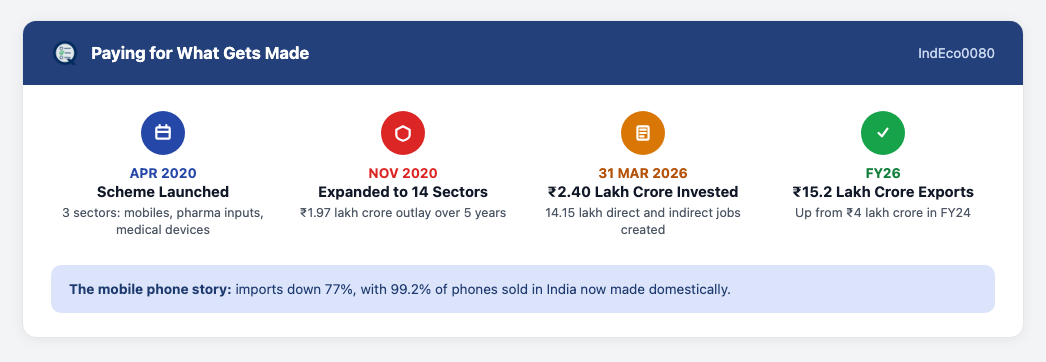
- April 2020: The PLI Scheme launches for 3 sectors: mobile manufacturing, pharmaceutical key starting materials, and medical devices.
- November 2020: The Union Cabinet expands the scheme to 14 sectors, with a total outlay of ₹1.97 lakh crore over 5 years.
- 31 March 2026: The scheme has attracted over ₹2.40 lakh crore in actual investment, generating 14.15 lakh direct and indirect jobs.
- FY26: Exports under the scheme reach ₹15.2 lakh crore, up from ₹4 lakh crore in FY24.
Must Know.
✊ Must Know
1. What the PLI Scheme pays for
- Fact The Production-Linked Incentive (PLI) Scheme launched in April 2020, paying manufacturers incentives tied to their actual production and sales growth.
2. Expanded to 14 sectors
- Fact In November 2020, the scheme was expanded to 14 sectors, with a total outlay of ₹1.97 lakh crore over 5 years.
3. Which sectors are covered
- Fact Covered sectors include mobile phones, pharmaceuticals, medical devices, automobiles, specialty steel, textiles, solar PV modules, and drones.
4. Investment and jobs so far
- Fact As of 31 March 2026, the scheme has attracted over ₹2.40 lakh crore in investment and created 14.15 lakh jobs.
Good to Know.
📘 Good to Know
1. Exports have grown sharply
- Fact PLI exports rose from ₹4 lakh crore in FY24, to ₹6.5 lakh crore in FY25, to ₹15.2 lakh crore in FY26.
2. Mobile phones: the scheme’s clearest win
- Fact Mobile phone production has grown roughly 2.4 times since launch. About 99.2% of phones sold in India are now made domestically, with imports down 77%.
3. Where the investment concentrated
- Fact The highest cumulative sector investment came from solar PV modules (₹64,873 crore), followed by pharmaceuticals and automobiles.
4. Real companies, not just headline numbers
- Fact Many local companies, and some foreign companies operating in India, have taken advantage of PLI incentives across its 14 sectors.
5. A mix of high-tech and traditional sectors
- Fact The scheme covers high-tech sectors like electronics and ACC batteries, and traditional manufacturing like textiles, food processing, and white goods.
6. Pharmaceuticals’ scale under PLI
- Fact Pharmaceuticals recorded cumulative sales of over ₹3.64 lakh crore. The scheme enabled domestic manufacture of 1,931 pharmaceutical products, including 191 first-time bulk drugs.
7. Bulk Drugs cut import dependence
- Fact In Bulk Drugs, the scheme built capacity for about 55,000 MT across 26 critical APIs, cutting import dependence for drugs like Paracetamol and Levofloxacin.
8. Medical devices and food-sector jobs
- Fact The Medical Devices PLI has commissioned 55 unique devices so far. Food Products recorded the scheme’s highest employment of any sector, at 3.29 lakh jobs.
9. ACC batteries have their own story
- See also The ACC battery sector has its own detailed story, including a fake bidder and a still-unfinished 50 GWh target. See IndEco0178 — Advanced Chemistry Cell (ACC) Battery Manufacturing in India.
Test Yourself

Great to Know.
🏆 Great to Know
1. A shift in industrial-policy design
- Analysis PLI marks a deliberate shift from protecting industry with tariffs to directly subsidising measurable output, tying government money to results.
2. Mobile phones became the template
- Fact The mobile phone transformation is the scheme’s clearest success. In July 2026, the Cabinet approved a dedicated successor, the Mobile Phone Manufacturing Scheme (MPMS), to build on it.
3. A “prove the model, then scale” rollout
- Analysis Starting with just 3 sectors and expanding to 14 within a year shows a deliberate prove-then-scale approach to the policy’s rollout.
4. Integrating into global supply chains
- Analysis Rising PLI exports, from ₹4 lakh crore to ₹15.2 lakh crore in two years, suggest the scheme is integrating Indian manufacturing into global supply chains.
5. The outlay figure has shifted slightly
- Fact Announced at ₹1.97 lakh crore in 2020, a July 2026 parliamentary reply cites ₹1.91 lakh crore as the current approved outlay. (Source: PIB)
6. An Empowered Group reviews implementation
- Fact An Empowered Group of Secretaries, chaired by the Cabinet Secretary, reviews implementation and has led to eligibility relaxations. (Source: PIB)
7. A related sector-specific PLI
- See also The PLI Scheme for Specialty Steel is one of the sector-specific programmes here. See IndEco0152 — Steel Sector in India.
Previous Year Questions.
📝 Previous Year Questions
UPSC CSP 2023, GS Paper I, Q88: India’s Export Share and the PLI Scheme
- Prelims PYQ Asked about India’s 3.2% global export-of-goods share (incorrect — that figure was actually services imports) and companies using the PLI scheme (correct).
- View this question →
Leave a Reply