In 2022, a company calling itself “Hyundai Global Motors” won a share of India’s flagship battery-manufacturing incentive. It had no real connection to Hyundai. The capacity it forfeited is only now, in 2026, finally going back out to tender.
 MCQ Questions
IndEco0178
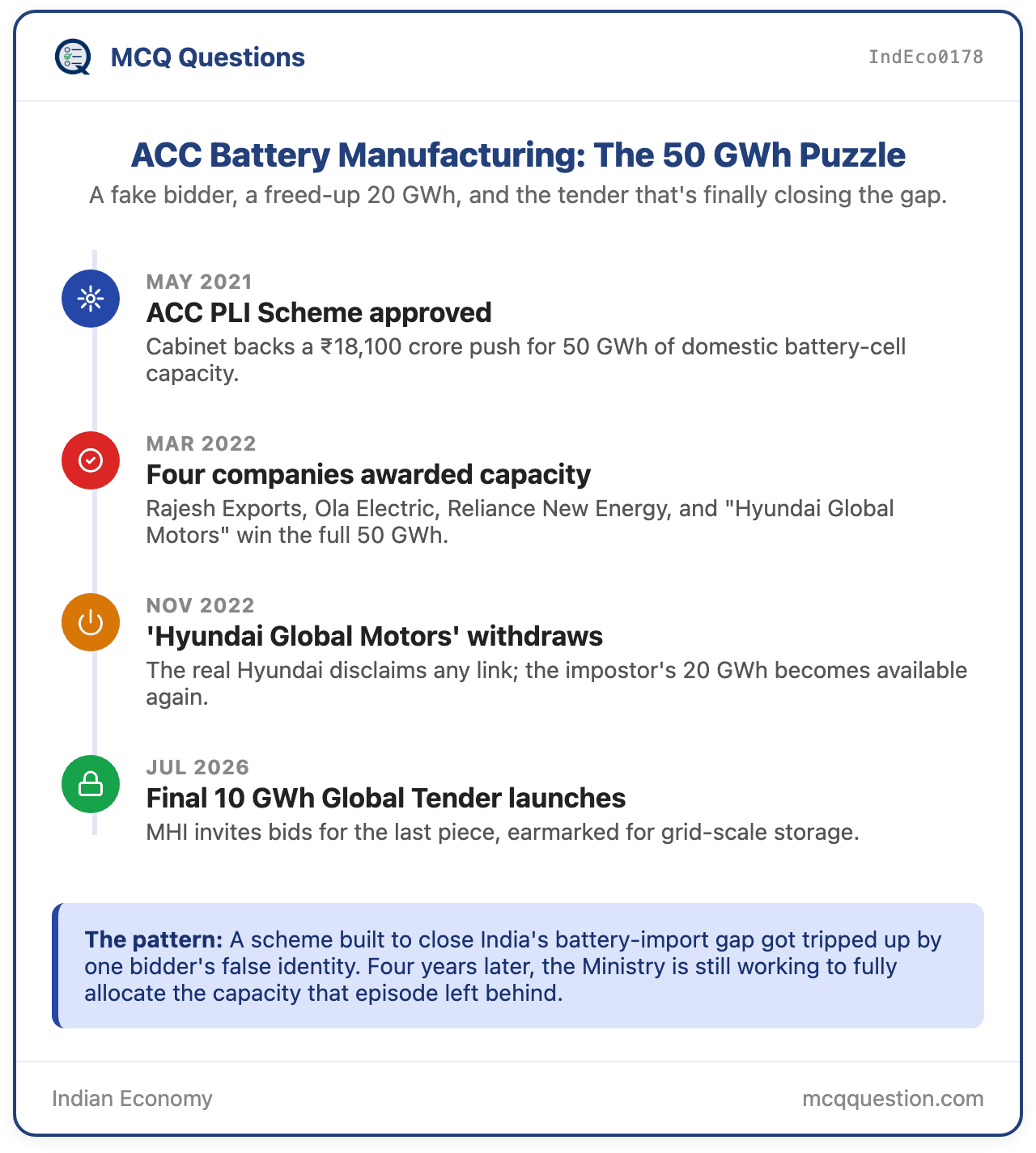
ACC Battery Manufacturing: The 50 GWh Puzzle
A fake bidder, a freed-up 20 GWh, and the tender that’s finally closing the gap.
May 2021
ACC PLI Scheme approved
Cabinet backs a ₹18,100 crore push for 50 GWh of domestic battery-cell capacity.
Mar 2022
Four companies awarded capacity
Rajesh Exports, Ola Electric, Reliance New Energy, and “Hyundai Global Motors” win the full 50 GWh.
Nov 2022
‘Hyundai Global Motors’ withdraws
The real Hyundai disclaims any link; the impostor’s 20 GWh becomes available again.
Jul 2026
Final 10 GWh Global Tender launches
MHI invites bids for the last piece, earmarked for grid-scale storage.
The pattern: A scheme built to close India’s battery-import gap got tripped up by one bidder’s false identity. Four years later, the Ministry is still working to fully allocate the capacity that episode left behind.
Indian Economymcqquestion.com
Must Know
- The Union Cabinet approved the Production Linked Incentive (PLI) Scheme for Advanced Chemistry Cell (ACC) Battery Storage in May 2021. Its outlay is ₹18,100 crore.
- The scheme targets 50 GWh of domestic ACC manufacturing capacity. It aims to cut India’s dependence on imported battery cells, mostly from China.
- The Ministry of Heavy Industries (MHI) administers the scheme. Incentives are disbursed over five years, tied to actual sales of batteries manufactured in India.
- The scheme is technology-agnostic. Beneficiary companies can choose their own cell chemistry and manufacturing technology.
- In March 2022, four companies were awarded the full 50 GWh: Rajesh Exports (5 GWh), Ola Electric Mobility (20 GWh), Reliance New Energy Solar (5 GWh), and Hyundai Global Motors (20 GWh).
- On 15 July 2026, MHI released a Global Tender for the last 10 GWh of capacity. This tranche is earmarked for Grid-Scale Stationary Storage (GSSS) applications.
- Bidding uses a two-stage Quality and Cost Based Selection (QCBS) process on the Central Public Procurement (CPP) Portal. Bids are due 13 October 2026.
Good to Know
- “Hyundai Global Motors,” awarded 20 GWh in 2022, had no real connection to Hyundai Motor Company. The genuine Hyundai publicly disclaimed the firm in August 2022.
- Hyundai Global Motors voluntarily withdrew from the scheme that November. Its 20 GWh became available for reallocation.
- Of that freed capacity, Reliance New Energy Solar later received an additional 10 GWh, taking its total award to 15 GWh. The remaining 10 GWh was set aside for grid-scale storage, at the request of the Ministry of New and Renewable Energy (MNRE).
- As of July 2026, 40 GWh of the original 50 GWh target had been awarded to domestic manufacturers. This new tender covers the remaining 10 GWh.
- The scheme is expected to draw around ₹45,000 crore in direct investment. It could also help save ₹2,00,000 to ₹2,50,000 crore on India’s oil import bill, through EV adoption over the scheme’s life.
- The ACC PLI scheme runs alongside the PLI Scheme for Automobile and Auto Components (₹25,938 crore) and the FAME scheme (₹10,000 crore). Together, they support India’s shift to electric vehicles.
- Progress has lagged behind the original targets. As of October 2025, independent analysis found only about 2.8% of the target capacity, roughly 1.4 GWh, had actually been commissioned, entirely by Ola Electric.
Test Yourself

Great to Know
- The Hyundai Global Motors episode is a real case study in tender due diligence. A bidder can clear a competitive government screening process and still misrepresent its own identity.
- “Awarded” capacity and “commissioned” capacity are different things worth telling apart. A company can be allotted GWh on paper years before any of it is actually built and running.
- This article covers one specific tranche of a much larger programme. For the PLI Scheme’s broader architecture across all sectors, see IndEco0080 — Production-Linked Incentive (PLI) Scheme.
- The 10 GWh Grid-Scale Stationary Storage tranche reflects a wider shift in priorities. As India’s renewable energy share grows, storing that power matters as much as powering electric vehicles.
- ACC manufacturing scales up existing lithium-ion chemistry. India’s research labs are also exploring newer chemistries. See Zinc-Air Battery Technology Research for CSIR’s work on a cheaper, safer alternative.
Current Affairs
- On 17 July 2026, DST-affiliated researchers unveiled an ultrafast organic anode material for next-generation batteries. It reached 80% charge in just over one minute, while holding up well over repeated charge cycles. (Source: PIB)
- The material, a covalent organic framework (COF), came from a joint team at IACS and the S.N. Bose National Centre for Basic Sciences, led by Dr. Urmimala Maitra and Dr. Pradip Pachfule. (Source: PIB)
- The same COF material can also store sodium ions, not just lithium. This opens a path toward cheaper sodium-ion batteries, alongside faster-charging lithium-ion cells. (Source: PIB)
- On 29 July 2026, MHI held the pre-bid conference for the 10 GWh ACC Grid-Scale Stationary Storage tender, at India Habitat Centre, New Delhi. More than 30 prospective bidders attended, alongside NITI Aayog, MNRE, and the Ministry of Power. (Source: PIB)
- Bidders’ last date to submit further queries by email is 20 August 2026. (Source: PIB)
- 15 July 2026: The Ministry of Heavy Industries released a Global Tender inviting bids for the final 10 GWh of ACC manufacturing capacity, earmarked for Grid-Scale Stationary Storage. (Source: PIB)
- 15 July 2026: Tender documents became available the same day. The pre-bid conference is set for 29 July 2026, with bids due 13 October and technical bids opening 14 October. (Source: PIB)
- 15 July 2026: The same release confirmed that 40 GWh of the scheme’s original 50 GWh target has been awarded to domestic manufacturers to date. (Source: PIB)
Beyond the answer
Browse all indian-economy topics →
📚 Keep reading
IndEco0119 — Electric Vehicles in IndiaIndEco0210 — Renewable Energy in IndiaIndEco0212 — E-Rickshaws in India: Battery Management and RegulationSciTech0158 — Types of UAVs: Fixed-Wing, Rotary-Wing and Hybrid Drones ExplainedIndEco0007 — Money and Banking❓ Practice this topic
Atal Innovation Mission is set up under theD0231 — Which statement about India's fisheries sector is correct?D0230 — Why is the Rann of Kutch important for non-farm primary activity?D0229 — Which pairing of a non-farm primary activity with its physiographic setting is correct?🎲 Take a Indian Economy Quiz
Leave a Reply