In July 2026, the government discovered something alarming: mobile apps that could remotely switch off an e-rickshaw’s battery, mid-ride, from anywhere. It ordered them pulled from every app store. The episode exposed a regulatory story that goes back over a decade — from a total ban to a mandatory safety standard.
 MCQ Questions
IndEco0212
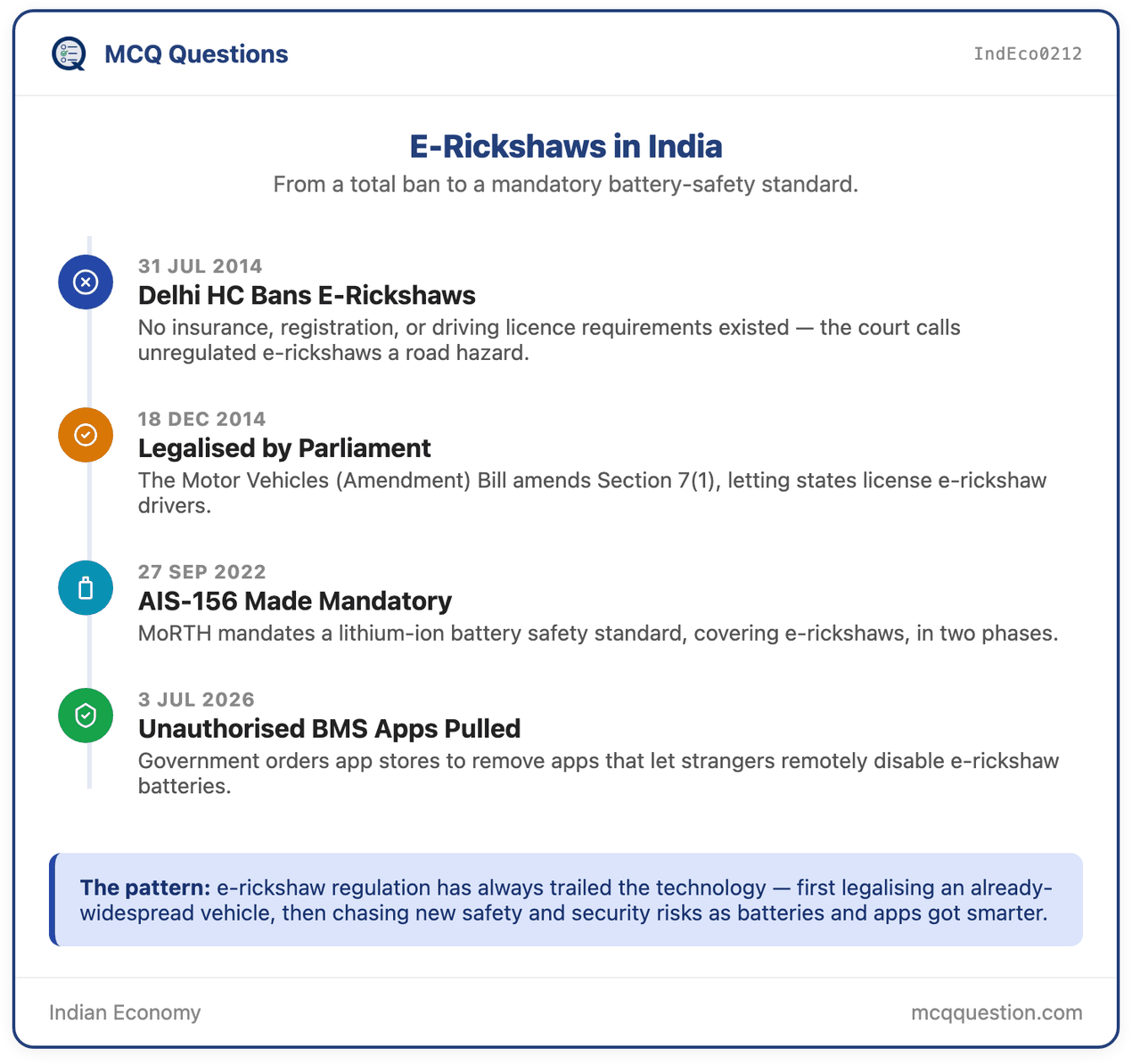
E-Rickshaws in India
From a total ban to a mandatory battery-safety standard.
31 JUL 2014
Delhi HC Bans E-Rickshaws
No insurance, registration, or driving licence requirements existed — the court calls unregulated e-rickshaws a road hazard.
18 DEC 2014
Legalised by Parliament
The Motor Vehicles (Amendment) Bill amends Section 7(1), letting states license e-rickshaw drivers.
27 SEP 2022
AIS-156 Made Mandatory
MoRTH mandates a lithium-ion battery safety standard, covering e-rickshaws, in two phases.
3 JUL 2026
Unauthorised BMS Apps Pulled
Government orders app stores to remove apps that let strangers remotely disable e-rickshaw batteries.
The pattern: e-rickshaw regulation has always trailed the technology — first legalising an already-widespread vehicle, then chasing new safety and security risks as batteries and apps got smarter.
Indian Economymcqquestion.com
Timeline
- 31 July 2014: The Delhi High Court bans e-rickshaws in the capital. It cites the lack of insurance, registration, or driver licensing as a road-safety hazard.
- 18 December 2014: The Lok Sabha passes the Motor Vehicles (Amendment) Bill, 2014. It amends Section 7(1) of the Motor Vehicles Act, 1988, letting states license e-rickshaw and e-cart drivers.
- 27 September 2022: The Ministry of Road Transport and Highways (MoRTH) mandates AIS-156, a lithium-ion battery safety standard covering e-rickshaws, in two phases.
- 3 July 2026: The government orders app stores to remove unauthorised Battery Management System (BMS) apps, after reports of remote, unauthorised battery shutdowns.
Must Know
- E-rickshaws are battery-powered three-wheelers. They fall under the L5M vehicle category, alongside e-carts, under India’s Motor Vehicles Rules.
- The Delhi High Court banned e-rickshaws on 31 July 2014. At the time, no law covered their registration, insurance, or driver licensing.
- Parliament legalised them soon after. The Motor Vehicles (Amendment) Bill, 2014, passed on 18 December 2014, amended Section 7(1) of the Motor Vehicles Act, 1988.
- India had about 18.1 lakh registered e-rickshaws nationwide, as of November 2024 — one of the country’s largest electric-vehicle categories by sheer volume.
- Battery safety is now governed by AIS-156, an Automotive Industry Standard covering lithium-ion traction batteries. It became mandatory in two phases, from December 2022 and March 2023.
- AIS-156 requires a microprocessor-based Battery Management System (BMS), with cell-level protections, thermal-runaway testing, and RFID-based traceability.
Good to Know
- Government support for e-rickshaws runs through three successive schemes. FAME I (2015-2019) came first, followed by FAME II (2019-2024), which gave 5 lakh e-rickshaws a ₹50,000 incentive each.
- The current scheme, PM E-DRIVE, covers e-rickshaws under its L5M category. It offers ₹25,000 in the first year and ₹12,500 in the second, calculated at ₹5,000 per kWh of battery capacity.
- PM E-DRIVE’s window for registered e-rickshaws and e-carts runs until 31 March 2028 — a longer runway than the scheme gives other electric three-wheeler categories.
- See IndEco0119 — Electric Vehicles in India for the broader EV policy picture, including PM E-DRIVE’s coverage of cars, buses, and two-wheelers.
- A Battery Management System (BMS) protects a lithium-ion pack from overcharging, overheating, and short circuits. It is the same component that unauthorised apps exploited to disable batteries remotely.
Test Yourself

Great to Know
- E-rickshaws show a recurring regulatory pattern in India. A cheap, informally adopted technology spreads first; formal regulation, safety standards, and enforcement follow only once problems surface.
- The 2026 BMS-app episode extended cybersecurity concerns to everyday consumer hardware, not just critical infrastructure. Agencies built for large-scale threats, like CERT-In and the National Cyber Coordination Centre, are now also policing battery apps for three-wheelers.
- A related CERT-In finding flagged a Bluetooth vulnerability in some low-cost e-rickshaw BMS units, where default or missing credentials let unauthorised users connect and cut power remotely. See IndEco0119 for that specific advisory.
- Regulating e-rickshaws carries a livelihood dimension too. Most drivers are low-income operators, so safety rules need enforcement that does not simply push informal, unregistered vehicles further underground.
Current Affairs
- On 3 July 2026, the government ordered the removal of unauthorised Battery Management System (BMS) apps from app stores. These apps had enabled unauthorised remote control of e-rickshaw batteries. (Source: PIB)
- On 22 July 2026, the Ministry of Electronics and IT detailed this within a broader integrated cybersecurity framework, in a Lok Sabha reply. The framework coordinates threat response across several dedicated agencies. (Source: PIB)
- This includes the National Cyber Security Coordinator (NCSC), CERT-In (the national incident-response agency under Section 70B of the IT Act, 2000), and the National Cyber Coordination Centre (NCCC), which detects and shares cyberspace threats. (Source: PIB)
- It also includes the National Critical Information Infrastructure Protection Centre (NCIIPC), under Section 70A of the IT Act. The Consumer Protection Act, 2019, and MeitY’s Information Security Education and Awareness (ISEA) project round out the framework. (Source: PIB)
Beyond the answer
Browse all indian-economy topics →
📚 Keep reading
UPSC CSP 2025 — General Studies Paper I (Full Question Paper)UPSC CSP 2026 — General Studies Paper I (Full Question Paper)UPSC CSP 2024 — General Studies Paper I (Full Question Paper)UPSC CSP 2023 — General Studies Paper I (Full Question Paper)IndEco0119 — Electric Vehicles in India❓ Practice this topic
Atal Innovation Mission is set up under theD0231 — Which statement about India's fisheries sector is correct?D0230 — Why is the Rann of Kutch important for non-farm primary activity?D0229 — Which pairing of a non-farm primary activity with its physiographic setting is correct?🎲 Take a Indian Economy Quiz
Leave a Reply