A mango farmer’s son, taught in a Tamil-medium government school, went on to lead India’s space programme. K. Sivan spent decades building rocket engines before the world watched him, as ISRO Chairman, react live as Chandrayaan-2’s lander went silent just short of the Moon.
 MCQ Questions
SciTech0095
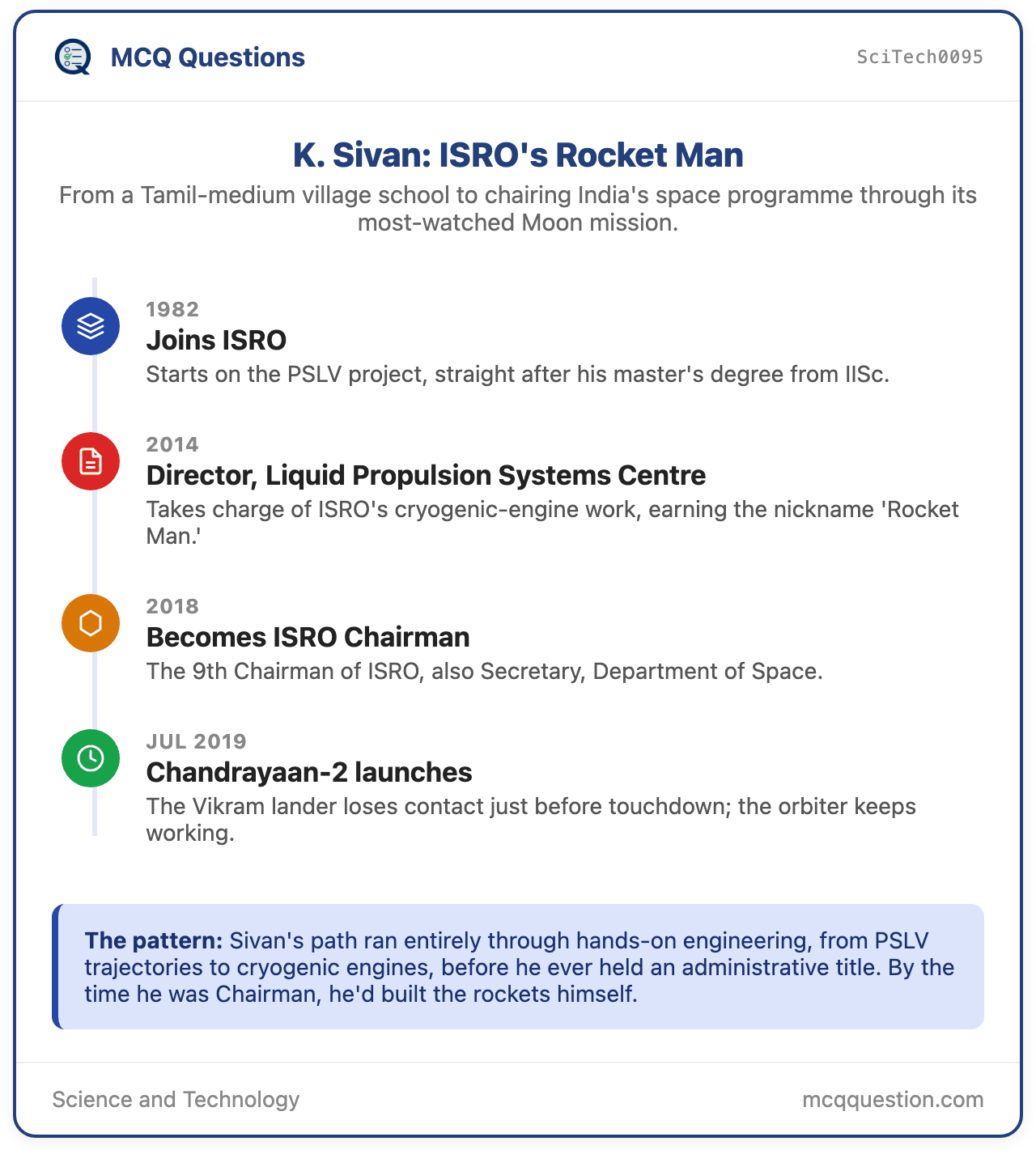
K. Sivan: ISRO‘s Rocket Man
From a Tamil-medium village school to chairing India’s space programme through its most-watched Moon mission.
1982
Joins ISRO
Starts on the PSLV project, straight after his master’s degree from IISc.
2014
Director, Liquid Propulsion Systems Centre
Takes charge of ISRO’s cryogenic-engine work, earning the nickname ‘Rocket Man.’
2018
Becomes ISRO Chairman
The 9th Chairman of ISRO, also Secretary, Department of Space.
Jul 2019
Chandrayaan-2 launches
The Vikram lander loses contact just before touchdown; the orbiter keeps working.
The pattern: Sivan’s path ran entirely through hands-on engineering, from PSLV trajectories to cryogenic engines, before he ever held an administrative title. By the time he was Chairman, he’d built the rockets himself.
Science and Technologymcqquestion.com
Must Know
- Kailasavadivu Sivan was born on 14 April 1957, in Sarakkalvilai, Kanyakumari district, Tamil Nadu. He was the first graduate in his family.
- He earned a B.Tech in Aeronautical Engineering from Madras Institute of Technology in 1980, and a Master’s in Aerospace Engineering from IISc Bangalore in 1982.
- Sivan joined ISRO in 1982, working on the Polar Satellite Launch Vehicle (PSLV) project. He earned a PhD in Aerospace Engineering from IIT Bombay in 2006.
- He was appointed Director of ISRO’s Liquid Propulsion Systems Centre in July 2014, and Director of the Vikram Sarabhai Space Centre (VSSC) in June 2015.
- Sivan became the 9th Chairman of ISRO, taking office on 15 January 2018. He also served as Secretary, Department of Space, and Chairman of the Space Commission.
- Under his chairmanship, ISRO launched Chandrayaan-2 on 22 July 2019. The Vikram lander and Pragyan rover lost contact during descent, though the orbiter continued functioning.
- His term was extended by a year in December 2020, and he served as ISRO Chairman until 14 January 2022, when S. Somanath succeeded him.
Good to Know
- Sivan grew up as the son of a mango farmer, and studied in a Tamil-medium government school in his village before going on to engineering college.
- He played a major role in reviving ISRO’s GSLV programme, and led development of SITARA, a 6D trajectory simulation software still used at ISRO.
- His work on cryogenic engine technology, essential for launching heavier payloads, earned him the nickname “Rocket Man.”
- In February 2017, while Sivan was VSSC Director, ISRO set a world record by launching 104 satellites on a single PSLV rocket.
- He received the Dr. A.P.J. Abdul Kalam Award in 2019, and the IEEE Simon Ramo Medal (shared with B.N. Suresh) in 2020.
- Sathyabama University, Chennai, conferred an honorary Doctor of Science on him in 2014.
- He is a Fellow of the Indian National Academy of Engineering, the Aeronautical Society of India, and the Systems Society of India.
- After leaving ISRO, Sivan was appointed Chairman of the Board of Governors at IIT Indore, in August 2023.
Test Yourself

Great to Know
- Sivan’s entire path to the top ran through hands-on engineering roles, not administration. By the time he became Chairman, he had personally worked on trajectory design, propulsion systems, and cryogenic engines.
- Chandrayaan-2’s partial setback didn’t end India’s lunar ambitions. The lessons from Vikram’s loss of contact directly shaped Chandrayaan-3, which achieved a successful soft landing under his successor, S. Somanath, in 2023.
- Sivan’s rise, from a Tamil-medium village school to leading India’s space agency, mirrors a broader pattern among India’s scientist-administrators. See SciTech0076 — U.R. Rao: Father of India’s Satellite Programme, another ISRO leader who rose through hands-on research rather than administrative rank alone.
- His move to chair IIT Indore’s Board of Governors after ISRO reflects a common pattern for retired Indian scientist-administrators: continuing to shape institutions, just in a different sector.
Beyond the answer
Browse all science-and-technology topics →
📚 Keep reading
SciTech0083 — ISRO (Indian Space Research Organisation)SciTech0076 — U.R. Rao: Father of India's Satellite ProgrammeSciTech0106 — Skyroot Aerospace and Vikram-1ModHist0317 — Mysorean RocketsSciTech0007 — India's Space Programme❓ Practice this topic
What does India's National Viral Hepatitis Control Programme aim to achieve by 2030?According to WHO, how does viral hepatitis's global death toll compare to HIV/AIDS?What can now cure most Hepatitis C infections, even without a vaccine?Since when has a Hepatitis B vaccine existed?🎲 Take a Science And Technology Quiz
Leave a Reply