In 2018, two engineers quit safe jobs at ISRO to build India’s first private rocket company. On 18 July 2026, their rocket reached orbit.
 mcqquestion.com
Science & Technology · SciTech0106
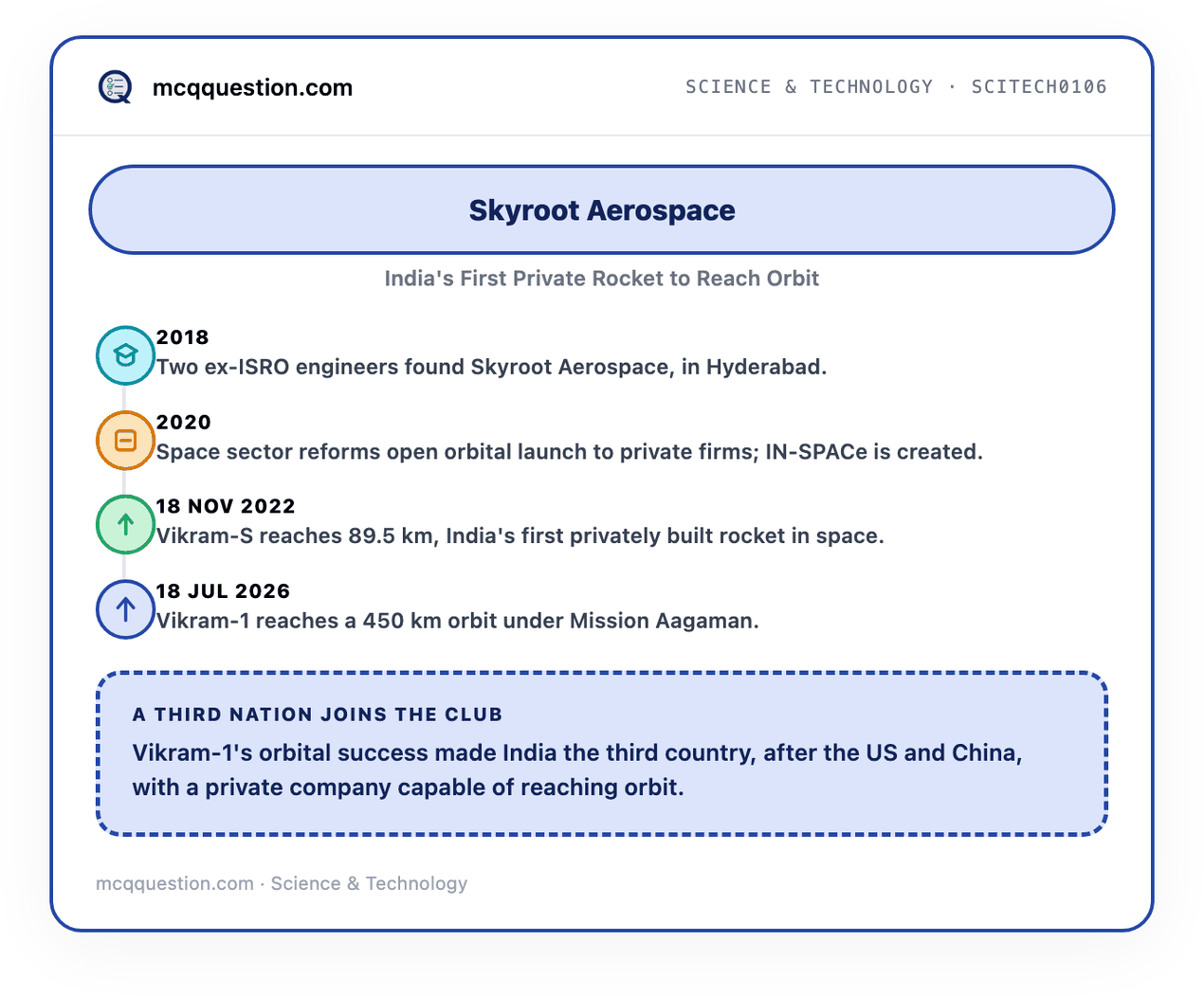
Skyroot Aerospace
India’s First Private Rocket to Reach Orbit
2018
Two ex-ISRO engineers found Skyroot Aerospace, in Hyderabad.
2020
Space sector reforms open orbital launch to private firms; IN-SPACe is created.
18 Nov 2022
Vikram-S reaches 89.5 km, India’s first privately built rocket in space.
18 Jul 2026
Vikram-1 reaches a 450 km orbit under Mission Aagaman.
A Third Nation Joins the Club
Vikram-1’s orbital success made India the third country, after the US and China, with a private company capable of reaching orbit.
Must Know
- Skyroot Aerospace is a private Indian space company, founded in 2018 and based in Hyderabad.
- It was founded by Pawan Kumar Chandana and Naga Bharath Daka, both former ISRO engineers and IIT alumni.
- On 18 July 2026, Skyroot’s Vikram-1 rocket reached orbit. This made Skyroot the first private Indian company to launch a rocket into orbit from Indian soil.
- The launch also made India the third country, after the United States and China, with a private company capable of reaching orbit.
- Vikram-1 is named after Vikram Sarabhai, widely regarded as the father of India’s space programme.
Good to Know
- Skyroot’s rise followed the Indian government’s 2020 space sector reforms. These reforms opened orbital launch and rocket manufacturing to private companies, not just ISRO.
- The reforms also created IN-SPACe (Indian National Space Promotion and Authorisation Centre). It acts as a single-window regulator, giving private firms access to ISRO’s facilities and expertise.
- Skyroot first proved its technology with Vikram-S, a smaller suborbital rocket. Vikram-S launched on 18 November 2022, under Mission Prarambh, reaching 89.5 km before splashing down in the Bay of Bengal.
- Vikram-S was India’s first privately built rocket to reach space. It validated flight avionics and other technologies later used in Vikram-1.
- In June 2025, former ISRO Chairman S. Somanath joined Skyroot as its Honorary Chief Technical Advisor. Somanath had led ISRO’s Chandrayaan-3 and Aditya-L1 missions.
Test Yourself

Great to Know
- Vikram-1 is a four-stage rocket, about 22 metres tall. Its first three stages use solid fuel, and a final liquid-fuelled stage handles precise orbital adjustment.
- It is designed to carry payloads of up to 350 kg into low-Earth orbit.
- On 27 November 2025, Prime Minister Narendra Modi inaugurated Skyroot’s “Infinity Campus” in Hyderabad by video conference. He also unveiled the Vikram-1 rocket at the same event.
- The Infinity Campus spans about 200,000 square feet. It is built to design, integrate, and test multiple launch vehicles, with capacity to produce one orbital rocket a month.
- In May 2026, Skyroot became a space-sector unicorn, valued at about $1.1 billion. A $60 million funding round took its total funding past $160 million, from investors including Sherpalo Ventures and Singapore’s sovereign wealth fund.
Current Affairs
- 27 July 2026: Prime Minister Narendra Modi met Skyroot Aerospace co-founders Pawan Chandana and Naga Bharath Daka for what he called “a great interaction.” Vikram-1’s success featured prominently in their discussion, alongside the company’s future plans. He said their “energy, ambition and positivity reflect the vibrant spirit” of India’s private space ecosystem. (Source: PMO).
- 19 July 2026: The Technology Development Board (TDB), under the DST, congratulated Skyroot on Vikram-1’s success. It called the mission “a watershed moment” for India’s private space sector. TDB Secretary Rajesh Kumar Pathak said the journey validated “the strength of India’s innovation ecosystem.” (Source: PIB)
- TDB had recognised Skyroot early, through the National Technology Start-up Award 2022. Dr. Jitendra Singh presented it during National Technology Day, for Skyroot’s indigenous cryogenic, liquid, and solid propulsion technologies. Skyroot has also proposed a new project to TDB’s Research, Development and Innovation (RDI) Fund, still under consideration. (Source: PIB)
- Vikram-1 lifted off on 18 July 2026, from ISRO’s First Launch Pad at the Satish Dhawan Space Centre, Sriharikota. This mission was named “Mission Aagaman.”
- The rocket reached a 450 km orbit about 15 minutes after liftoff.
- Mission Aagaman carried Skyroot’s own SCOPE technology demonstrator, along with customer payloads from Grahaa Space, Cosmoserve, and DCubed.
- Officials called the launch proof that India’s 2020 space sector reforms had succeeded, strengthening India’s standing as a global space player.
- Skyroot has said it plans another test flight later in 2026, before moving toward regular commercial launches from 2027. A larger vehicle, Vikram-2, is expected in 2027, designed to carry up to 900 kg to low-Earth orbit.
Leave a Reply