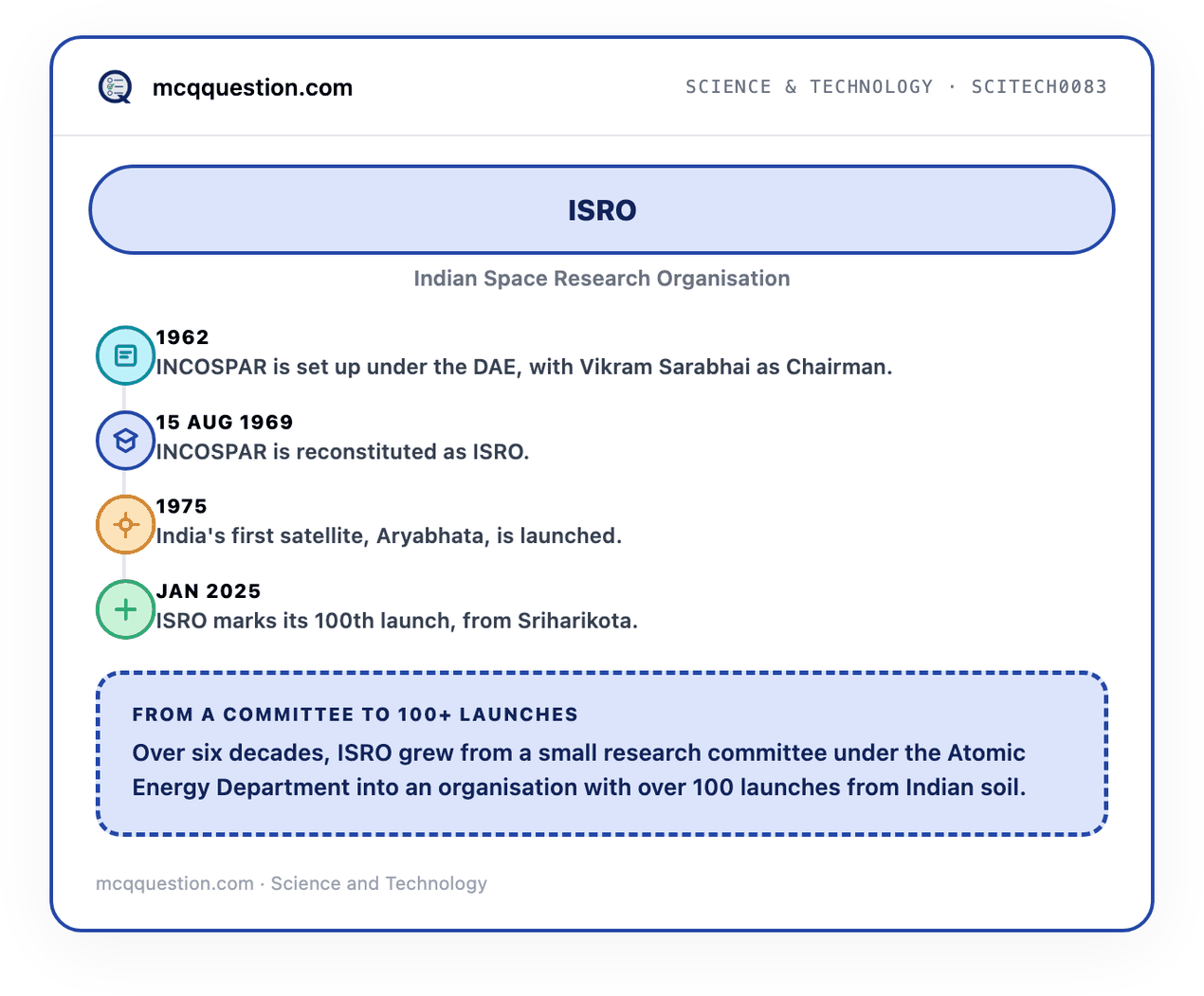
ISRO, the Indian Space Research Organisation, is the government body that runs India’s space programme. It grew from a small research committee in 1962 into an organisation that has crossed 100 launches from Indian soil.
 mcqquestion.com
Science & Technology · SciTech0083
ISRO
Indian Space Research Organisation
1962
INCOSPAR is set up under the DAE, with Vikram Sarabhai as Chairman.
15 Aug 1969
INCOSPAR is reconstituted as ISRO.
1975
India’s first satellite, Aryabhata, is launched.
Jan 2025
ISRO marks its 100th launch, from Sriharikota.
From a Committee to 100+ Launches
Over six decades, ISRO grew from a small research committee under the Atomic Energy Department into an organisation with over 100 launches from Indian soil.
Must Know
- ISRO traces its origins to 1962, when the Indian National Committee for Space Research (INCOSPAR) was set up, under the Department of Atomic Energy.
- Vikram Sarabhai, its first chairman, is widely regarded as the father of India’s space programme.
- INCOSPAR was reconstituted as the Indian Space Research Organisation (ISRO), on 15 August 1969.
- The Department of Space (DOS) was created in 1972. ISRO has functioned under it ever since. DOS reports directly to the Prime Minister.
- ISRO is headquartered in Bengaluru.
- Its major centres include the Vikram Sarabhai Space Centre (VSSC), in Thiruvananthapuram, which develops launch vehicles.
- Another key centre is the U R Rao Satellite Centre (URSC), in Bengaluru, which builds satellites.
- The Satish Dhawan Space Centre (SDSC), at Sriharikota, is India’s main spaceport, and its third major centre.
- Beyond these three, ISRO also runs specialised regional centres. NESAC, at Umiam, Meghalaya, applies space technology specifically to the Northeast.
- Dr. V. Narayanan has served as ISRO Chairman and DOS Secretary, since January 2025.
- ISRO’s programmes include its own satellite launch vehicles, the PSLV and GSLV. It also runs the INSAT and IRS satellite series, and India’s Moon and Mars missions.
Good to Know
- ISRO developed India’s first satellite, Aryabhata, launched in 1975.
- ISRO also launches satellites for other countries, through its commercial arm, NewSpace India Limited (NSIL).
- ISRO collaborates internationally too. Its NISAR mission, a joint radar satellite built with NASA, launched in July 2025.
- ISRO is also developing India’s own human spaceflight programme, Gaganyaan. It is also building a planned space station, the Bharatiya Antariksh Station.
- ISRO also operates ASTROSAT, India’s first dedicated multi-wavelength space astronomy observatory, launched in 2015.
Test Yourself

Great to Know
- ISRO marked its 100th launch from Sriharikota, in January 2025. The mission, GSLV-F15, carried the NVS-02 navigation satellite.
- Several other figures central to ISRO’s story have their own dedicated profiles on this site, including U.R. Rao, Rakesh Sharma, and Nambi Narayanan.
Current Affairs
- As of August 2026, ISRO has not conducted a rocket launch since 12 January 2026 — a gap of more than six months. (Source: Government of India, All India Radio News)
- The pause followed a failure of the PSLV-C62 rocket, on 12 January 2026, during its EOS-N1 mission. The rocket failed to place its satellites into orbit. (Source: Government of India, All India Radio News, 12 Jan 2026)
- ISRO Chairman Dr. V. Narayanan said a “slightly higher disturbance in the vehicle’s roll rates was observed, followed by a deviation in the flight path,” near the end of the rocket’s third stage. (Source: Government of India, All India Radio News, 12 Jan 2026)
- During this pause, ISRO has focused heavily on its Gaganyaan human spaceflight programme. Its first uncrewed test flight is targeted for later in 2026.
- During this same pause, India’s launch capability still advanced. On 18 July 2026, Skyroot Aerospace’s Vikram-1 lifted off from ISRO’s own First Launch Pad at Sriharikota, becoming the first privately built Indian rocket to reach orbit.
Leave a Reply