
_-_Liftoff_from_First_Launch_Pad_of_Satish_Dhawan_Space_Centre,_Sriharikota_003.jpg)
A launch vehicle is the rocket that carries a satellite into space. This article explains India's four rockets and the facts exams ask about them. It also fixes some counts that older notes get wrong.
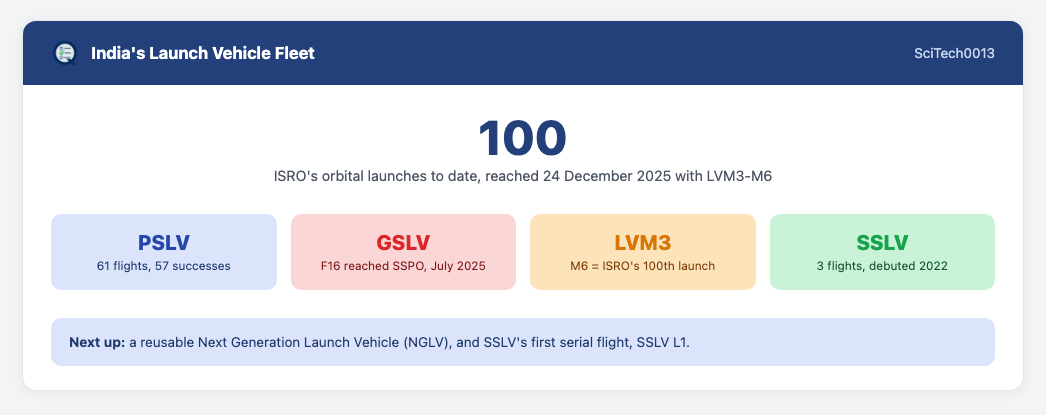
- PSLV: four stages. India’s workhorse for polar and Sun-synchronous orbits.
- GSLV Mk II: three stages and a cryogenic top stage. Built for GTO.
- LVM3: three stages. India’s biggest launcher, with 640 t at lift-off and 4,000 kg to GTO.
- SSLV: three solid stages. Built for small satellites on demand.
- Launch count: GSLV-F15 was the 100th launch. LVM3-M6 was the 104th.
Download the launch vehicles graphic
Contents
1. What is a launch vehicle, and why does it have stages?
A satellite cannot fly itself into space. A rocket has to carry it up and give it speed. That rocket is called a launch vehicle.
India flies four of them today. They are the PSLV, the GSLV, the LVM3 and the SSLV. Each one has a different job. This article explains what each one does and which exam facts matter.
1.1 What does a launch vehicle do?
A launch vehicle has two jobs. First, it pushes the satellite up through the thick air. Second, it gives the satellite a big sideways push.
The sideways push matters most. A satellite stays up because it moves very fast around the Earth. ESA says a launcher must pass through the atmosphere and then provide the horizontal velocity push needed to get into orbit.
The choice of rocket depends mainly on the weight of the satellite. It also depends on how far from Earth the satellite must go. A heavy or high-flying satellite needs a more powerful rocket.
1.2 Why does a rocket drop its stages?
Most of a rocket’s weight is fuel and the tanks that hold it. Once a tank is empty, it is only dead weight. So the rocket drops it.
Each dropped part is called a stage. NASA explains it simply. When a lower stage has used its propellant, the whole stage falls away. This makes the upper stages more efficient in reaching high altitudes.
Think of a relay race. Each runner does one part of the race and then hands over. The rocket does the same with its stages.
- First stage: gives the huge push needed for lift-off.
- Middle stages: keep adding speed in thinner air.
- Last stage: places the satellite into its exact orbit.
1.3 What are solid, liquid and cryogenic stages?
Stages differ in the fuel they burn. Exams ask about this, so learn the three types.
- Solid stage: the fuel is a hard rubbery block called HTPB. It is simple and gives a strong push.
- Liquid stage: the fuel and the oxidiser are liquids kept in tanks. ISRO’s Vikas engine burns UH25 or UDMH with nitrogen tetroxide.
- Cryogenic stage: the fuel is liquid hydrogen and the oxidiser is liquid oxygen. Both are kept very cold. This pair gives a very strong push for each kilogram of fuel.
ISRO’s cryogenic stages in the GSLV and LVM3 burn liquid oxygen with liquid hydrogen. Sections 4 and 5 cover their history.
1.4 Which launch vehicles does India fly today?
PIB says India can now launch satellites up to 10 tonnes to Low Earth Orbit and 4 tonnes to Geosynchronous Transfer Orbit. It does this with the PSLV, GSLV, LVM3 and SSLV.
The numbers below come from ISRO’s own vehicle pages. Learn the pattern, not every digit.
- PSLV: four stages. About 1,750 kg to a 600 km Sun-synchronous orbit.
- GSLV Mk II: three stages with four liquid strap-ons. About 2,250 kg to GTO.
- LVM3: three stages with two solid strap-ons. About 4,000 kg to GTO and 8,000 kg to LEO.
- SSLV: three solid stages and a liquid trimming module. Up to 500 kg to a 500 km orbit.
2. Which orbits do Indian rockets aim for?
An orbit is the curved path a satellite follows around the Earth. Different jobs need different orbits. A rocket is built for the orbits its customers want.
2.1 What is Low Earth Orbit?
Low Earth Orbit, or LEO, is the zone close to the Earth. ESA says it lies below about 2,000 km. Satellites usually do not fly below about 180 km, because the thin air still slows them down.
Satellites in LEO move at about 7.8 km per second. They circle the Earth in about 90 minutes. The International Space Station is here. Camera satellites like LEO because they see fine detail from close by.
ISRO’s LVM3 carried the BlueBird Block-2 satellite to LEO in December 2025. The OneWeb satellites went to a circular orbit 450 km high.
2.2 What is a polar or Sun-synchronous orbit?
A polar orbit goes roughly from pole to pole. As the Earth turns below, the satellite sees every part of the planet in time. ESA says polar orbits are usually between 200 and 1,000 km high.
A Sun-synchronous orbit is a special polar orbit. The satellite passes over the same place at the same local time every day. That keeps the light the same, which is good for comparing pictures.
The PSLV was designed for this orbit. ISRO’s GSLV-F16 put NISAR into a Sun-synchronous orbit 743 km high, tilted at 98.4 degrees. ISRO calls it SSPO, short for Sun-Synchronous Polar Orbit.
2.3 What are GTO and the geostationary orbit?
A geostationary orbit is very high, at 35,786 km. It lies above the equator. A satellite there takes 23 hours 56 minutes and 4 seconds to go round, which matches the Earth’s spin. So it seems to hang over one spot.
Rockets rarely carry a satellite all the way. ESA explains that the rocket drops it into a Geostationary Transfer Orbit, or GTO. This is a stretched oval path that works like a shortcut. The satellite then fires its own engine to reach the final circle.
This is why communication satellites need the GSLV or the LVM3. Their GTO payload numbers are the figures to remember.
Explain it back: why does a rocket need a sideways push, not just height?
Speed keeps a satellite up, because it moves very fast around the Earth. Height alone would let it fall back. The rocket must give it that sideways speed.
3. PSLV: India’s workhorse
PSLV stands for Polar Satellite Launch Vehicle. ISRO calls it the workhorse of its fleet. It is India’s third-generation launch vehicle. It was also the first Indian launch vehicle with liquid stages.
3.1 How is PSLV built?
PSLV has four stages. The fuels alternate: solid, liquid, solid, liquid. This pattern is a favourite exam question.
- PS1: a large solid motor called S139, with about 139 tonnes of HTPB fuel.
- PS2: a liquid stage with one Vikas engine, using UDMH and nitrogen tetroxide.
- PS3: a solid stage, also using HTPB.
- PS4: a liquid stage with two small engines.
The rocket stands about 44 metres tall and is 2.8 metres wide. ISRO lists the heaviest version, the XL, at about 320 tonnes at lift-off. It can carry about 1,750 kg to a 600 km Sun-synchronous orbit. Its first flight was on 20 September 1993.
3.2 What are the PSLV variants?
ISRO adds or removes small solid boosters, called strap-ons, to change the power. The names are easy to learn by counting boosters.
- PSLV-XL: six strap-ons.
- PSLV-QL: four strap-ons.
- PSLV-DL: two strap-ons.
- PSLV-CA: no strap-ons, the core alone.
PSLV-C62 flew as a DL. PSLV-C61 flew as an XL.
3.3 Which famous missions did PSLV fly?
PSLV carried some of India’s best-known satellites. Learn the vehicle and the date together.
- Chandrayaan-1: PSLV-C11, 22 October 2008.
- Mars Orbiter Mission (Mangalyaan): PSLV-C25, 5 November 2013.
- AstroSat: PSLV-C30, 28 September 2015.
- Aditya-L1: PSLV-C57, 2 September 2023.
PSLV-C37 launched Cartosat-2 and 103 co-passenger satellites in 2017. ISRO’s list dates that flight to 15 February 2017.
3.4 How many times has PSLV flown, and how often has it failed?
ISRO’s list shows 64 PSLV flights up to PSLV-C62 on 12 January 2026. Older notes say 61 flights and three failures. That total of 61 flights was right at the end of 2024. The 61st flight was PSLV-C59 on 5 December 2024.
Three more flights followed. PSLV-C60 flew SpaDeX on 30 December 2024. PSLV-C61 flew on 18 May 2025. PSLV-C62 flew on 12 January 2026.
ISRO’s list marks three PSLV flights as unsuccessful. They are D1 (1993), C39 (2017) and C61 (2025). On C61, ISRO said an observation in the third stage stopped the mission. On C62, ISRO reported an anomaly near the end of the PS3 stage, and PIB calls it a failure. So four flights did not complete their mission.
On 1 April 2026, PIB reported that a national-level expert committee was reviewing the PSLV anomaly. It said PSLV will return to flight after corrective action. So PSLV is still the workhorse. It was grounded for corrective action in 2026 (PIB, 1 April).
4. GSLV Mk II and the cryogenic stage
GSLV stands for Geosynchronous Satellite Launch Vehicle. It was built to place heavier communication satellites into GTO. Its main users are the INSAT class of satellites.
4.1 How is GSLV Mk II built?
GSLV Mk II has three stages and four liquid strap-ons. ISRO calls it a three-stage vehicle with four liquid strap-ons.
- First stage: an S139 solid motor derived from PSLV’s first stage. ISRO lists 138 t for GSLV and 139 t for PSLV. It has four liquid strap-ons. Each strap-on has one Vikas engine.
- Second stage: one Vikas engine. ISRO says it was derived from PSLV’s second stage.
- Third stage: the cryogenic upper stage, burning liquid oxygen and liquid hydrogen.
The rocket is about 51.7 metres tall with the 4 m fairing and weighs 420 tonnes at lift-off. ISRO gives its payload as 2,250 kg to GTO and 6,000 kg to LEO. Its first flight was on 18 April 2001.
4.2 Why was the cryogenic stage so hard to build?
Liquid hydrogen and liquid oxygen must be kept extremely cold. The engine must also handle them without leaks or freezing.
India first used cryogenic stages supplied by Russia. ISRO says it later built its own stage. The first flight with an Indian-made cryogenic stage was GSLV-D3 on 15 April 2010. That flight test was unsuccessful.
ISRO tried again. GSLV-D5 flew on 5 January 2014 with the Indian cryogenic stage as its third stage. It carried the GSAT-14 satellite. ISRO says the indigenous stage was inducted from GSLV-D5 onwards. The vehicle then logged six straight successes.
The cryogenic effort has a hard human story too. See [SciTech0074 on Nambi Narayanan](https://mcqquestion.com/articles/scitech0074-nambi-narayanan-the-isro-espionage-case/), the scientist who led this work.


4.3 What is GSLV’s flight record?
ISRO’s GSLV list shows 19 flights up to GSLV-F17 on 4 September 2026. ISRO marks four as unsuccessful. They are F02 (10 July 2006), D3 (15 April 2010), F06 (25 December 2010) and F10 (12 August 2021).
ISRO’s GSLV Mk II page notes that the vehicle logged six straight successes from January 2014. That run ended with GSLV-F10 in 2021.
4.4 What was special about GSLV-F16 and NISAR?
GSLV-F16 launched on 30 July 2025 from the Second Launch Pad at Sriharikota. It was the 18th GSLV flight and the 12th with the Indian cryogenic stage.
ISRO says it was the first GSLV mission to a Sun-Synchronous Polar Orbit. The rocket normally goes to GTO. This time it went to a 743 km orbit.
Its passenger was NISAR, a joint satellite of [NASA and ISRO](https://mcqquestion.com/articles/scitech0042-international-space-programmes/). It weighs 2,392 kg. It carries a NASA L-band radar and an ISRO S-band radar. It will scan the whole globe every 12 days, day and night, through clouds.
Think it through: why was the cryogenic stage so hard to build?
Liquid hydrogen and liquid oxygen must stay extremely cold. The engine must handle them without leaks. The first Indian-made stage flew on GSLV-D3 in 2010 and failed. GSLV-D5 flew it again in January 2014, and six straight successes followed.
5. LVM3: India’s heavy lifter
LVM3 is the launch vehicle of ISRO’s heaviest missions. Its older name was GSLV Mk III, and ISRO’s own page still shows that name in brackets. PIB writes it as Launch Vehicle Mark-3.
5.1 How is LVM3 built?
LVM3 has three stages and two big solid strap-on boosters. Learn the three names: S200, L110 and C25.
- S200: two solid boosters, each with about 205 tonnes of HTPB (one ISRO page says 204). ISRO says these are among the largest solid boosters in the world.
- L110: the liquid core stage. It has two Vikas engines and 115 tonnes of liquid propellant.
- C25: the cryogenic upper stage. It uses the CE-20 engine, India’s largest cryogenic engine, with 28 tonnes of liquid oxygen and liquid hydrogen.
The vehicle is 43.5 metres tall and weighs 640 tonnes at lift-off. ISRO gives its payload as 4,000 kg to GTO and 8,000 kg to LEO. Do not mix up its stage count. It has three stages, not four.

_of_SDSC-SHAR,_Sriharikota_(edit).jpg)
5.2 Which missions has LVM3 flown?
The ISRO list shows nine LVM3 launches.
- 18 December 2014: the LVM3-X test flight, which carried a crew module (CARE).
- 5 June 2017: GSAT-19.
- 14 November 2018: GSAT-29.
- 22 July 2019: Chandrayaan-2.
- 23 October 2022 and 26 March 2023: the two OneWeb missions.
- 14 July 2023: Chandrayaan-3.
- 2 November 2025: CMS-03.
- 24 December 2025: LVM3-M6 with BlueBird Block-2.
5.3 How did LVM3 enter the commercial market?
ISRO’s commercial arm NSIL had a contract to launch 72 satellites for OneWeb. LVM3 flew two missions of 36 satellites each. On 26 March 2023, it put 36 satellites into a circular orbit 450 km high, tilted at 87.4 degrees. The payload weighed 5,805 kg.
The third fully commercial mission was LVM3-M6 on 24 December 2025. It carried BlueBird Block-2, a communication satellite of the US company AST SpaceMobile. PIB quotes ISRO’s chairman calling it the heaviest satellite launched from Indian soil on an Indian rocket. It went to LEO.
Older notes call LVM3-M6 ISRO’s 100th launch. That is wrong. Section 7 explains why.
5.4 What is LVM3’s role in Gaganyaan?
India’s crewed spaceflight programme, Gaganyaan, will use a changed LVM3 called HLVM3. The H stands for human-rated. ISRO says it is built with extra reliability and a Crew Escape System, which can pull the crew module away if something goes wrong.
ISRO describes HLVM3 as a three-stage vehicle that can carry about 10 tonnes to LEO. It is 53 metres tall and weighs 640 tonnes.
6. SSLV: the small rocket
SSLV stands for Small Satellite Launch Vehicle. ISRO made it for small satellites that need a quick, cheap ride. It is built for launch on demand.
6.1 How is SSLV built?
SSLV has three solid stages. Its top part is a liquid Velocity Trimming Module, or VTM. The VTM fine-tunes the final speed.
- Size: 34 metres tall and 2 metres wide.
- Weight: about 120 tonnes at lift-off.
- Payload: up to 500 kg in a 500 km orbit.
- Stage weights: the three solid stages weigh 87, 7.7 and 4.5 tonnes, as ISRO lists them.
ISRO lists its key features as low cost, quick turnaround, room for several satellites and minimal launch equipment.


6.2 What happened on the three SSLV flights?
Only three SSLV flights have happened. ISRO’s list shows nothing after the third.
- SSLV-D1, 7 August 2022: the debut flight failed. ISRO says the vehicle fell short of placing the satellites in their intended orbits.
- SSLV-D2, 10 February 2023: a success. It put EOS-07, Janus-1 and AzaadiSAT-2 into a 450 km circular orbit.
- SSLV-D3, 16 August 2024: a success. It placed EOS-08 precisely and completed the SSLV development project.
So SSLV went from a failed debut to two straight successes. PSLV’s own history shows the same pattern. Its first flight, D1 in 1993, also failed.
6.3 Who will build SSLV from now on?
PIB reported on 1 April 2026 that SSLV had completed its development flights. It said SSLV was handed over to NSIL and industry for production and launch.
On 10 September 2025, NSIL, ISRO, IN-SPACe and Hindustan Aeronautics Limited (HAL) signed a technology transfer agreement for SSLV. ISRO says SSLV can launch from Sriharikota for inclined orbits. It can also use the planned new site at Kulasekarapattinam for polar launches.
Older notes mention a first operational flight called SSLV L1, with a payload named PARIKSHIT, targeted for early 2026. No official ISRO page confirms this. ISRO’s list shows no SSLV flight after August 2024.
Remember this: how many stages does each Indian rocket have?
PSLV has four stages. GSLV Mk II has three, plus four liquid strap-ons. LVM3 has three, plus two solid strap-ons. SSLV has three solid stages and a liquid trimming module.
7. How do we count ISRO’s launches?
Launch counts are easy to mix up. Different notes count different things. Use the official ISRO list as the reference.
7.1 Which launch was the 100th from Sriharikota?
The 100th launch from Sriharikota was GSLV-F15 with the NVS-02 navigation satellite. It lifted off on 29 January 2025. ISRO’s page says so. So does a PIB release from the same day.
GSLV-F15 was the 17th GSLV flight. NVS-02 is a satellite of India’s NavIC navigation system. It went to GTO.
7.2 What came after the 100th launch?
ISRO’s Launch Missions list gives each launch a number. Here are the numbers from 100 on.
- 100: GSLV-F15 / NVS-02, 29 January 2025.
- 101: PSLV-C61 / EOS-09, 18 May 2025. Not accomplished.
- 102: GSLV-F16 / NISAR, 30 July 2025.
- 103: LVM3-M5 / CMS-03, 2 November 2025.
- 104: LVM3-M6 / BlueBird Block-2, 24 December 2025.
- 105: PSLV-C62 / EOS-N1, 12 January 2026.
- 106: GSLV-F17 / EOS-05, 4 September 2026.
So LVM3-M6 was the 104th launch, not the 100th. The older note kept its date, 24 December 2025, but gave the wrong count.
7.3 Why did ISRO fly nothing for months in 2026?
After PSLV-C62 failed on 12 January 2026, the next ISRO launch was on 4 September 2026. ISRO’s timeline and launch list show nothing in between. That is almost eight months.
PIB said the PSLV delays were purely technical. A national-level expert committee was reviewing the C62 anomaly.
The gap ended when GSLV-F17 launched EOS-05 on 4 September 2026. It was ISRO’s 106th launch.
8. Reusable rockets and the exam traps
After decades of one-use rockets, ISRO now looks at reuse. A reusable stage can fly again, which cuts the cost of each launch.
8.1 What is the Next Generation Launch Vehicle?
On 18 September 2024, the Union Cabinet approved the Next Generation Launch Vehicle, or NGLV. PIB says it is designed to carry up to 30 tonnes to LEO. Its first stage will be reusable.
NGLV will carry three times the payload of LVM3 at 1.5 times the cost. The plan has three development flights over 96 months. The approved fund is Rs 8,240 crore. The goal is to support the Bharatiya Antariksh Station and a crewed Moon landing by 2040.
The move toward reuse is a strategic shift.
8.2 What has ISRO tried with reusable vehicles so far?
ISRO’s timeline lists three Reusable Launch Vehicle autonomous landing missions. They flew on 2 April 2023, 22 March 2024 and 23 June 2024.
These were landing tests of a test vehicle. They are small steps toward reuse. NGLV is the big, operational plan.
8.3 How did UPSC test PSLV and GSLV in 2018?
The UPSC Civil Services Prelims 2018 asked three statements about India’s launch vehicles. See [UPSC CSP 2018 GS Paper I, Q95](https://mcqquestion.com/articles/upsc-csp-2018-general-studies-paper-i-full-question-paper/#q95) or [view this question](https://mcqquestion.com/science-and-technology/with-reference-to-indias-satellite-launch-vehicles-consider-the-following-statements-1-pslvs-launch-the-satellites-useful-for-earth-resources-monitoring-whereas-gslvs-are-designed-mainly-to-launch/).
- Statement 1: PSLV launches Earth-resources satellites, GSLV mainly launches communication satellites. Correct. ISRO’s list shows PSLV carrying Resourcesat and Cartosat satellites. ISRO says GSLV’s main payloads are INSAT-class communication satellites.
- Statement 2: satellites launched by PSLV stay fixed in the sky. Wrong. PSLV mainly uses polar and Sun-synchronous orbits. Only a geostationary satellite seems fixed.
- Statement 3: GSLV Mk III is four-staged. Wrong. LVM3, once called GSLV Mk III, has three stages.
So only statement 1 is correct, and the answer is “1 only”. The question says GSLVs are “designed mainly” for communication satellites. This is fair, even though GSLV-F16 took NISAR to a polar orbit in 2025.
8.4 Which stage counts and traps should you remember?
- PSLV: four stages, alternating solid and liquid. It is the only one of the four with four stages.
- GSLV Mk II: three stages, plus four liquid strap-ons. The third stage is cryogenic.
- LVM3: three stages, plus two solid strap-ons. Its upper stage is cryogenic.
- SSLV: three solid stages, plus a liquid trimming module.
- 100th launch: GSLV-F15, not LVM3-M6.
- Flights: PSLV has 64 flights to January 2026; GSLV has 19 to September 2026; LVM3 has nine launches to December 2025; SSLV has three.
For wider ISRO context, read [SciTech0083 on ISRO](https://mcqquestion.com/articles/scitech0083-isro/) and [SciTech0007 on India’s Space Programme](https://mcqquestion.com/articles/indias-space-programme/).
Think it through: how can GSLV be 'mainly for communication satellites' if F16 went to a polar orbit?
The UPSC statement says 'designed mainly'. GSLV's main job is to place communication satellites in GTO. F16 was the first GSLV mission to a polar orbit. It is an exception, not the rule.
Your understanding checks
This score resets when the page reloads.
Practice: 8 MCQs
0 of 1 answered Question 1 of 1 0 of 1 answered Question 1 of 1 0 of 1 answered Question 1 of 1 0 of 1 answered Question 1 of 1 0 of 1 answered Question 1 of 1 0 of 1 answered Question 1 of 1 0 of 1 answered Question 1 of 1 0 of 1 answered Question 1 of 1
Leave a Reply