CRISPR started as a bacteria’s defence against viruses. Scientists turned it into a tool that edits any gene, in any organism, on command. In November 2025, India used that same tool to launch a therapy of its own.

🗓️ Timeline
From Bacteria to Bedside
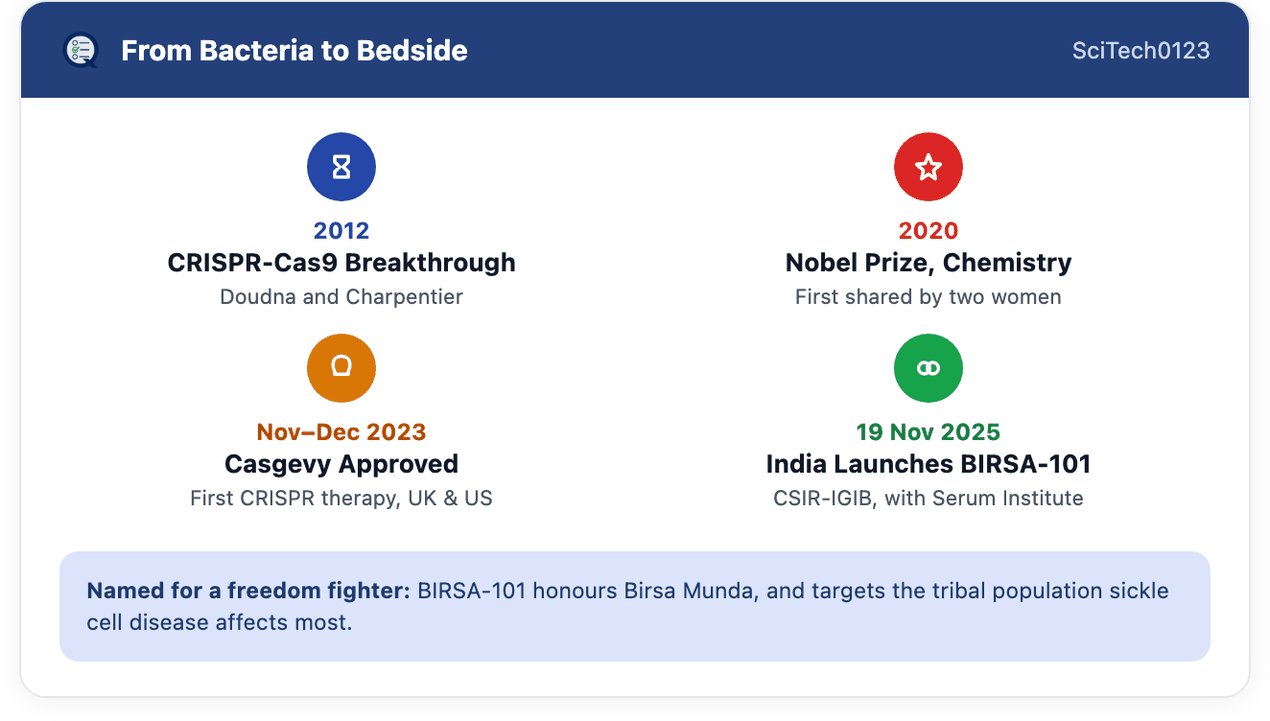
- 2012: Jennifer Doudna and Emmanuelle Charpentier show that CRISPR-Cas9 can cut DNA at a chosen site.
- 2020: Doudna and Charpentier win the Nobel Prize in Chemistry, the first Nobel shared by only two women.
- November–December 2023: Casgevy, the first CRISPR-based therapy, is approved in the UK and the US, to treat sickle cell disease.
- 19 November 2025: India launches BIRSA-101, its own indigenous CRISPR-based gene therapy for sickle cell disease.
🏛️ Must Know
CRISPR-Cas9’s Core Facts
- CRISPR stands for Clustered Regularly Interspaced Short Palindromic Repeats. It began as part of a bacterial immune system that cuts up viral DNA.
- In 2012, Jennifer Doudna and Emmanuelle Charpentier made a key discovery. CRISPR, paired with a protein called Cas9, could be programmed to cut DNA at any chosen site.
- The technique uses just one DNA-cutting protein and a “guide” molecule, which directs it to the right spot in a genome. This simplicity is what makes it so powerful.
- Doudna and Charpentier won the 2020 Nobel Prize in Chemistry for this work.
- In November 2025, India launched BIRSA-101, its first indigenous CRISPR-based gene therapy, developed at CSIR-IGIB for sickle cell disease.
📘 Good to Know
From Lab Breakthrough to Real Therapies
- The first CRISPR-based therapy to reach patients was Casgevy. It was approved in the UK in November 2023, and by the US FDA in December 2023, to treat sickle cell disease.
- Casgevy edits a patient’s own blood stem cells, switching off a genetic “brake.” This lets the body produce a form of haemoglobin that prevents red blood cells from sickling.
- CRISPR is also reshaping agriculture. India has approved its first genome-edited rice varieties, including DRR Dhan 100. It edits a single gene, boosting yield by around 19% and maturing up to 20 days earlier.
- BIRSA-101 is named after Birsa Munda, the tribal freedom fighter, whose 150th birth anniversary had just been observed. Sickle cell disease disproportionately affects India’s tribal population.
- CSIR-IGIB signed a technology transfer agreement with the Serum Institute of India, to scale up BIRSA-101 affordably. This supports the government’s target of a Sickle Cell-Free India by 2047.
📝 Previous Year Questions
UPSC CSP 2019 — What Cas9 Protein Actually Is
- UPSC 2019 Cas9 is a molecular scissors used in targeted gene editing, not a biosensor, a pest-resistance gene, or a herbicidal substance. See UPSC CSP 2019 GS Paper I, Q99. View this question.
Test Yourself

🌟 Great to Know
Why India’s Approach to CRISPR Is Different
- CRISPR is part of a much larger wave of Indian nanoscience and biotech breakthroughs. See SciTech0120 — Nano-robots for Targeted Cancer Therapy for another recent example.
- Overseas, gene therapies like Casgevy can cost over $3 million per patient. India’s approach is different: developing its own platform, then pairing it with a low-cost manufacturer. It is a deliberate bet on making the same kind of cure affordable at scale.
📰 Current Affairs
Latest CRISPR-Cas9 Developments
- 19 November 2025: Union Minister Dr. Jitendra Singh launched BIRSA-101, India’s first indigenous CRISPR-based gene therapy for sickle cell disease. (Source: PIB, Ministry of Science and Technology)
- 19 November 2025: The therapy uses an engineered enFnCas9 CRISPR platform, developed at CSIR-IGIB. It could replace treatments priced at ₹20-25 crore overseas. (Source: PIB, Ministry of Science and Technology)
- 19 November 2025: CSIR-IGIB signed a technology transfer agreement with the Serum Institute of India. The goal is to manufacture the therapy at scale and keep it affordable. (Source: PIB, Ministry of Science and Technology)
Leave a Reply