Roman gold flowed east. Chinese silk flowed west. Indian spices moved in both directions at once. This article covers the trade network that made all three possible, and the empire that profited from sitting in the middle.

Timeline
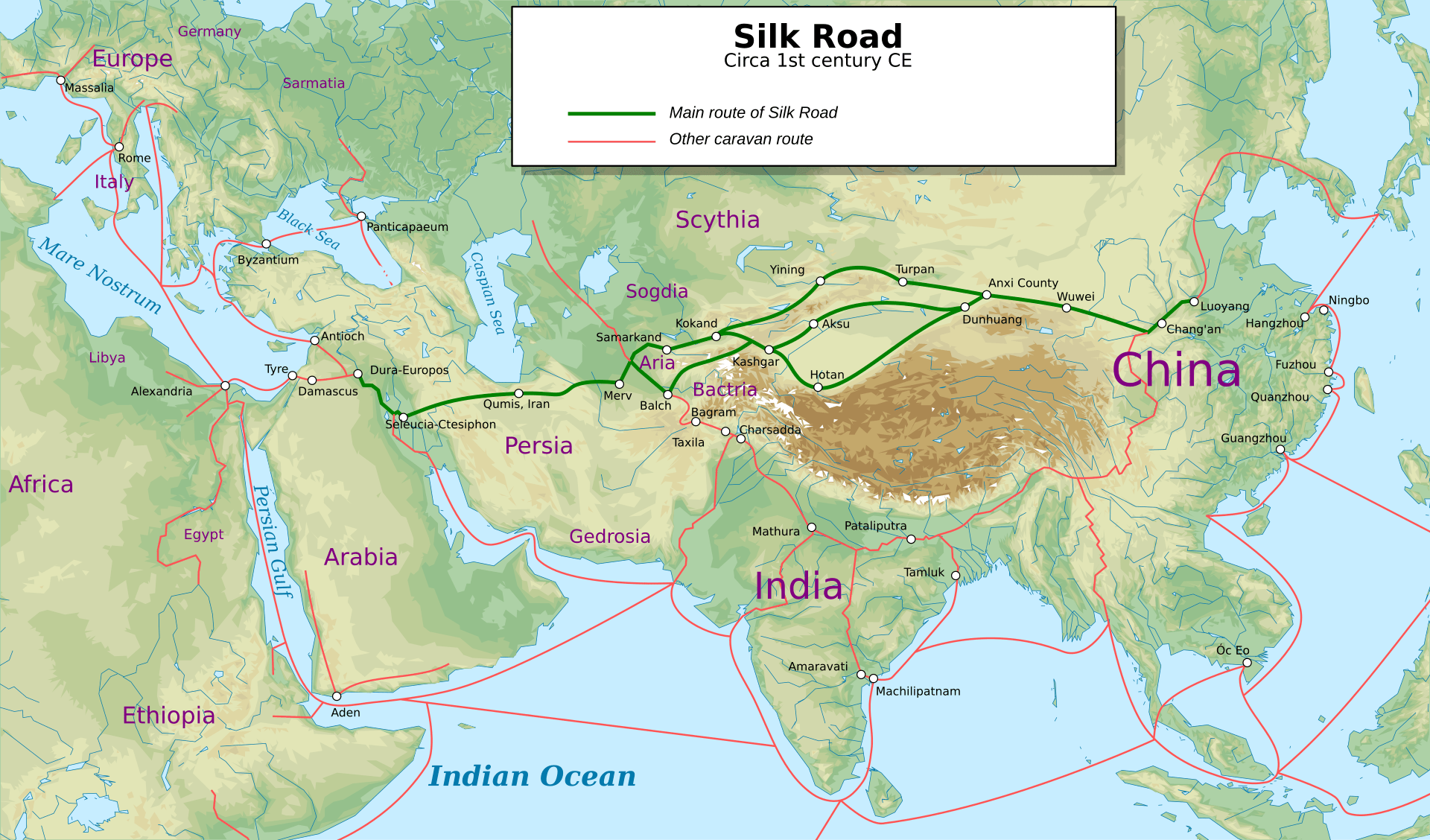
- C. 6th century BCE onward: Taxila, at the junction of routes from Central Asia, Persia and China, becomes India’s main gateway to the wider network.
- Late 4th–1st century BCE: A sequence of Hellenistic and Central Asian successor kingdoms, the Indo-Greeks and then the Indo-Parthians, control this corridor.
- Kushan era: The Kushan Empire unifies the overland route, linking the Oxus and Ganges river regions into one corridor.
- Same period: Maritime trade routes between Indian and Roman ports let merchants bypass Parthian caravan taxes.
- Goods in motion: Indian spices, cotton textiles and gems move west. Chinese silk, Central Asian horses and Roman glassware move into India.
- 1st-2nd century CE: Buddhist texts and monks travel these same roads, reaching Central Asia and China.
Taxila: India’s Gateway to the Route Need to Know
- India’s main connection to the Silk Road ran through the Gandhara region, in the northwest of the subcontinent.
- Its key city was Taxila, sitting at the junction of three major routes: one from Central Asia, one from Persia, and one from China.
- Taxila had already been a major city for centuries before the Silk Road’s peak. It briefly served as a provincial capital under the Achaemenid Persian Empire, from the 6th century BCE.
- Nearby Charsadda, ancient Pushkalavati, was Gandhara’s other major city on these same routes, alongside Bagram further north.
- For Taxila’s own history as a centre of learning, see AncHist0083 — Taxila (Takshashila): Ancient Centre of Learning. For Gandhara’s own political history, see AncHist0048 — Gandhara (Mahajanapada).
What Actually Moved Along the Route Need to Know
- India’s exports were specific, not just generic “goods.” Spices led the list: pepper, cardamom and cinnamon, prized in Rome above almost anything else.
- India also exported fine cotton textiles, including muslin, along with ivory. Gemstones such as pearls, sapphires and rubies came from the Golconda and Coromandel regions.
- India’s imports were equally specific. Chinese silk arrived via the overland route. Horses came from Central Asia and Arabia, since India’s own climate limited large-scale horse breeding.
- Roman glassware, wine, gold and silver coin also flowed into India. Many Roman gold coins ended up in Indian temples and treasuries rather than circulating as everyday currency.

Successor Kingdoms Along the Corridor Good to Know
- Control of this northwestern corridor passed through several hands over four centuries, each one profiting from the same trade routes.
- After Alexander’s campaigns, Seleucus Nicator’s Seleucid Empire briefly held the border satrapies here, before ceding them to the Mauryas. See AncHist0057 — Greeks in India Immediately After Alexander: Seleucus Nicator.
- Later, the Indo-Greek kingdom, based in Bactria and ruled by kings like Menander, controlled Gandhara and the routes running through it. See AncHist0076 — The Indo-Greek Kingdom: Bactria, Demetrius and Menander.
- The Indo-Parthian kingdom, under rulers like Gondophares, held this same corridor next. See AncHist0077 — The Indo-Parthian Kingdom (Gondophares).
- The Kushans finally unified the route under one power. For their fuller political history, see AncHist0016 — Indo-Greeks, Shakas and Kushans.
Buddhism Travels the Same Roads Good to Know
- Gandhari Buddhist texts, written in the Gandhari language of the Kushan realm, were among the first Buddhist writings to reach China. They arrived in the 1st or 2nd century CE.
- Many of the earliest Buddhist translators working in China were themselves of Kushan origin.
- Taxila itself served as a staging post for monks, manuscripts and religious art heading toward Central Asia, alongside its role as a trading city.
- For Buddhism’s broader spread and present-day status, see AncHist0027 — Buddhism: Historical Timeline and Present-Day Status.
Test Yourself



Legacy Great to Know
- Controlling a trade corridor, not just conquering territory, was the real source of Kushan wealth. Their power came from sitting between two much larger economies, Rome and China.
- Taxila’s role shows how a single city could function as both a commercial hub and an intellectual one at the same time. Trade wealth and scholarship grew together there, not separately.
- Buddhism spread along these same commercial roads, not through separate religious missions alone. Trade networks and religious transmission ran on the identical physical infrastructure.
- Kushan translators becoming central to Chinese Buddhism shows how thoroughly people, not just goods, moved along these routes. Cultural transmission needed human carriers, not just merchandise.
- Avoiding Parthian land taxes by shifting to maritime routes shows ancient merchants actively rerouting trade around political friction, much like international shipping still does today.
Beyond the answer
Browse all ancient-indian-history topics →
📚 Keep reading
IndEco0252 — Silk Production in IndiaAncHist0083 — Taxila (Takshashila): Ancient Centre of LearningIndEco0207 — Central Silk BoardIntlRel0159 — India and the Central Asian Republics: A Deepening PartnershipIntlRel0161 — US–China Rivalry vs the Soviet Era: An Existential Comparison❓ Practice this topic
James Burgess founded a journal in 1872, and later served as Director General of the Archaeological Survey of India from 1886 to which year?Alexander Rea first excavated Amaravati in 1888–89. In which year did he go on to become the first Superintendent of the Archaeological Survey of Southern India?Robert Sewell's 1900 book “A Forgotten Empire” is a history of which South Indian empire, drawn from two Portuguese travellers' accounts?A.H. Longhurst's excavations from 1926 to 1931 uncovered a great stupa and several smaller structures at which site?🎲 Take a Ancient Indian History Quiz
Leave a Reply