One Rigvedic hymn describes society as born from the body of a single cosmic being. Historians now read that same hymn as one of the Rigveda’s youngest additions, not its oldest core. This article traces the varna system from that hymn through its later, far more rigid form.

Timeline
- Within the Rigveda, earliest layers: hymns describe a range of occupations, without a fixed, formal four-part scheme.
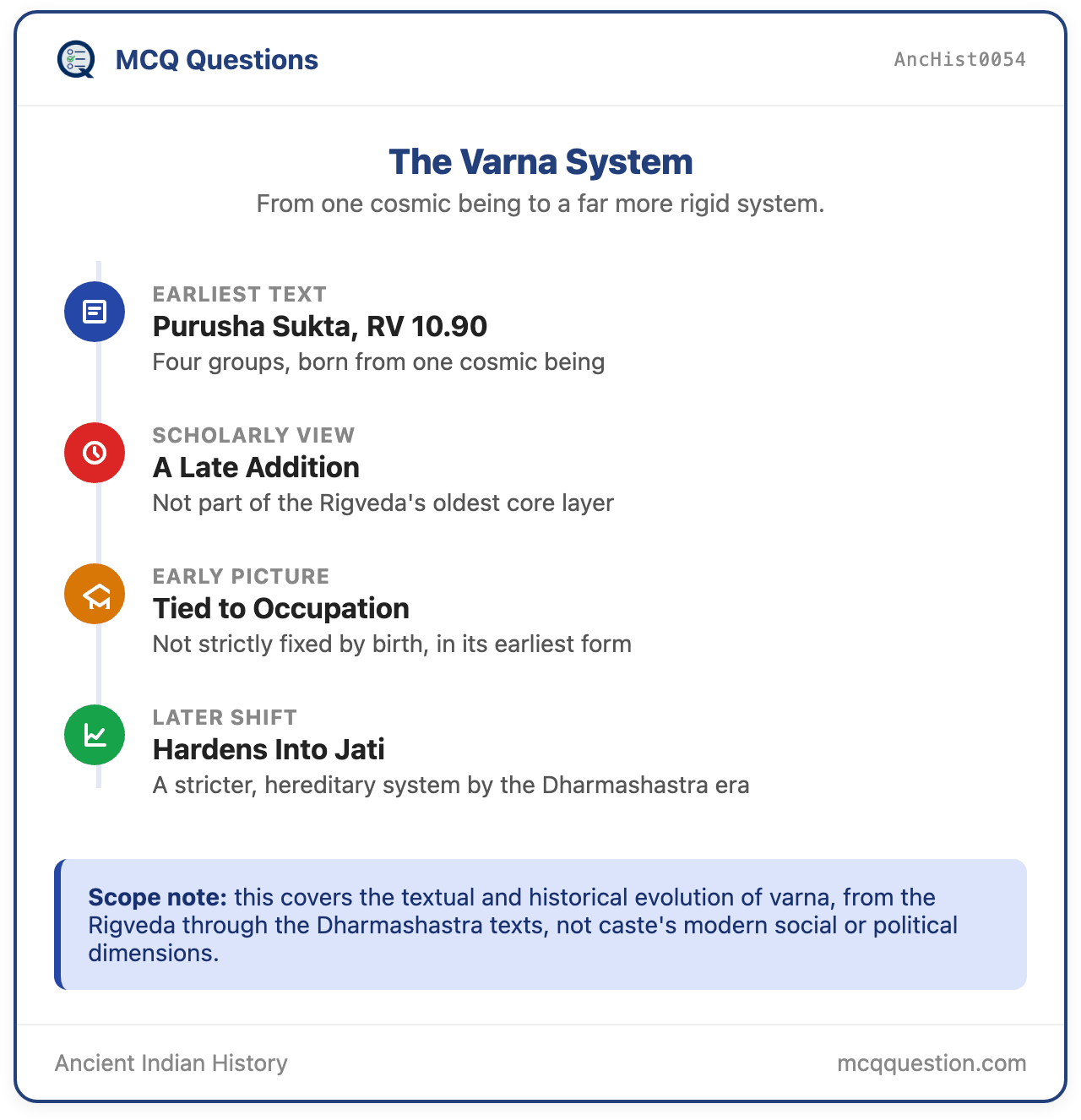
- Within the Rigveda, latest layer (Mandala 10): the Purusha Sukta (RV 10.90) first names Brahmana, Rajanya, Vaishya, and Shudra as born from one cosmic being.
- Later Vedic period: varna terminology appears more often in ritual and social discourse, still short of a fully fixed system.
- Dharmashastra period, roughly 200 BCE to 200 CE: texts like the Manusmriti codify a stricter, hereditary system, and formalise rules on marriage, food, and ritual by jati.
- Dharmashastra texts also add: a theory of intermarriage between varnas producing many jatis, and formal categories placed outside the four-varna scheme.
The Purusha Sukta’s Cosmic Origin Story Need to Know
- The Purusha Sukta, a hymn in the Rigveda’s 10th Mandala (RV 10.90), is the earliest text to describe the four varnas.
- It pictures society emerging from the body of Purusha, a single cosmic being. Brahmanas come from his mouth, Rajanyas (Kshatriyas) from his arms, Vaishyas from his thighs, and Shudras from his feet.
- Multiple historians, including Rigveda translators Stephanie Jamison and Joel Brereton, place this hymn in the Rigveda’s youngest textual layer, not its oldest core.
- This reading rests on two separate kinds of evidence. One is how the hymn’s ideas and language compare to the rest of the text. The other is independent linguistic dating, which places Mandala 10 as the Rigveda’s latest section.
- Historian Suvira Jaiswal describes the hymn as a later interpolation. B.R. Ambedkar held a similar view.
Occupation or Birth: What the Early Texts Suggest Need to Know
- Mainstream scholarship reads early varna as tied more closely to occupation than to fixed birth. This reading rests on limited textual evidence, though, not a complete social record.
- One often-cited example is RV 9.112.3. Its speaker says he is a poet, his father is a physician, and his mother grinds grain, three different occupations within one household.
- The Bhagavad Gita (4.13) has Krishna say the four varnas were created and divided by guna and karma, quality and action, rather than birth.
- Readings of this verse differ. Many modern commentators read it as describing temperament and vocation, not birth. The classical commentator Shankara instead ties guna to a person’s nature at birth. In practice, this still anchors varna to birth, rather than escaping it.
- Jamison and Brereton describe the varna system, even within the Rigveda itself, as “a social ideal rather than a social reality,” both then and later.
From Four Varnas to Many Jatis Good to Know

- Varna is the four-fold textual category. Jati refers to the much larger number of actual hereditary, endogamous groups that structured everyday social life.
- Dharmashastra texts, especially the Manusmriti, set out detailed rules on marriage, food, and ritual by jati, going well beyond the Rigveda’s simple four-part scheme.
- These same texts explain the many jatis as arising from intermarriage between varnas, a theory called varna-sankara.
- The Rigveda’s four-fold scheme has no separate category for what Dharmashastra texts later term outcastes. That additional category is a later, post-Vedic textual development.
- The term Shudra itself shifts over time. Early texts use it as a broad label for laborers and service providers. Later Dharmashastra texts narrow it and attach far more specific restrictions.
Test Yourself

How Historians Read This Evolution Great to Know
- Historian Romila Thapar treats the varna scheme as an idealised model of social order, not a direct description of how ancient society actually worked, at any period.
- She points out that poorer Vaishyas and Shudras were often economically similar in practice. That complicates any simple, clean hierarchy running straight from text to daily life.
- The Rigveda’s varna language is brief. Its later Dharmashastra-era form is far more detailed and rigid. Historians treat that gap itself as real evidence of gradual social change across many centuries, not one fixed system handed down all at once.
- The wider shift in Vedic religious life, from simple household rites toward an increasingly hierarchical ritual order, forms the backdrop to this story. See AncHist0007 — Rigvedic Religion and the Later Vedic Age for that fuller account.
- For the broader Rigvedic social and political setting the Purusha Sukta emerged into, see AncHist0006 — Rigvedic Polity and Society.
Beyond the answer
Browse all ancient-indian-history topics →
📚 Keep reading
AncHist0002 — Vedic and Puranic Literature as Historical SourcesAncHist0056 — The Ashrama System: Four Stages of LifeUPSC CSP 2026 — General Studies Paper I (Full Question Paper)AncHist0006 — Rigvedic Polity and Society: Government by Assembly, Not by DecreeAncHist0051 — Gods of the Vedic Age: The Rigvedic Pantheon❓ Practice this topic
James Burgess founded a journal in 1872, and later served as Director General of the Archaeological Survey of India from 1886 to which year?Alexander Rea first excavated Amaravati in 1888–89. In which year did he go on to become the first Superintendent of the Archaeological Survey of Southern India?Robert Sewell's 1900 book “A Forgotten Empire” is a history of which South Indian empire, drawn from two Portuguese travellers' accounts?A.H. Longhurst's excavations from 1926 to 1931 uncovered a great stupa and several smaller structures at which site?🎲 Take a Ancient Indian History Quiz
Leave a Reply