A single narrow channel of water can carry a quarter of the world’s traded goods — and a single stuck ship can freeze billions of dollars in trade for days.

 MCQ Questions
✅ Must Know
What a strait is
- A strait is a narrow channel of water connecting two larger bodies of water. Ships often have no shorter alternative route through the region.
What an isthmus is
- An isthmus is a narrow strip of land connecting two larger landmasses. A canal cut through one can link two seas directly.
Why they matter for trade
- Both features create chokepoints: narrow passages where a huge share of global trade concentrates. This makes them strategically valuable and vulnerable at the same time.
The Strait of Malacca
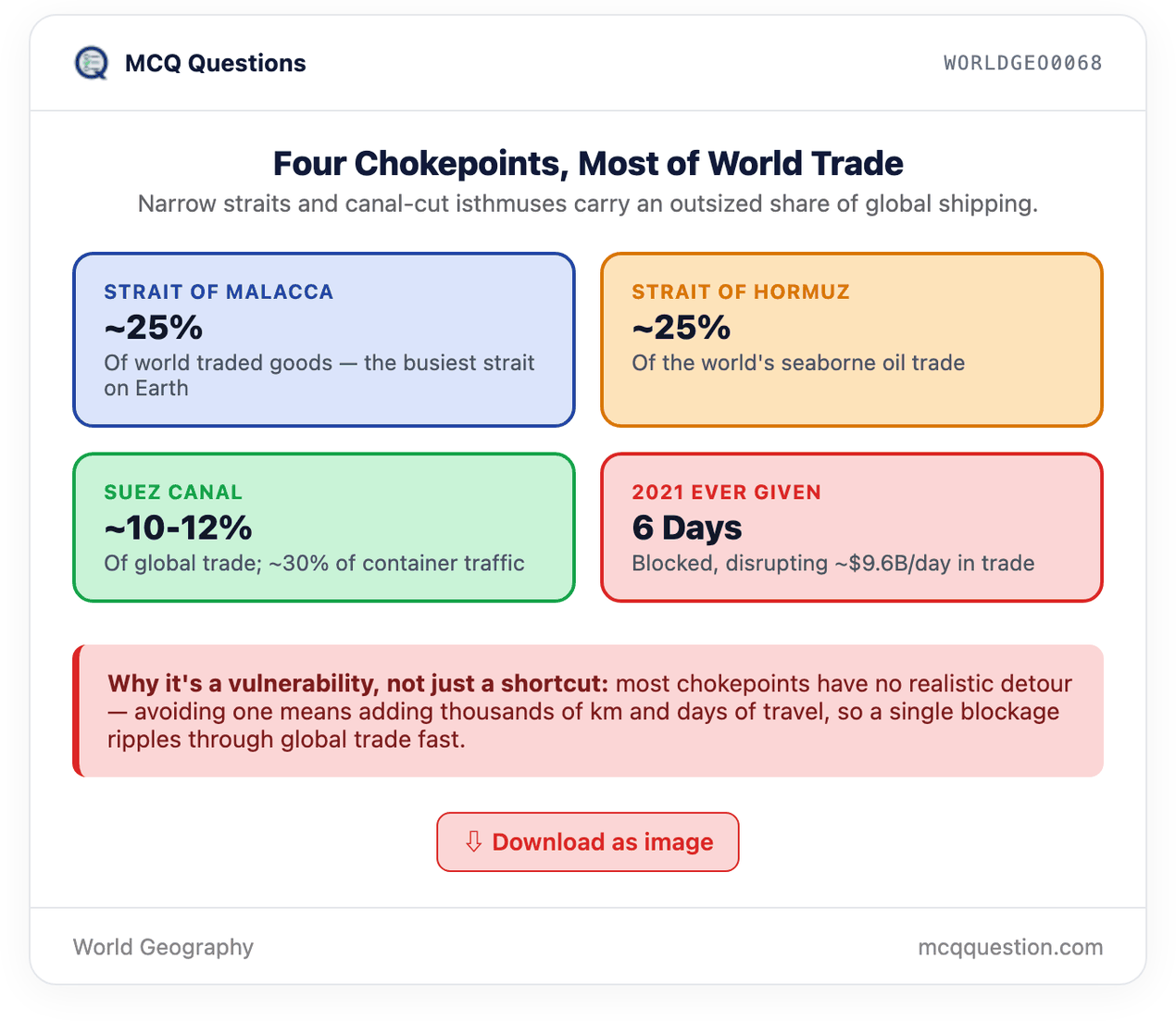
- The Strait of Malacca links the Indian Ocean to the Pacific. About 25% of the world’s traded goods pass through it each year, making it the world’s busiest strait.
💡 Good to Know
The Strait of Hormuz
- The Strait of Hormuz links the Persian Gulf to the open ocean. It carries about 25% of the world’s seaborne oil trade, at its narrowest only about 33 km wide.
The Suez Canal
- Cut through the Isthmus of Suez, the canal links the Mediterranean to the Red Sea. It carries about 10-12% of global trade and nearly a third of global container traffic.
The Panama Canal
- Cut through the Isthmus of Panama, the canal links the Atlantic and Pacific Oceans. It lets ships skip the long, dangerous route around South America’s Cape Horn.
The Bab-el-Mandeb Strait
- This strait links the Red Sea to the Gulf of Aden. Nearly all Suez-bound traffic from the Indian Ocean must pass through it first, making the two chokepoints linked in practice.
Test Yourself


🌟 Great to Know
Canals save enormous distance
- A ship sailing from Europe to India saves thousands of kilometres by using the Suez Canal instead of rounding Africa. That distance directly translates into fuel cost and delivery time.
The 2021 Ever Given blockage
- In 2021, the container ship Ever Given ran aground and blocked the Suez Canal for six days. The blockage disrupted an estimated $9.6 billion in trade per day, showing how a single vessel can freeze global shipping.
Chokepoints as geopolitical leverage
- Countries bordering a chokepoint gain outsized strategic leverage. Turkey’s control of the Bosphorus and Dardanelles under the Montreux Convention, for example, lets it regulate naval traffic between the Black Sea and the Mediterranean.
Why alternatives rarely exist
- Most chokepoints have no realistic detour. Avoiding the Strait of Hormuz or the Suez Canal means adding thousands of kilometres and days of travel, which is why disruptions here ripple through global trade so fast.
📝 Previous Year Questions
UPSC Mains 2022 GS Paper I, Q16
Beyond the answer
Browse all world-geography topics →
📚 Keep reading
IntlRel0084 — The Strait of Hormuz and India's Energy SecurityIndGeo0064 — The Indira Gandhi Canal: A Canal Through the TharWorldGeo0048 — The Sumed Pipeline: Egypt's Suez Canal BypassUPSC CSP 2026 — General Studies Paper I (Full Question Paper)IndGeo0043 — The Palk Strait❓ Practice this topic
D0095 — Where and when are small tornadoes most often reported in India?D0094 — Which statement correctly distinguishes a tornado from a tropical cyclone?D0093 — Why do the majority of the world's tornadoes form around the Gulf of Mexico?D0092 — On what basis does the Enhanced Fujita (EF) scale rate the intensity of a tornado?🎲 Take a World Geography Quiz
Leave a Reply