For about three centuries, European powers saw colonies as wealth machines. The ruling idea was mercantilism. A nation grew rich, it said, by piling up gold and silver.
That idea shaped empires, trade routes and the Atlantic slave trade. This lesson follows the money, the ships and the people, and ends with how economists still argue about the legacy.


Mercantilism: the idea that national wealth is gold and silver, won by selling more than you buy.
Zero-sum: one side’s gain is exactly the other side’s loss.
Chartered company: a firm given special trading rights by the state.
Monoculture: an economy built around a single crop.
1What was mercantilism?
Mercantilism was the leading economic idea in Europe from the 16th to the 19th century. It said a nation’s strength lay in its stock of gold and silver. The best way to get it was to sell more than you bought.
Trade, in this view, was a zero-sum game. If one country gained, another lost. So European powers raced for colonies.
Colonies had a set job. They supplied raw materials and bought finished goods from the mother country. They were often barred from making rival goods or trading freely with others.
Why does this matter? Mercantilism explains why empires cared so much about control of trade, not just land.
- Wealth meant gold and silver.
- Trade seen as zero-sum.
- Colonies: raw materials in, finished goods out.
2How did the triangular trade work?
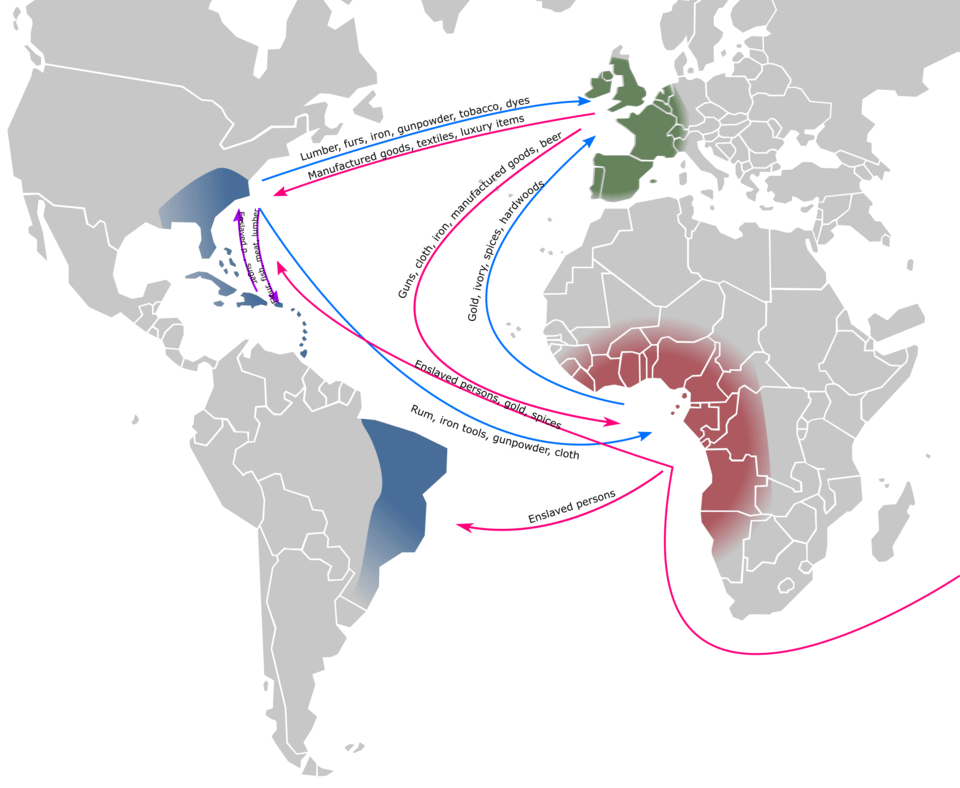
The triangular trade linked Europe, West Africa and the Americas. Many slave voyages followed this pattern, especially in the early years.
Leg one went from Europe to Africa. Ships carried goods such as cloth, guns and alcohol. These were traded for enslaved people.
Leg two was the Middle Passage. Enslaved people were carried across the Atlantic to the Americas.
Leg three brought colonial goods back to Europe. These included sugar, cotton and tobacco.
Why does this matter? The route tied three continents into one money machine. It also shows how deeply slavery was built into it.
- Leg one: goods to West Africa.
- Leg two: enslaved people across the Atlantic, the Middle Passage.
- Leg three: sugar, cotton, tobacco to Europe.
True or False: In the triangular trade, ships carried goods to Africa, enslaved people to the Americas, and sugar or cotton back to Europe.
3How big was the transatlantic slave trade?
The scale was enormous. Historians estimate that about 12.5 million captives were carried off from Africa. About 10.7 million of them survived the voyage to the Americas.
That means roughly 1.8 million people died on the way. The deaths were a built-in cost of how the trade worked.
Most captives were sent to work on plantations. They grew sugar, cotton and tobacco for European markets. The main destinations were the Caribbean, Brazil and the southern United States.
Why does this matter? The slave trade was not a side issue. It was a central part of the colonial economy.
- About 12.5 million carried off.
- About 10.7 million survived the voyage.
- Crops: sugar, cotton, tobacco.
4How did chartered companies make profits?
States often handed trade to big chartered companies. The English East India Company was founded in 1600. It held a royal charter with exclusive trading rights.
With no rival buyers or sellers, such a company could set prices to suit itself. The state backed it. In time the Company also took over large parts of India.
Why does this matter? Monopoly trade moved wealth in one direction. It went from the colony to the company and its investors.
- East India Company founded 1600.
- Backed by a royal charter.
- No rivals meant monopoly profits.
5Why were plantation economies so fragile?
Plantation colonies often grew one cash crop, such as sugar. That left little room for growing their own food. They had to buy food from outside.
So the colony depended on the very trade system that drained it. After independence this weakness did not vanish. Their economies were never built to stand alone.
Rival powers also took wealth by force. Governments licensed private ships, called privateers, to attack enemy shipping.
Why does this matter? Monoculture explains why some former colonies stayed poor even after the empire left.
- One crop meant imported food.
- Dependence on the same trade system.
- Privateers: licensed private raiders.
Think it through: Why would a colony growing only sugar need to import its own food?
Its land and labour all went to the export crop. Little was left for food. So it bought food through the same system that took its sugar.
6How did Smith and Naoroji criticise the system?
Adam Smith published The Wealth of Nations in 1776. It attacked the mercantilist idea that trade is zero-sum. He argued that monopolies and exclusive companies hurt growth.
Smith did not oppose every rule. He still backed the naval-defence parts of the Navigation Acts. His target was trade restrictions, not defence.
Dadabhai Naoroji made a different case for India. His “drain” theory said wealth flowed out of India through salaries, military charges and a one-way surplus of exports. He set it out in Poverty and Un-British Rule in India in 1901.
Why does this matter? Smith criticised a trade theory. Naoroji described an India-specific drain. They are not the same argument.
- Smith, 1776: attacks mercantilist restrictions.
- Naoroji: the drain of wealth from India.
- Two critiques, two different mechanisms.
True or False: Adam Smith rejected the Navigation Acts’ naval-defence provisions entirely.
Remember: Smith attacked mercantilism in 1776. Naoroji described the drain from India.
7Did independence end the gap?
Political freedom did not rebuild industries overnight. Centuries of extraction had blocked the growth of local industry and strong institutions.
Economists still debate how much this legacy explains today’s inequality. Some stress weak inherited institutions. Others point to countries that overcame the past with strong policy.
Why does this matter? History shapes outcomes, but it may not fix them. Exam answers should show both sides.
- Freedom did not rebuild industries at once.
- Debate: weak institutions against good policy.
True or False: Nearly all of the roughly 12.5 million people carried off from Africa survived the voyage.
8What are the exam traps?
- Link the mechanism (mercantilism, drain, monoculture) to its modern effect. Do not only name it.
- Do not mix the triangular trade with Naoroji’s India-specific drain.
- Smith opposed trade restrictions, not every colonial law.
- The Middle Passage is the second leg, not the whole route.
MCQ on Colonial Economics: Mercantilism and the Triangular Trade
Answered 0 of 3 checks.
Share your thoughts