The Korean War, 1950-53
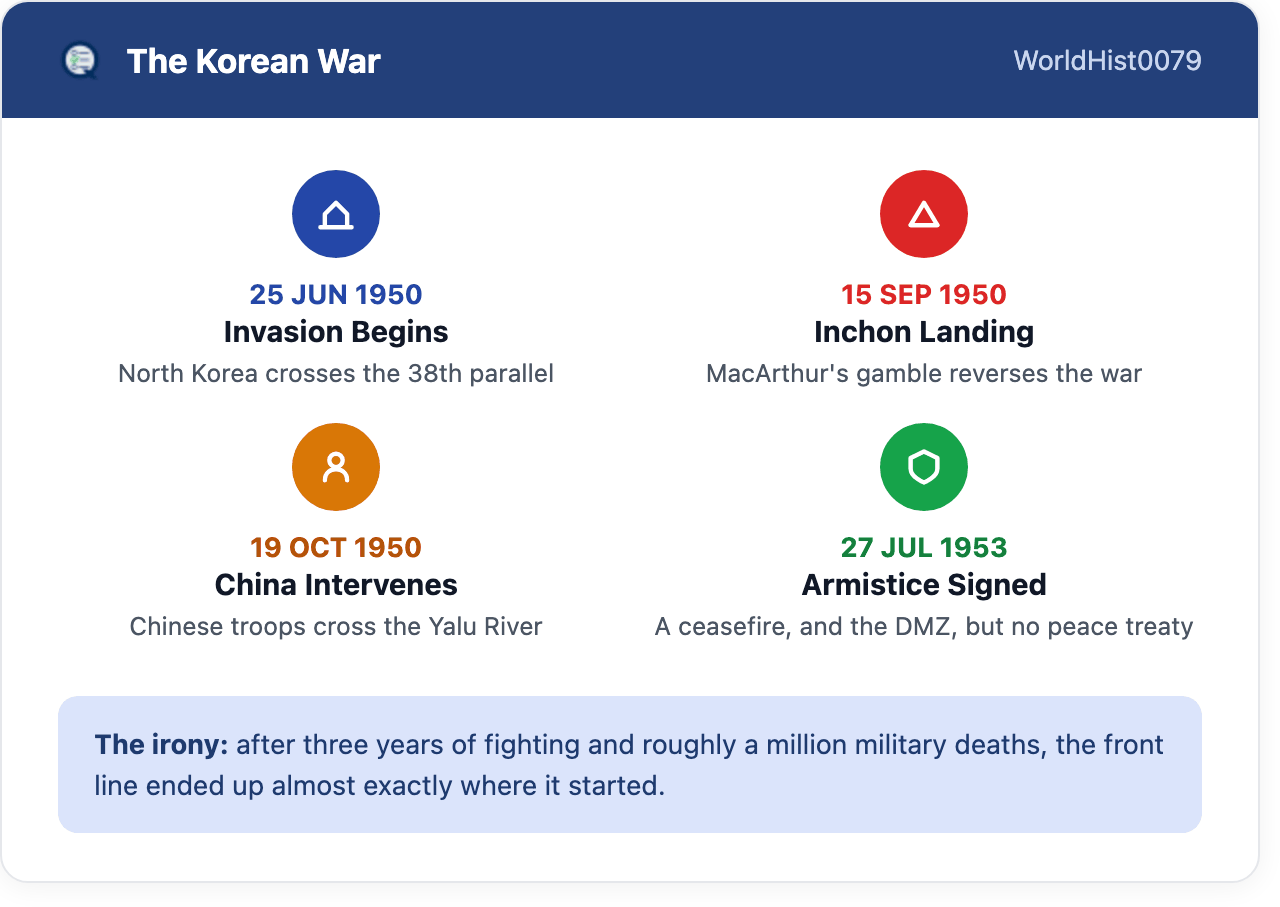
North Korea invaded South Korea in 1950. This dragged in the United Nations, then China, in the Cold War’s first hot proxy war. Three years of fighting ended almost exactly where it started.
This lesson covers why the war broke out, its major turning points, and why the peninsula is technically still at war today.

- Why was Korea split at the 38th parallel?
- How did the war actually start?
- How did MacArthur’s Inchon landing turn the war around?
- Why did China enter the war?
- Why did the war end in a stalemate, not a peace treaty?
- What did the war actually cost?
- Why does this “forgotten war” still matter today?
- Exam Angle
Why was Korea split at the 38th parallel?
After Japan’s WWII surrender, the US and USSR temporarily divided Korea at the 38th parallel, but the temporary line hardened into two rival states.
Japan had ruled Korea as a colony until its surrender in 1945, ending the Second World War. The United States and the Soviet Union agreed to divide Korea at the 38th parallel for administrative purposes. The Soviets accepted Japan’s surrender north of the line, and the Americans accepted it south of the line.
This division was meant to be temporary. But as the Cold War took hold, it hardened into two separate, rival governments. A communist state formed in the North, and a US-aligned state in the South.
Source: standard record of Korea’s post-1945 division, verified via Wikipedia and Britannica.
Pause and decide · 1 of 9
The division of Korea at the 38th parallel was designed from the start as a permanent border between two separate countries. True or false?
False. It was meant to be a temporary administrative line, splitting where the US and USSR would each accept Japan’s surrender. It only hardened into a permanent divide as the Cold War took hold.


How did the war actually start?
North Korea launched a surprise invasion across the 38th parallel on 25 June 1950. The United Nations Security Council then voted to send troops to defend the South.
North Korea launched a surprise invasion across the 38th parallel at 4:00am on 25 June 1950. About 75,000 soldiers of the North Korean People’s Army poured south.
The UN Security Council voted to send an international force to help South Korea. The Soviet Union was boycotting the Council at the time, so it could not use its veto to block the vote. The United States led this UN force, which came to be called the United Nations Command.
North Korea’s advance was fast and brutal. Within weeks, UN and South Korean forces were pushed back into a small corner of the peninsula. This corner, around the port city of Busan, was known as the Pusan Perimeter.
Source: standard record of North Korea’s 25 June 1950 invasion, verified via Wikipedia and Britannica.
Pause and decide · 2 of 9
The UN Security Council was able to vote to send troops to Korea partly because the Soviet Union was boycotting the Council at the time and could not use its veto. True or false?
True. Within weeks of the invasion, UN and South Korean forces had been pushed back into the small Pusan Perimeter around Busan.
How did MacArthur’s Inchon landing turn the war around?
General MacArthur’s daring amphibious landing at Inchon in September 1950 cut off North Korean forces and let UN troops retake Seoul within two weeks.
US General Douglas MacArthur planned a risky amphibious landing at the port of Inchon, far behind North Korean lines, from 15-26 September 1950. Around 75,000 troops and over 260 naval vessels took part.
The landing worked. It cut off North Korean forces fighting further south, forcing them into a rapid retreat. UN and South Korean forces recaptured the South Korean capital, Seoul, within two weeks.
UN forces then pushed north, crossing the 38th parallel themselves and advancing toward the Yalu River, the border with China.
Source: standard record of the Battle of Inchon, September 1950, verified via Wikipedia and Britannica.
Pause and decide · 3 of 9
After the Inchon landing succeeded, UN forces didn’t stop at the 38th parallel — they crossed it and advanced toward the Chinese border at the Yalu River. True or false?
True. This advance toward China’s border is what triggered China’s own entry into the war.
Why did China enter the war?
China saw UN forces advancing toward its own border as a direct threat. It sent hundreds of thousands of troops across the Yalu River, starting in October 1950.
China watched UN forces advance toward its own border with alarm. North Korean leader Kim Il-sung asked Chinese leader Mao Zedong for help.
The Chinese People’s Volunteer Army crossed the Yalu River into Korea starting on 19 October 1950, entering the war in huge numbers. By late 1952, roughly 1.2 million Chinese soldiers were fighting in Korea, commanded by General Peng Dehuai.
Chinese intervention pushed UN forces back south again. By early 1951, the front line had stabilised roughly back around the 38th parallel, where it had started.
Source: standard record of Chinese intervention, October 1950, verified via Wikipedia and Britannica.
Pause and decide · 4 of 9
Chinese forces entered the Korean War in only small, token numbers, without materially changing the course of the fighting. True or false?
False. By late 1952, roughly 1.2 million Chinese soldiers were fighting in Korea. Their intervention pushed UN forces back south, stabilising the front roughly back around the 38th parallel.
Why did the war end in a stalemate, not a peace treaty?
Fighting settled into a stalemate near the original border, and the 1953 armistice stopped the fighting without ever becoming a formal peace treaty.
After China’s intervention, the war settled into a grinding stalemate near the original 38th parallel border, with neither side able to win a decisive victory.
The Korean Armistice Agreement, signed on 27 July 1953, stopped the fighting. It created a 4-kilometre-wide Demilitarized Zone (DMZ) along the front line, with a Joint Security Area at Panmunjom for both sides to meet.
The armistice was only a ceasefire, not a peace treaty. No side ever formally signed a treaty ending the war. Technically, North and South Korea remain at war to this day.
Source: standard record of the 1953 Korean Armistice Agreement, verified via Wikipedia.
Pause and decide · 5 of 9
The 1953 Korean Armistice Agreement was only a ceasefire, not a formal peace treaty — meaning North and South Korea are technically still at war today. True or false?
True. The armistice created the 4-kilometre-wide Demilitarized Zone (DMZ), with a Joint Security Area at Panmunjom.
What did the war actually cost?
The Korean War killed around one million soldiers and up to three million civilians, and left the peninsula roughly where it started.
The Korean War caused around one million military deaths across all sides. Civilian deaths are estimated even higher, at somewhere between 1.5 million and 3 million.
Despite three years of intense fighting and huge losses, the final front line ended up close to the original 38th parallel border. The war changed very little territory. It came at enormous human cost.
Source: standard record of Korean War casualty estimates, verified via Wikipedia and Britannica.
Pause and decide · 6 of 9
After three years of fighting and roughly a million military deaths, the final Korean War front line ended up far from where the war originally started. True or false?
False. Despite the huge losses, the final front line ended up close to the original 38th parallel border. The war changed very little territory, at enormous human cost.
Why does this “forgotten war” still matter today?
Often overshadowed by World War II and Vietnam, the Korean War set the template for Cold War proxy fighting. It left a still-divided, heavily militarised peninsula.
The Korean War is sometimes called the “Forgotten War.” It is often overshadowed in popular memory by World War II before it, and the Vietnam War after it.
It was the first major armed conflict of the Cold War. It set a template that later proxy wars followed: rival superpowers backing opposing local sides, without ever fighting each other directly.
The peninsula remains divided today, with one of the most heavily militarised borders on Earth running along the DMZ. North and South Korea have followed dramatically different paths since 1953.
Source: standard analysis of the Korean War’s Cold War significance and legacy.
Pause and decide · 7 of 9
The Korean War is sometimes called the “Forgotten War” because it is often overshadowed in popular memory by World War II and the Vietnam War. True or false?
True. It was also the first major armed conflict of the Cold War, setting a template later proxy wars followed.
Exam Angle: The Usual Traps Here
Trap 1: don’t confuse the 1953 Korean Armistice Agreement with a formal peace treaty. No peace treaty was ever signed. Technically, the two Koreas remain at war.
Trap 2: the Korean War is a classic example of a Cold War “proxy war.” The two superpowers, the US and USSR, backed opposing sides without directly fighting each other. China, not the USSR, provided the ground troops that actually fought UN forces.
Trap 3: know the sequence of turning points in order. First, the North Korean invasion (June 1950) and the Pusan Perimeter. Then the Inchon landing (September 1950) and the UN advance toward the Yalu. Then Chinese intervention (October 1950), stalemate, and finally the armistice (July 1953). Questions often test which event came before another.
Source: standard exam-pattern guidance for the Korean War.
Pause and decide · 8 of 9
Soviet ground troops, not Chinese troops, were the main force that fought UN forces after intervention on North Korea’s side. True or false?
False. China provided the ground troops, not the Soviet Union — a classic exam trap in this Cold War proxy-war setup.
Pause and decide · 9 of 9
In the correct sequence, the Inchon landing came before Chinese intervention, which came before the war settled into a stalemate. True or false?
True. The order was: invasion (June 1950), Inchon landing (September 1950), Chinese intervention (October 1950), then stalemate and the 1953 armistice.
Check your understanding
Answer the nine checks above. You will see each explanation after choosing.
Primary sources
- Standard record of the Korean War, 1950-53, verified via Wikipedia and Britannica.
Practice what you learned
Loading practice…
Beyond the answer
Browse all world-history topics →
📚 Keep reading
WorldHist0068 — Taiwan and Korea: Two Paths to Modern DemocracyIntlRel0056 — India's Free Trade AgreementsWorldHist0007 — The First Indochina War and the Fall of Dien Bien PhuWorldHist0080 — The Vietnam WarWorldHist0001 — The United Nations: Founding, Charter, and the Veto❓ Practice this topic
On what date did North Korea launch its surprise invasion of South Korea, starting the Korean War?D4159 — How did the Korean War of 1950-53 formally end?Who planned the September 1950 Inchon landing that reversed the Korean War's early momentum?What did the 27 July 1953 Korean Armistice Agreement actually establish?🎲 Take a World History Quiz
Leave a Reply