The Hungarian Uprising, 1956
Hungarian students and workers rose up against Soviet control in October 1956. For 12 days, it looked like they might actually win.
This lesson covers what sparked the uprising, its short-lived success, and how the Soviet Union crushed it.

- What made Hungarians rise up in 1956?
- How did the uprising actually begin?
- What did Imre Nagy’s new government actually do?
- How did the Soviet Union crush the uprising?
- Who replaced Nagy, and what happened to him?
- What did the uprising actually cost?
- Why does 1956 still matter for the Cold War?
- Exam Angle
What made Hungarians rise up in 1956?
Khrushchev’s 1956 speech denouncing Stalin, unrest in Poland, and neighbouring Austria’s new neutrality all encouraged Hungarians to hope for real change.
Soviet leader Nikita Khrushchev gave a “secret speech” in February 1956, attacking Joseph Stalin’s brutal rule. This relaxed the mood across the Soviet bloc, and encouraged open debate and criticism.
Unrest in Poland that same year showed other Soviet-bloc countries pushing back. Neighbouring Austria had also become fully neutral in 1955, with all occupying foreign troops leaving. Many Hungarians saw this as a hopeful sign for their own country.
Source: standard record of the causes behind the 1956 Hungarian Uprising, verified via Wikipedia and Britannica.
Pause and decide · 1 of 10
Khrushchev’s 1956 “secret speech” denouncing Stalin helped create the atmosphere that encouraged Hungarians to push for change. True or false?
True. Unrest in Poland and Austria’s new neutrality that same year also encouraged Hungarians to hope for real change.


How did the uprising actually begin?
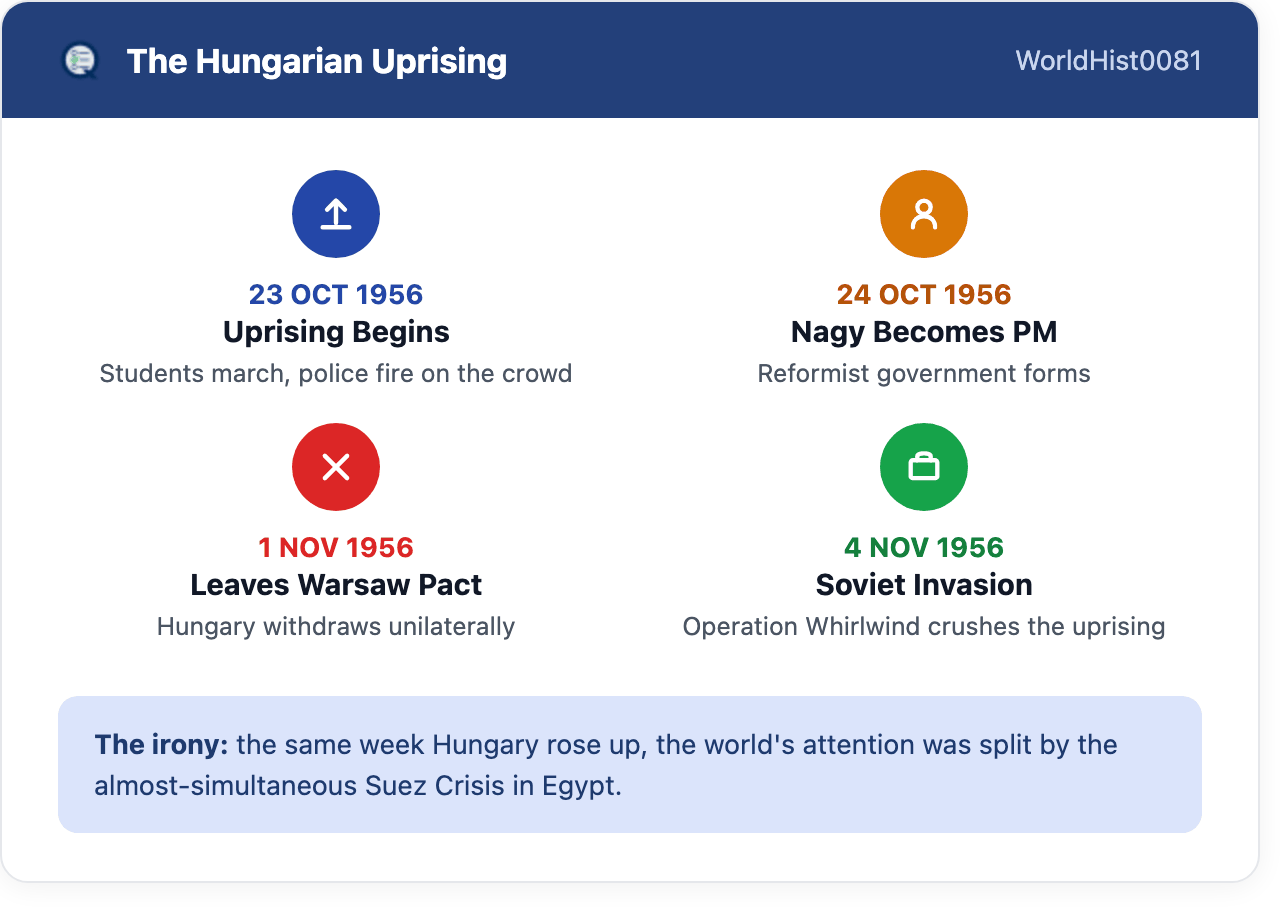
Students marched with a list of demands on 23 October 1956, and the revolution began when secret police fired on an unarmed crowd outside a radio station.
On 23 October 1956, university students in Budapest marched to the Hungarian Parliament, demanding reforms and Soviet withdrawal. A group of students had already drawn up a list of sixteen points the day before, laying out their key demands.
Students tried to enter the state radio station to broadcast their demands. They were detained. When a crowd gathered outside demanding their release, state security police opened fire on the unarmed crowd. That shooting set off the uprising itself.
Source: standard record of the uprising’s outbreak, 22-23 October 1956, verified via Wikipedia and Britannica.
Pause and decide · 2 of 10
The Hungarian Uprising began as a planned military coup, not as a student protest that turned violent. True or false?
False. It began with a student march and a list of demands. The uprising itself was triggered when state security police fired on an unarmed crowd outside the radio station.
What did Imre Nagy’s new government actually do?
Imre Nagy became Prime Minister, dissolved the hated secret police, and pulled Hungary out of the Warsaw Pact entirely.
Imre Nagy became Prime Minister on 24 October 1956, a central demand of the revolutionaries. His reformist government admitted non-communist politicians and promised free elections.
On 28 October, Nagy’s government dissolved the hated secret police, the AVH. On 1 November 1956, Nagy went further still, unilaterally withdrawing Hungary from the Warsaw Pact entirely.
Source: standard record of Imre Nagy’s government, October-November 1956, verified via Wikipedia and Britannica.
Pause and decide · 3 of 10
Imre Nagy’s government dissolved the hated secret police, the AVH, and unilaterally withdrew Hungary from the Warsaw Pact. True or false?
True. The Warsaw Pact withdrawal, on 1 November 1956, is what directly triggered the Soviet invasion.
How did the Soviet Union crush the uprising?
The Soviet Union launched a massive military invasion on 4 November 1956, crushing organised resistance within days.
Hungary’s withdrawal from the Warsaw Pact was the final trigger. In the early hours of 4 November 1956, the Soviet Union launched “Operation Whirlwind,” a massive military attack on Budapest and rebel strongholds across the country.
Organised resistance in Budapest was crushed by 7 November 1956, though scattered fighting continued in some areas until around 12 November. The whole uprising lasted just 12-15 days.
Source: standard record of the Soviet invasion, November 1956, verified via Wikipedia and Britannica.
Pause and decide · 4 of 10
The Soviet Union let Hungary’s withdrawal from the Warsaw Pact stand without a military response. True or false?
False. The withdrawal directly triggered “Operation Whirlwind,” a massive Soviet military invasion launched on 4 November 1956, which crushed organised resistance within days.
Who replaced Nagy, and what happened to him?
Janos Kadar formed a new Soviet-backed government, while Nagy fled to the Yugoslav Embassy before later being captured, secretly tried, and executed.
Janos Kadar, a former ally of Nagy who defected before the invasion, announced a new Soviet-backed government on the day of the invasion, declaring Nagy’s government illegitimate.
Nagy fled to the Yugoslav Embassy in Budapest for safety. He was later lured out, captured, secretly tried, and executed in 1958, two years after the uprising itself.
Source: standard record of Janos Kadar’s government and Nagy’s fate, 1956-58.
Pause and decide · 5 of 10
Imre Nagy was eventually captured, secretly tried, and executed in 1958, two years after the uprising itself was crushed. True or false?
True. He had first fled to the Yugoslav Embassy in Budapest for safety, before later being lured out and captured.
What did the uprising actually cost?
Around 2,500 Hungarians and 700 Soviet soldiers died, and roughly 200,000 Hungarians fled the country as refugees.
About 2,500 Hungarians and 700 Soviet soldiers died in the fighting. Nearly a quarter of a million Hungarians fled the country afterward.
Around 200,000 refugees escaped to the West. About 38,000 of them emigrated onward to North America in 1956-57.
Source: standard record of casualty and refugee estimates, verified via Wikipedia and Britannica.
Pause and decide · 6 of 10
Very few Hungarians left the country after the uprising was crushed, with most refugees returning home within weeks. True or false?
False. Around 200,000 Hungarians fled to the West as refugees, with about 38,000 of them going on to North America in 1956-57.
Why does 1956 still matter for the Cold War?
The crushed uprising showed the West would not intervene militarily behind the Iron Curtain, and exposed real cracks in the wider communist movement’s unity.
The West, especially the United States, did not intervene militarily to help the uprising, despite earlier rhetoric about “rolling back” communism. This showed the real limits of Western support for uprisings inside the Soviet bloc.
The crushing of the uprising damaged the international reputation of communist parties elsewhere, including in Western Europe, exposing real cracks in the movement’s claimed unity.
1956 set a precedent the Soviet Union would repeat: reform movements inside the Warsaw Pact that threatened to leave it would be crushed by force.
Source: standard analysis of the uprising’s Cold War significance.
Pause and decide · 7 of 10
Despite earlier Western rhetoric about “rolling back” communism, the US did not intervene militarily to help the Hungarian uprising. True or false?
True. This showed the real limits of Western support for uprisings inside the Soviet bloc during the Cold War.
Exam Angle: The Usual Traps Here
Trap 1: don’t confuse the Hungarian Uprising (1956) with the Prague Spring (1968). Both were Warsaw Pact crackdowns, but different countries, different decades, different reform leaders (Nagy vs. Dubcek).
Trap 2: know the exact sequence: secret speech (Feb 1956) → uprising begins (23 Oct) → Nagy becomes PM (24 Oct) → Warsaw Pact withdrawal (1 Nov) → Soviet invasion (4 Nov). The withdrawal is what triggered the invasion, not the other way around.
Trap 3: the uprising coincided almost exactly with the Suez Crisis in Egypt, which drew Western media attention away from Hungary at a critical moment. Both crises unfolded in the same weeks of late 1956.
Source: standard exam-pattern guidance for the Hungarian Uprising.
Pause and decide · 8 of 10
The Soviet invasion of Hungary happened before Nagy’s government withdrew from the Warsaw Pact, provoking the withdrawal as a response. True or false?
False. The sequence was the other way around — Nagy withdrew Hungary from the Warsaw Pact on 1 November, and that withdrawal triggered the Soviet invasion three days later.
Pause and decide · 9 of 10
The Hungarian Uprising coincided almost exactly with the Suez Crisis in Egypt, which drew Western media attention away from Hungary. True or false?
True. Both crises unfolded in the same weeks of late 1956, a detail worth remembering for chronology questions.
Pause and decide · 10 of 10
Imre Nagy led the 1968 Prague Spring, while Alexander Dubcek led the 1956 Hungarian Uprising. True or false?
False. It’s the reverse — Imre Nagy led the 1956 Hungarian Uprising, and Alexander Dubcek led the 1968 Prague Spring. Don’t mix up the two reform leaders and their decades.
Check your understanding
Answer the ten checks above. You will see each explanation after choosing.
Primary sources
- Standard record of the Hungarian Uprising, 1956, verified via Wikipedia and Britannica.
Practice what you learned
Loading practice…
Beyond the answer
Browse all world-history topics →
📚 Keep reading
WorldHist0082 — The Prague Spring, 1968WorldHist0002 — The Cold War and the Berlin Wall: A Divided WorldWorldHist0083 — The Space RaceWorldHist0003 — The Suez Crisis, 1956: The End of Old EmpiresEconomy0027 — Aviation Insurance: Hull Cover and the Montreal Convention❓ Practice this topic
What specific action by Imre Nagy’s government, on 1 November 1956, directly triggered the Soviet invasion?What ultimately happened to Imre Nagy after the Soviet invasion crushed the uprising?What event on 23 October 1956 directly set off the Hungarian Uprising?Roughly how many Hungarians fled the country as refugees after the 1956 uprising was crushed?🎲 Take a World History Quiz
Leave a Reply