The Space Race
A satellite the size of a beach ball triggered a national panic in America. Twelve years later, two American astronauts walked on the Moon.
This lesson covers how the Space Race started, its key milestones, and how it ended.

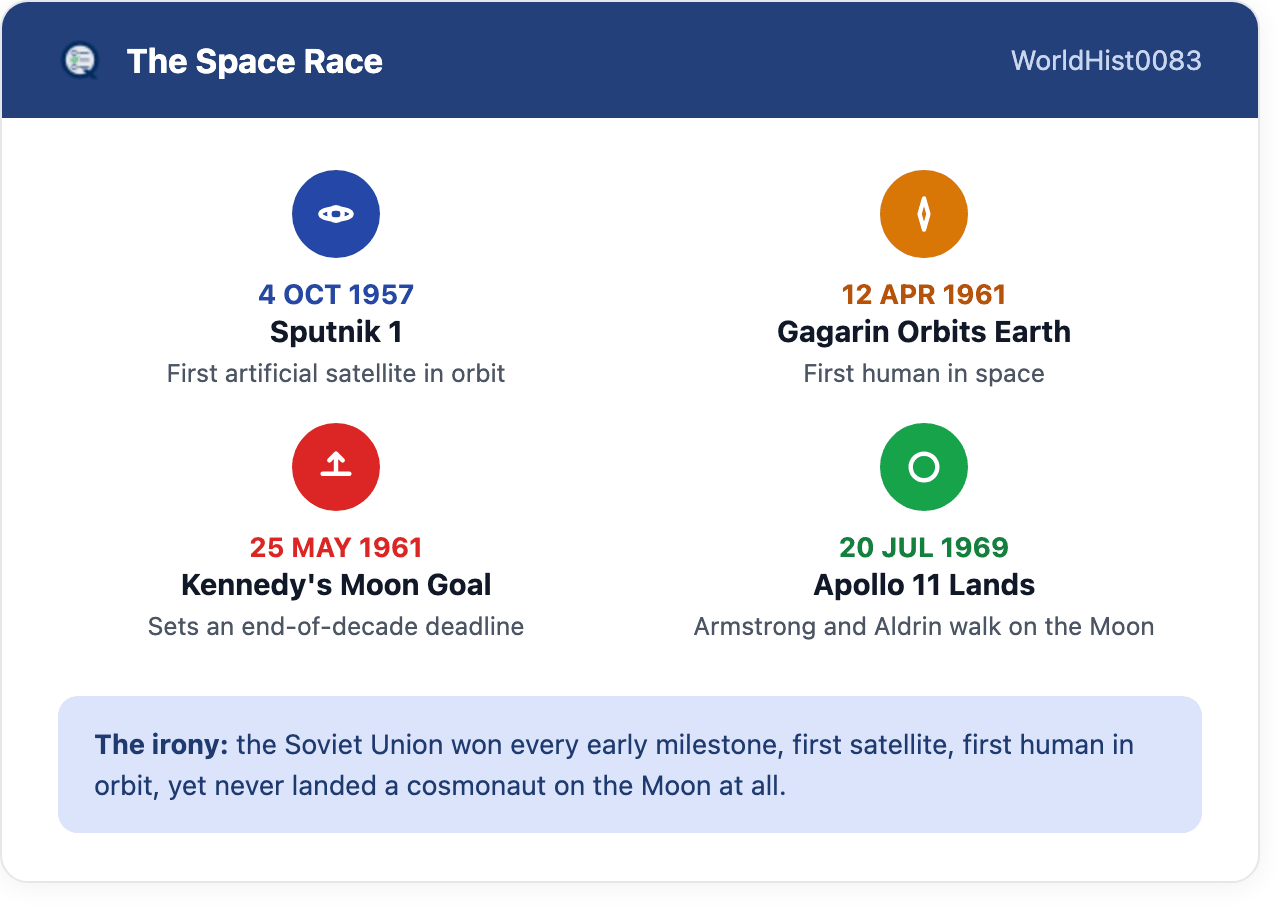
- How did Sputnik start the Space Race?
- Why was NASA created, and what did it do first?
- Who was the first human in space?
- Why did Kennedy set a Moon deadline?
- How did Apollo 11 actually land on the Moon?
- Why did the Soviet Union lose the Moon race?
- What did the Space Race actually leave behind?
- Exam Angle
How did Sputnik start the Space Race?
The Soviet Union launched Sputnik 1 on 4 October 1957, the first artificial satellite, triggering a wave of public anxiety in the United States.
The Soviet Union launched Sputnik 1 on 4 October 1957. It was the first artificial satellite ever put into orbit, a polished metal sphere about 58cm wide, broadcasting simple radio pulses.
Sputnik’s success triggered what became known as the “Sputnik crisis” in the United States: real public fear that America had fallen dangerously behind the Soviet Union in technology.
Source: standard record of Sputnik 1’s launch, October 1957, verified via Wikipedia and Britannica.
Pause and decide · 1 of 10
Sputnik 1, launched by the Soviet Union in October 1957, was the first artificial satellite ever put into orbit. True or false?
True. Its success triggered real public anxiety in the United States, known as the “Sputnik crisis.”


Why was NASA created, and what did it do first?
The Sputnik crisis directly led the United States to create NASA, its own dedicated space agency, to compete with the Soviet program.
The Sputnik crisis directly triggered the creation of the National Aeronautics and Space Administration (NASA) in the United States. The Soviet Union ran its own rival program.
Both sides treated the Space Race as a way to publicly demonstrate technological and scientific superiority, without directly fighting each other, similar in spirit to other Cold War proxy competitions.
Source: standard record of NASA’s founding, verified via Wikipedia and Britannica.
Pause and decide · 2 of 10
NASA existed well before Sputnik, and the Soviet Union’s satellite launch had little effect on how it was set up. True or false?
False. The Sputnik crisis directly triggered NASA’s creation, as the United States moved to compete with the Soviet Union’s space program.
Who was the first human in space?
Soviet cosmonaut Yuri Gagarin became the first human in space and the first to orbit Earth on 12 April 1961, giving the Soviets an early lead.
Yuri Gagarin, a Soviet cosmonaut, became the first human in space on 12 April 1961. Flying aboard Vostok 1, he completed a full orbit of Earth in a flight lasting 108 minutes.
This was a major Soviet achievement, giving them a clear early lead in the Space Race over the United States.
Source: standard record of Yuri Gagarin’s 1961 spaceflight, verified via Wikipedia and Britannica.
Pause and decide · 3 of 10
Yuri Gagarin’s April 1961 flight, aboard Vostok 1, made him the first human to orbit the Earth. True or false?
True. The flight lasted just 108 minutes, but gave the Soviet Union a clear early lead in the Space Race.
Why did Kennedy set a Moon deadline?
President Kennedy challenged the US to land a man on the Moon by the end of the 1960s, a direct response to the Soviet Union’s early lead.
In May 1961, weeks after Gagarin’s flight, US President John F. Kennedy set a bold national goal: landing a man on the Moon, and returning him safely, before the end of the decade.
This was a direct response to the Soviet Union’s early lead. Kennedy picked a genuinely difficult goal, betting the US could out-build the Soviet program on a longer-term, more technically demanding target.
Source: standard record of Kennedy’s 1961 Moon goal, verified via Wikipedia and Britannica.
Pause and decide · 4 of 10
Kennedy set his Moon-landing goal years before Gagarin’s 1961 flight, unrelated to the Soviet Union’s own achievements. True or false?
False. Kennedy set the goal in May 1961, just weeks after Gagarin’s flight, as a direct response to the Soviet Union’s early lead.
How did Apollo 11 actually land on the Moon?
Apollo 11 landed on the Moon on 20 July 1969, and Neil Armstrong became the first human to walk on its surface, followed by Buzz Aldrin.
On 20 July 1969, Apollo 11 landed on the Moon. Neil Armstrong became the first human to walk on the lunar surface, about six hours after landing. Buzz Aldrin followed him out nineteen minutes later.
The two astronauts spent about two and a half hours on the surface. They planted a US flag, spoke by radio with President Nixon, set up scientific instruments, and collected about 21.5kg of lunar material to bring home.
A third astronaut, Michael Collins, stayed in lunar orbit throughout, piloting the command module that would bring all three home.
Source: standard record of the Apollo 11 Moon landing, July 1969, verified via Wikipedia and Britannica.
Pause and decide · 5 of 10
Michael Collins, the third Apollo 11 astronaut, stayed in lunar orbit while Armstrong and Aldrin walked on the Moon’s surface. True or false?
True. He piloted the command module that eventually brought all three astronauts home.
Pause and decide · 6 of 10
Buzz Aldrin was the first human to step onto the Moon’s surface, with Neil Armstrong following him. True or false?
False. It was the reverse — Neil Armstrong stepped out first, with Buzz Aldrin following about nineteen minutes later.
Why did the Soviet Union lose the Moon race?
The Soviet Union’s own crewed Moon program suffered repeated rocket failures and never landed a cosmonaut, letting the United States win the race outright.
The Soviet Union did pursue its own crewed Moon landing program, but its giant N1 rocket suffered repeated launch failures and was never successfully flown with a crew.
Without a working rocket capable of the trip, the Soviet Union’s own Moon landing ambitions quietly collapsed. Apollo 11’s 1969 landing effectively ended the Moon race, with the United States the clear winner of that specific milestone.
Source: standard record of the Soviet crewed Moon program’s failure, verified via Wikipedia and Britannica.
Pause and decide · 7 of 10
The Soviet Union’s own crewed Moon landing program suffered repeated rocket failures and never successfully landed a cosmonaut. True or false?
True. This let the United States effectively win the specific milestone of a crewed Moon landing.
What did the Space Race actually leave behind?
Beyond the Moon landing itself, the Space Race produced lasting technology, satellite infrastructure, and eventually genuine US-Soviet cooperation in space.
The Space Race pushed rapid advances in rocketry, materials science, and computing, with effects reaching well beyond space exploration itself.
It also built the foundation for today’s satellite infrastructure, used constantly for communication, weather forecasting, and navigation.
Rivalry eventually gave way to cooperation. The 1975 Apollo-Soyuz Test Project saw American and Soviet spacecraft dock together in orbit, a symbolic first step toward the international cooperation that later built the International Space Station.
Source: standard analysis of the Space Race’s technological and diplomatic legacy.
Pause and decide · 8 of 10
US-Soviet space rivalry stayed purely competitive throughout the Cold War, with no direct cooperation ever taking place in orbit. True or false?
False. The 1975 Apollo-Soyuz Test Project saw American and Soviet spacecraft dock together in orbit, a symbolic first step toward later international cooperation in space.
Exam Angle: The Usual Traps Here
Trap 1: know the exact sequence of “firsts.” Sputnik 1 (first satellite, 1957) came before Gagarin (first human in space, 1961), which came before Apollo 11 (first Moon landing, 1969). Don’t mix up the order.
Trap 2: the Soviet Union won the early stages of the Space Race (first satellite, first human in space), but the United States won the specific milestone of the crewed Moon landing. Don’t treat one side as winning “the whole race” outright.
Trap 3: Kennedy’s Moon speech came in May 1961, a direct response to Gagarin’s flight that same year, not an independent, unrelated initiative.
Source: standard exam-pattern guidance for the Space Race.
Pause and decide · 9 of 10
In the correct sequence, Sputnik 1 (1957) came before Gagarin’s flight (1961), which came before the Apollo 11 Moon landing (1969). True or false?
True. Mixing up this order is a common exam trap.
Pause and decide · 10 of 10
The Soviet Union clearly won every single stage of the Space Race, including the crewed Moon landing. True or false?
False. The Soviet Union won the early stages (first satellite, first human in space), but the United States won the specific milestone of the crewed Moon landing.
Check your understanding
Answer the ten checks above. You will see each explanation after choosing.
Primary sources
- Standard record of the Space Race, 1957-75, verified via Wikipedia and Britannica.
Practice what you learned
Loading practice…
Beyond the answer
Browse all world-history topics →
📚 Keep reading
SciTech0203 — Chandrayaan-3: India's South-Pole Landing and Its SystemsWorldHist0081 — The Hungarian Uprising, 1956WorldHist0082 — The Prague Spring, 1968WorldHist0002 — The Cold War and the Berlin Wall: A Divided WorldIntlRel0161 — US–China Rivalry vs the Soviet Era: An Existential Comparison❓ Practice this topic
What did the Soviet Union launch on 4 October 1957, triggering the "Sputnik crisis" in the United States?What 1975 mission marked a symbolic shift from Space Race rivalry toward US-Soviet cooperation in orbit?Why did the Soviet Union ultimately fail to land a cosmonaut on the Moon?D3400 — Consider the following statements about international events: 1. The First Gulf War was related to the Iraq invasion of Kuwait. 2. Mikhail Gorbachev was the President of the Soviet Union at the time of its disintegration. 3. Boris Yeltsin was the first elected President of Russia. How many of the statements given above are correct? **[CAPF (ACs) 2025]**🎲 Take a World History Quiz
Leave a Reply