A foreign pilgrim praised Gupta India’s mild laws and low crime. The same era’s own evidence shows a caste system growing more rigid, and real, if unevenly documented, limits on women’s lives. This article covers both, without treating either as the whole picture.

Timeline
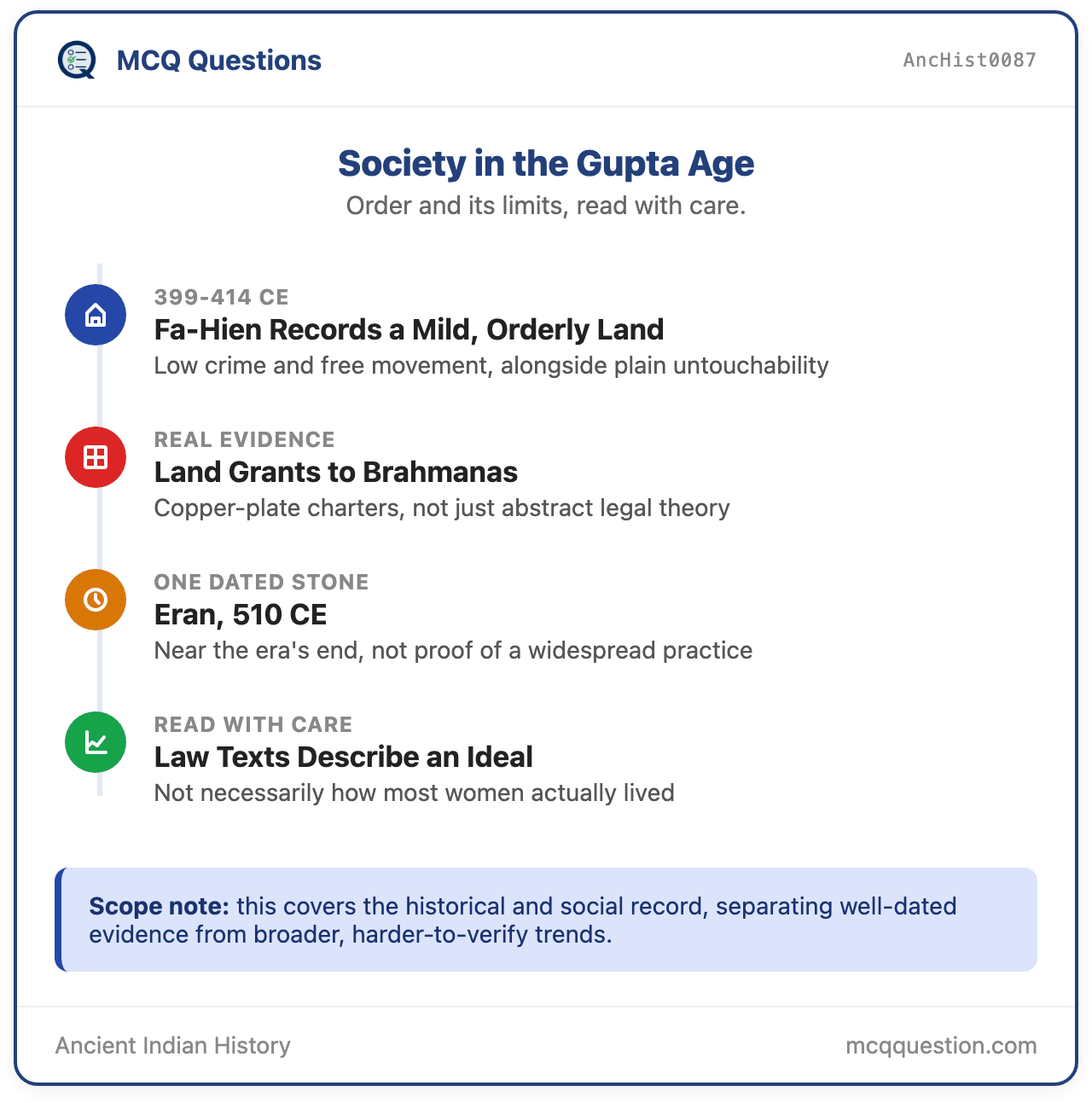
- 399-414 CE: Chinese pilgrim Fa-Hien visits India, during the reign of Chandragupta II. He records mild governance and low crime, alongside plainly practiced untouchability.
- Across the period: Gupta and Gupta-era kings issue copper-plate land grants to Brahmanas, a real, dated form of economic privilege.
- 436 CE, with a later addition in 473 CE: the Mandsaur inscription records a guild of silk weavers funding a temple, evidence of organised craft life alongside caste.
- 510 CE, near the empire’s end: the Eran memorial, the earliest widely accepted epigraphic evidence of sati in India, is set up.
🙏 Must Know
1. Fa-Hien’s India: Order and Its Limits
- Fa-Hien Chinese pilgrim Fa-Hien travelled through India between 399 and 414 CE, during the reign of Chandragupta II. His account, the Foguoji, records mild governance, low crime, and free movement.
- Daily Life Fa-Hien also recorded that most people avoided killing living creatures, drinking alcohol, and eating onions or garlic.
- Chandalas He noted one clear exception: Chandalas, associated with hunting and the meat trade, who he said lived apart from others. A Chandala entering a town or market had to strike a piece of wood to announce himself, so others could avoid contact.
- Why It Matters Fa-Hien was a foreign, independent observer. His record isn’t a court inscription praising a king, so it offers a check on what official sources leave out.
2. Caste in Practice: Land, Privilege, and Guilds
- Older Theory The four-fold varna theory itself is older, and covered separately. See AncHist0054 — The Varna System for that textual history.
- Real Evidence This period offers real, dated evidence of caste privilege in practice. Gupta and Gupta-era kings issued copper-plate charters granting entire villages to Brahmanas, called agrahara or brahmadeya grants.
- Land Grants These grants usually came with tax exemptions and administrative rights over the land, not just symbolic honour. Examples include Samudragupta’s Nalanda plate and the Gaya copper plate.
- The Manusmriti This major legal text, often loosely linked to this era, actually predates the Gupta period. Most scholars date its composition to somewhere between 200 BCE and 200 CE. Gupta-era elites drew on and helped enforce it, rather than authoring it.
- Guilds Social life wasn’t only organised by caste. The 436 CE Mandsaur inscription records a guild of silk weavers who migrated from Gujarat and funded a temple collectively. It’s real evidence of occupation-based organisation running alongside caste.

👩 Good to Know
Women’s Status: What the Evidence Actually Shows
- Legal Texts vs. Reality Much of what gets repeated about women’s status in this period comes from Dharmashastra legal texts. These describe an elite Brahmanical ideal, not necessarily how most women actually lived.
- Historians’ Caution Historians Uma Chakravarti and Kumkum Roy specifically caution against reading these prescriptive texts as a direct record of lived reality. Actual evidence for ordinary women’s daily lives in this period is thin and uneven.
- Caste and Gender Linked Chakravarti’s own work links caste control and gender control together. Upper-caste women’s marriages and sexuality carried real weight for maintaining caste boundaries across generations.
- Real Restrictions Legal texts of the era do restrict women’s independent legal standing and inheritance relative to men, and put social pressure toward earlier marriage age. These are real, if narrow, pieces of evidence.
- Not One Experience Status also varied by class, region, and rural versus urban setting. Treating “women in the Gupta period” as one single, uniform experience is itself a distortion historians push back on.
Test Yourself

🪨 Great to Know
The Eran Stone: One Dated Fact, Not a Trend
- The Memorial A memorial at Eran, in modern Madhya Pradesh, commemorates Goparaja, a chieftain killed fighting the Huna invaders, and is dated to around 510 CE.
- Earliest Sati Evidence Its closing lines are read by most scholars as describing his widow’s death on his funeral pyre. This makes it the earliest widely accepted epigraphic evidence of sati in India.
- Not a Trend The year 510 CE falls near the very end of the Gupta period, not its middle or beginning. One dated stone from this point doesn’t show a practice spread evenly across the whole era.
- Historians Agree Historians including A.S. Altekar and Vidya Dehejia read the wider evidence the same way. Sati stayed a rare, isolated practice through most of the Gupta period, becoming more common only in the century or two after the empire’s decline.
- A Contrast with Vedic Evidence The Vedic-era evidence points the other way entirely. See AncHist0049 — Status of Women in Vedic Society, where a Rigvedic funeral verse sometimes cited as an early sati reference actually tells the widow to rise and return to the living.
Previous Year Question
Asked as: “Fa-hien (Faxian), the Chinese pilgrim, travelled to India during the reign of.” (UPSC CSP 2025, GS Paper I).
Beyond the answer
Browse all ancient-indian-history topics →
📚 Keep reading
ModHist0094 — Caste Consciousness Movements, 19th CenturyUPSC CSP 2026 — General Studies Paper I (Full Question Paper)IndSoc0028 — Caste as a Tool of Social StratificationIndSoc0004 — Sanskritization and the Dominant Caste: M. N. Srinivas's TheoryAncHist0084 — Chandragupta II (Vikramaditya)❓ Practice this topic
James Burgess founded a journal in 1872, and later served as Director General of the Archaeological Survey of India from 1886 to which year?Alexander Rea first excavated Amaravati in 1888–89. In which year did he go on to become the first Superintendent of the Archaeological Survey of Southern India?Robert Sewell's 1900 book “A Forgotten Empire” is a history of which South Indian empire, drawn from two Portuguese travellers' accounts?A.H. Longhurst's excavations from 1926 to 1931 uncovered a great stupa and several smaller structures at which site?🎲 Take a Ancient Indian History Quiz
Leave a Reply