One ancient Indian school trusted only what it could directly see. No god, no soul, no afterlife passed that test. This article covers Charvaka’s actual arguments, and the real problem of knowing about a philosophy whose own books are lost.

Timeline
- Tradition, uncertain date: a figure named Brihaspati is credited as author of the lost Brihaspati Sutra, Charvaka’s founding text.
- Classical period: Charvaka, also called Lokayata, flourishes as a nastika school, alongside Buddhism and Jainism.
- Around 800 CE: Jayarasi Bhatta writes the Tattvopaplavasimha, a text sometimes linked to Charvaka, sometimes treated as its own distinct school of radical scepticism.
- Sometime after this: the Brihaspati Sutra is lost. No original Charvaka text survives today.
- 14th century CE: Madhavacharya records Charvaka’s doctrines in his Sarvadarsanasangraha, a hostile but detailed summary of 16 philosophical schools.
Only What You Can See: Charvaka’s Epistemology Need to Know
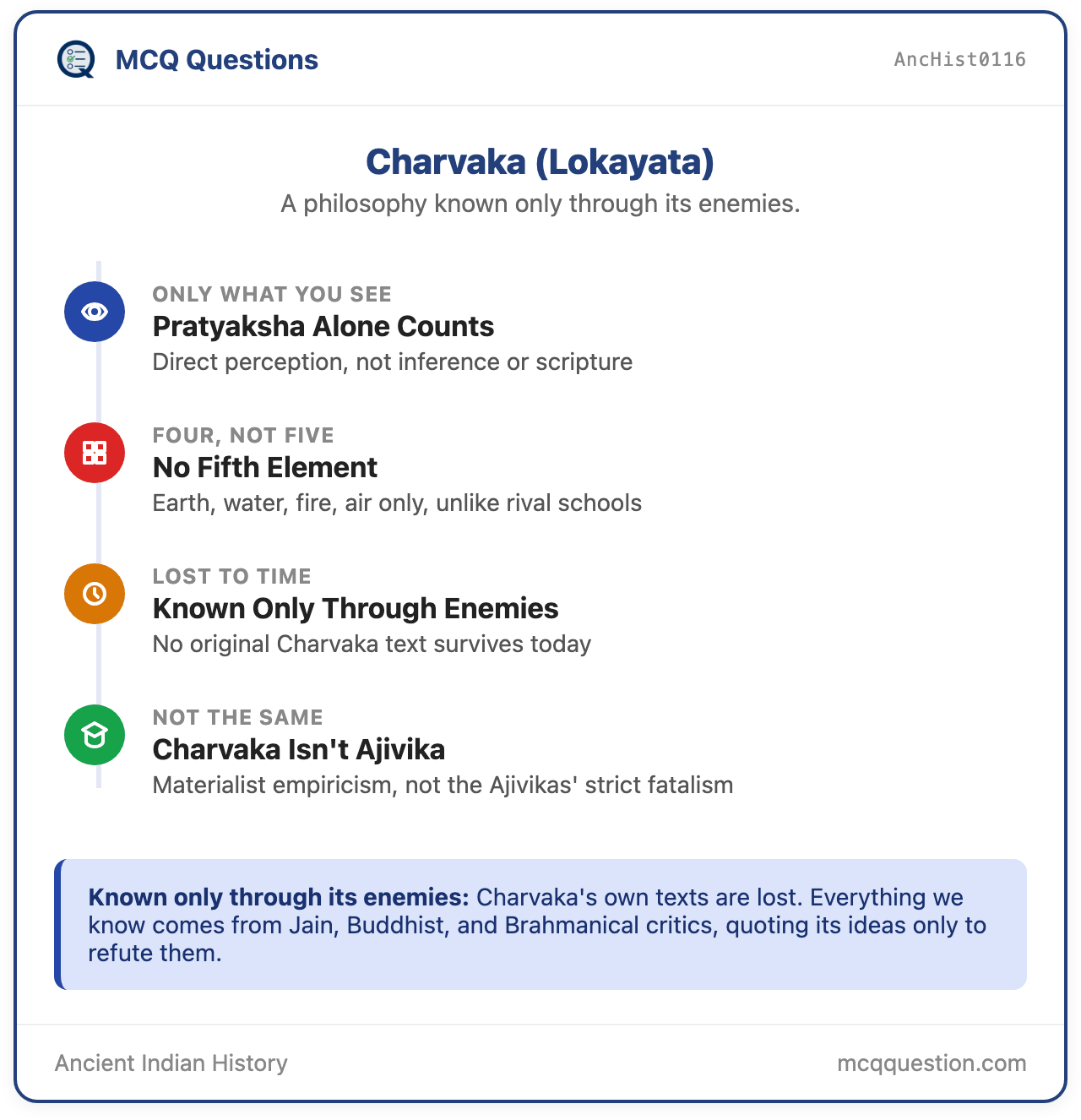
- Charvaka accepted only pratyaksha, direct perception, as a valid source of knowledge. It rejected both anumana (inference) and shabda (verbal testimony, including scripture).
- Its argument against inference targets something specific: vyapti, the claim that two things are universally, necessarily connected, like smoke and fire.
- Charvaka argued nobody can ever observe every instance of a connection, across all time and place, to prove it’s truly universal. Perception alone can’t establish that certainty.
- Using inference itself to prove that a connection is universal only assumes the very thing in question, a circular argument.
- Since testimony, including scripture, ultimately rests on the same kind of unproven claims, Charvaka rejected it for the same reason.
A World of Four Elements Need to Know
- Charvaka held that only four elements exist: earth, water, fire, and air.
- Most rival Indian schools added a fifth element, akasha (ether or space). Charvaka rejected it, since its existence can only be inferred, never directly perceived.
- It explained consciousness as an emergent property of the body, arising from these four elements combined. Its own sources compare this to how an intoxicating power emerges from fermented ingredients that, individually, lack it.
- Charvaka also turned its scepticism on Vedic ritual itself. One line, attributed directly to Brihaspati in the Sarvadarsanasangraha, calls fire sacrifices and ascetic practices mere means of livelihood. It adds a blunt jab: for those who have “no manliness nor sense.”
- Denying an afterlife, karma, and rebirth followed directly from this materialism. With nothing beyond the body’s four elements, pleasure in this one life becomes the only rational goal.
A Philosophy Known Only Through Its Enemies Good to Know

- No complete original Charvaka text survives. What we know comes almost entirely from Jain, Buddhist, and Brahmanical writers who quoted its ideas only to refute them.
- The single most detailed surviving account is Madhavacharya’s 14th-century Sarvadarsanasangraha, which presents Charvaka’s position before arguing against it.
- Jayarasi Bhatta’s Tattvopaplavasimha, from around the 8th or 9th century CE, is a real surviving text sometimes linked to Charvaka. Scholars are divided on whether it’s a genuine Charvaka offshoot, or a separate, more radical school of scepticism that questioned even perception itself.
- Not every ancient reference to Charvaka, called Lokayata here, was hostile. Kautilya’s Arthashastra lists Lokayata as one of three components of critical inquiry a king should study, alongside Samkhya and Yoga. That’s a comparatively neutral, administrative mention.
Test Yourself

Not the Same as Ajivika Great to Know
- Charvaka is often loosely grouped with other ancient “atheistic” schools, but it shouldn’t be confused with the Ajivikas, a separate heterodox tradition.
- The Ajivikas built their entire philosophy around niyati, strict cosmic determinism. Charvaka’s materialism carries no such commitment to fate.
- Both are classified as nastika, since both reject Vedic authority. That shared label is where the confusion usually starts, not from any real overlap in doctrine.
- Brihaspati’s own status as founder stays unresolved. Scholars are divided on whether he was a real historical author or a legendary attribution. Some even ask if he’s the same Brihaspati known elsewhere as the preceptor of the gods. No source resolves this cleanly.
- See ArtnCulture0046 — Four Orthodox Schools for the astika side Charvaka stood apart from, and AncHist0107 — Jain Texts and Scriptures for a similar pattern of lost original texts.
Beyond the answer
Browse all ancient-indian-history topics →
📚 Keep reading
UPSC CSP 2020 — General Studies Paper I (Full Question Paper)UPSC CSP 2025 — General Studies Paper I (Full Question Paper)UPSC CSP 2026 — General Studies Paper I (Full Question Paper)UPSC CSP 2022 — General Studies Paper I (Full Question Paper)UPSC CSP 2017 — General Studies Paper I (Full Question Paper)❓ Practice this topic
James Burgess founded a journal in 1872, and later served as Director General of the Archaeological Survey of India from 1886 to which year?Alexander Rea first excavated Amaravati in 1888–89. In which year did he go on to become the first Superintendent of the Archaeological Survey of Southern India?Robert Sewell's 1900 book “A Forgotten Empire” is a history of which South Indian empire, drawn from two Portuguese travellers' accounts?A.H. Longhurst's excavations from 1926 to 1931 uncovered a great stupa and several smaller structures at which site?🎲 Take a Ancient Indian History Quiz
Leave a Reply