Diseases fall into two broad categories, based on one key distinction: whether they can spread from person to person, or not.

.jpg)
 MCQ Questions
India’s Disease Burden
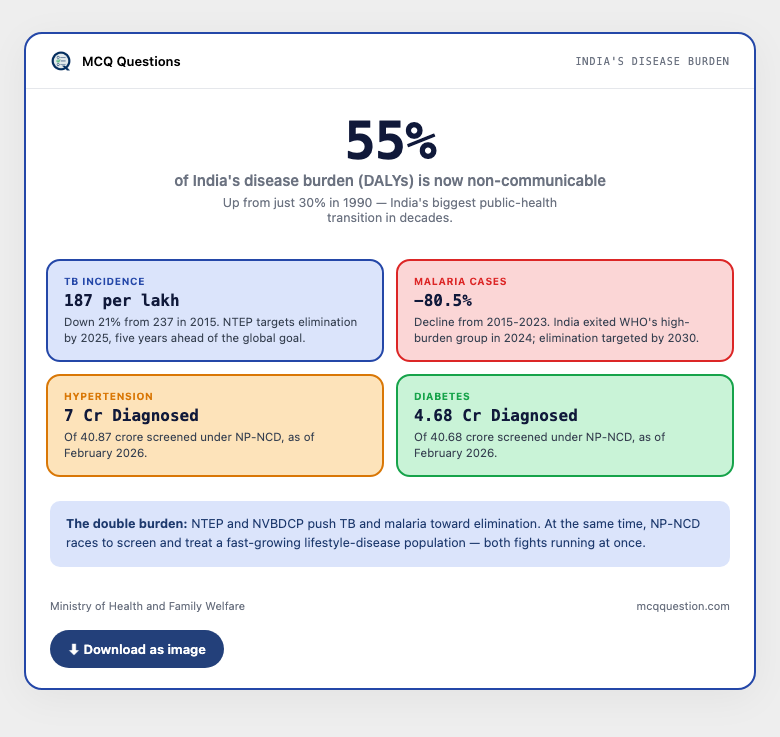
55%
of India’s disease burden (DALYs) is now non-communicable
Up from just 30% in 1990 — India’s biggest public-health transition in decades.
TB Incidence
187 per lakh
Down 21% from 237 in 2015. NTEP targets elimination by 2025, five years ahead of the global goal.
Malaria Cases
−80.5%
Decline from 2015-2023. India exited WHO’s high-burden group in 2024; elimination targeted by 2030.
Hypertension
7 Cr Diagnosed
Of 40.87 crore screened under NP-NCD, as of February 2026.
Diabetes
4.68 Cr Diagnosed
Of 40.68 crore screened under NP-NCD, as of February 2026.
The double burden: NTEP and NVBDCP push TB and malaria toward elimination. At the same time, NP-NCD races to screen and treat a fast-growing lifestyle-disease population — both fights running at once.
⬇ Download as image
Must Know
🏛️ Must Know
Two Broad Categories of Disease
- Communicable Communicable diseases are caused by pathogens — bacteria, viruses, fungi, or parasites. They can spread from person to person.
- Examples Common communicable diseases in India include tuberculosis, malaria, dengue, and various respiratory infections.
- Non-Communicable Non-communicable diseases don’t spread between people. They include conditions like diabetes, hypertension, and cardiovascular disease.
- Vaccination Vaccination remains one of the most effective tools for preventing many communicable diseases at a population level.
- Lifestyle Link Non-communicable diseases are often linked to lifestyle factors. These include diet, physical activity levels, and tobacco or alcohol use.
- Acute vs Chronic An acute disease lasts only a short time, like the common cold. A chronic disease persists for a long time, sometimes a lifetime, and does far more lasting damage to overall health.
- How Diseases Spread Infectious diseases spread through several routes: airborne (tuberculosis), waterborne (cholera), vector-borne through an insect carrier (malaria, dengue), and direct physical or sexual contact.
Good to Know
📘 Good to Know
India’s Disease Burden and Control Programmes
- Dual Burden India’s disease burden includes both persistent communicable diseases and a rising share of non-communicable, lifestyle-related conditions.
- Vector Control Vector-borne diseases spread through carriers like mosquitoes. They need distinct prevention strategies, including vector control alongside treatment.
- Surveillance Public health surveillance systems track disease outbreaks. This helps authorities respond quickly to prevent wider communicable-disease spread.
- TB and Malaria As of 2024, India’s TB incidence had fallen to 187 per lakh population, down from 237 in 2015. Malaria cases fell 80.5% over 2015-2023, and India exited the WHO’s high-burden group that year.
- Shifting Burden Non-communicable diseases made up just 30% of DALYs (a measure of healthy years lost) in 1990. That share had risen to 55% by 2016. See GenSci0032 — NCDs in India for the full policy picture behind this shift.
Zika Virus Disease
- Mosquito Link In tropical regions, Zika virus disease spreads through the same Aedes mosquito species that spreads dengue.
- Sexual Transmission Zika can also spread through sexual contact. This route is confirmed by CDC-documented cases, not just mosquito bites.
- Symptoms Most Zika infections cause mild or no symptoms, such as fever, rash, and joint pain. But infection during pregnancy can cause serious birth defects.
- Related For more on virus biology generally, see GenSci0045 — Virus Biology Basics.
Test Yourself
Loading practice…
Great to Know
🌟 Great to Know
Why the Two Categories Matter for Policy
- Shifting Burden India’s disease burden is shifting. It is moving from mostly communicable disease toward a growing share of non-communicable disease.
- Changing Lifestyles This shift reflects broader changes in lifestyle and rising life expectancy across the population.
- Policy Design Effective public health policy must address both categories at once. Each needs a very different prevention and treatment strategy.
- Two Approaches The communicable versus non-communicable distinction explains why some health interventions focus on containment. Others focus instead on lifestyle change.
📰 Current Affairs
Dengue in 2026: This Article’s Communicable-Disease Case Study, Live
- The NumbersIndia’s National Center for Vector Borne Diseases Control reported 6,927 dengue cases and 10 deaths nationwide, provisional data as of 28 February 2026. (Source: NCVBDC, Ministry of Health and Family Welfare)
- The Global PictureGlobally, over 1.5 million dengue cases and more than 500 dengue-related deaths were reported in 2026 through 31 July, continuing dengue’s status as one of the world’s fastest-spreading mosquito-borne diseases.
- So WhatThis is the same Aedes-mosquito-borne disease this article’s own PYQ card covers (UPSC CSP 2017, Q31), now with real, current surveillance numbers instead of just the underlying biology. Vector-borne communicable disease tracking is exactly the kind of live government data this topic keeps generating year after year.
📝 Previous Year Questions
NDA-NA (II) 2016 — Malarial Parasite is a Protozoan
- NDA-NA-2 2016 Malaria is caused by Plasmodium, a single-celled protozoan, not a bacteria, virus, or fungus — it spreads via the bite of an infected female Anopheles mosquito. See NDA-NA (II) 2016, Q69.
UPSC CSP 2017 — Zika Virus Transmission
- UPSC 2017 Both statements are correct. In tropical regions, the Aedes mosquito spreads Zika, and it also spreads dengue. Zika can also spread through sexual contact, a route confirmed by CDC-documented cases. See UPSC CSP 2017 GS Paper I, Q31.
Beyond the answer
Browse all general-science topics →
📚 Keep reading
GenSci0032 — Non-Communicable Diseases (NCDs) in India: Cancer, Diabetes, ObesityIndGov0007 — Health Sector: Initiatives, Challenges and Emerging DiseasesGenSci0027 — ICMR (Indian Council of Medical Research)GenSci0033 — India's First Dengue VaccineGenSci0042 — The Wolbachia Method❓ Practice this topic
D4452 — In India, the alternating current supplied to homes reverses its direction at a frequency of how many hertz?D4451 — What is the role of the split ring in a simple electric motor?D4450 — Inside a current-carrying solenoid, the magnetic field lines run as parallel straight lines. What does this indicate about the field?D4449 — In an electric motor, which rule gives the direction of the force acting on a current-carrying coil placed in a magnetic field?🎲 Take a General Science Quiz
Leave a Reply