In Assam, a Bihu dancer’s hair is never bare. It carries a spray of small white flowers, spotted pink, dangling like a fox’s tail. That flower is Rhynchostylis retusa — and it is the official state flower of not one, but two Indian states.

 MCQ Questions
1. Taxonomy and Shape
- Overview Rhynchostylis retusa (L.) Blume is a flowering orchid in the Vanda alliance, within the family Orchidaceae.
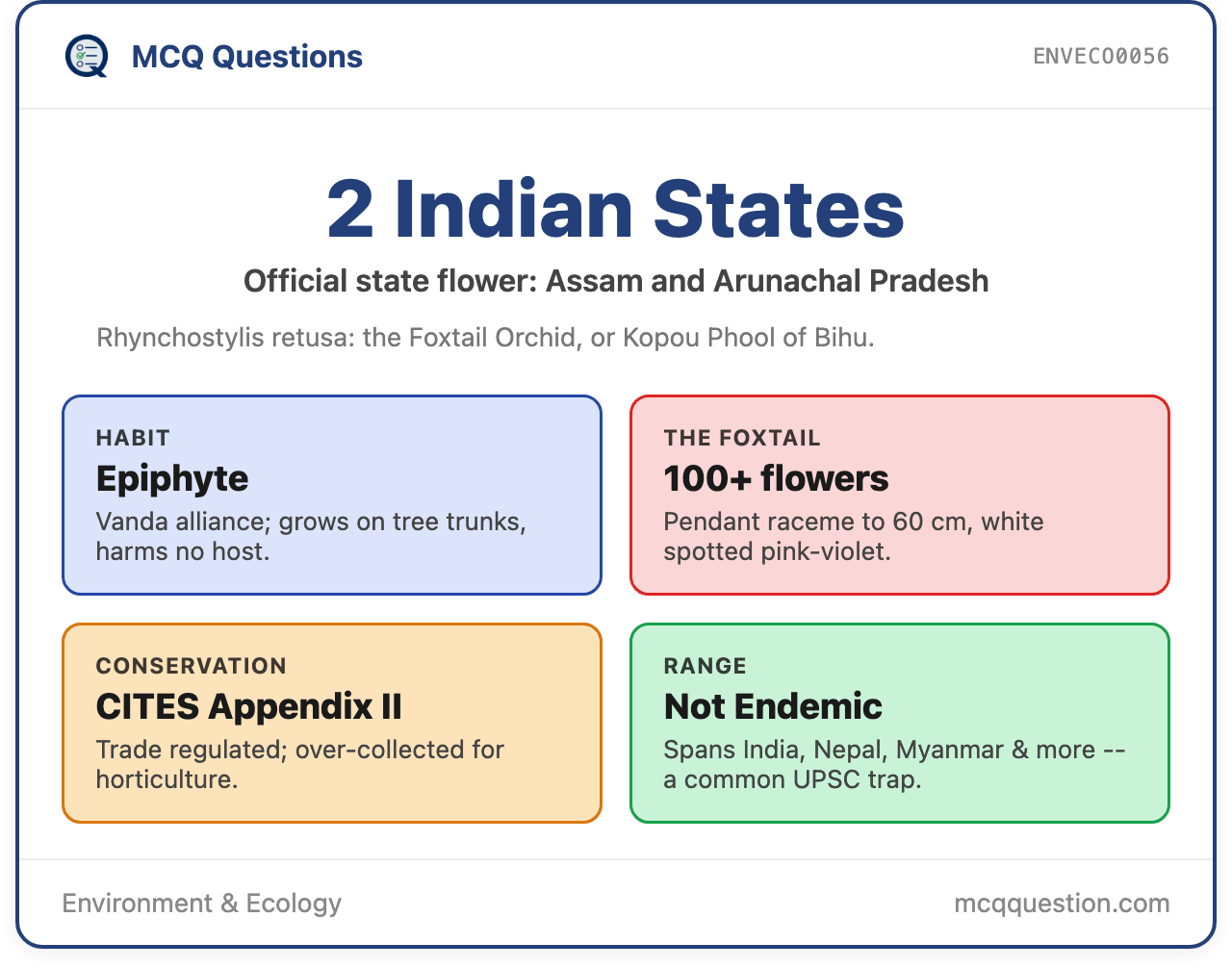
- Habit It is a monopodial epiphyte. It clings to tree trunks with aerial roots and absorbs moisture from the air, without parasitising its host.
- Stem & Leaves It carries a short, stout, creeping stem with up to 12 fleshy leaves. Each leaf tip is notched, or “retuse,” which gives the species its name.
- The Foxtail Its signature feature is a pendant raceme up to 60 cm long. It packs in over 100 white flowers, spotted pink or violet, shaped like a bushy fox’s tail.
2. Where It Grows
- Not Endemic Despite its strong link to North-east India, R. retusa is not endemic to the region — a frequent exam trap.
- Wide Range It also grows across Nepal, Bhutan, Sri Lanka, Myanmar, Thailand, Malaysia, Indonesia, and the Philippines.
- In India Within India, it is most common in the North-east, plus Odisha, Andhra Pradesh, and the Andaman forests.
- Habitat It grows on tree trunks in open forests, from lowland humid forests up to roughly 300-1,500 m elevation.
1. Bihu and Two State Flowers
- Kopou Phool In Assam, the flower is called kopou phool. It is an essential part of a Bihu dancer’s attire.
- Symbolism Among Assamese youth, it stands for love. It also appears at weddings, as an emblem of fertility and celebration.
- Two States R. retusa is the official state flower of both Assam and Arunachal Pradesh — a rare case of one species serving two Indian states.
- Not Sikkim Sikkim’s own state flower is a different orchid, Dendrobium nobile, not R. retusa.
- Beyond India The species also serves as the provincial flower of Uva Province, Sri Lanka, where it is called Guruluraja.
2. Traditional Medicine
- Rasna Under the name rasna, the root has traditionally treated rheumatism across the subcontinent.
- Regional Uses In the Malabar region, preparations targeted asthma, tuberculosis, and cramps. In Assam, the plant has treated wounds, cuts, and bruises.
Test Yourself

1. Why Wild Stocks Are Falling
- Overexploitation Once plentiful, R. retusa is now classified as endangered in review literature. Heavy collection for the ornamental trade is the main driver.
- Habitat Loss Clearing of open forests removes the host trees the epiphyte depends on, adding to collection pressure.
2. Legal Protection
- CITES R. retusa is listed in CITES Appendix II. International commercial trade in wild-collected specimens is regulated, not banned outright.
- Orchid-wide Cover Nearly all orchid species sit under some CITES appendix, making orchids one of the most comprehensively trade-regulated plant families.
- Wildlife Act Under the original Wildlife (Protection) Act, 1972, most protected Indian orchids fell under Schedule VI. The 2022 amendment reorganised six schedules into four, folding CITES-listed specimens into a new Schedule IV.
- Tissue Culture Researchers back micropropagation, or tissue culture, as the sustainable way to meet horticultural demand without stripping wild trees.
3. Previous Year Question
- UPSC 2026 On epiphytism, endemism, and state-flower status, this exact species was asked about directly in UPSC CSP 2026, GS Paper I. See below.
Previous Year Question
Asked as: “Consider the following statements about Rhynchostylis retusa (Foxtail orchid): 1. It is an epiphytic orchid. 2. The species is endemic to North-east India. 3. It is the State flower of Arunachal Pradesh and Assam. Which of the statements given above is/are correct?” (UPSC CSP 2026, GS Paper I). Answer: 1 and 3 only — the species is epiphytic and is the state flower of both states, but it is not endemic to North-east India.
For India’s mangrove ecosystems, see EnvEco0027 — Mangrove Forests of India: Beyond the Sundarbans. For the climate of the Andaman & Nicobar Islands, home to other orchid-rich forests, see IndGeo0121 — Andaman and Nicobar Islands: Climate. For the 2022 six-to-four schedule reform from an animal-species angle, see EnvEco0063 — The Indian Flying Fox and the WPA 1972 Schedules.
Beyond the answer
Browse all environment-and-ecology topics →
📚 Keep reading
UPSC CSP 2026 — General Studies Paper I (Full Question Paper)UPSC CSP 2019 — General Studies Paper I (Full Question Paper)UPSC CSP 2023 — General Studies Paper I (Full Question Paper)UPSC CSP 2024 — General Studies Paper I (Full Question Paper)EnvEco0001 — Pollution, Ecosystems and Biodiversity❓ Practice this topic
India's mineral security problem is mostly about which of the following, rather than a shortage of underground reserves?Roughly what share of India's total degraded land is concentrated in just nine states, including Rajasthan, Maharashtra, and Gujarat?Roughly how much employment has India's Bonn Challenge restoration work generated, alongside its ecological goals?Which of these is NOT one of the main processes driving land degradation in India, per the ISRO Atlas?🎲 Take a Environment And Ecology Quiz
Leave a Reply