The rainbow colours of Yellowstone’s Grand Prismatic Spring aren’t a mineral trick — they’re living microbial mats, thriving in water hot enough to scald a human hand instantly.


mcqquestion.com
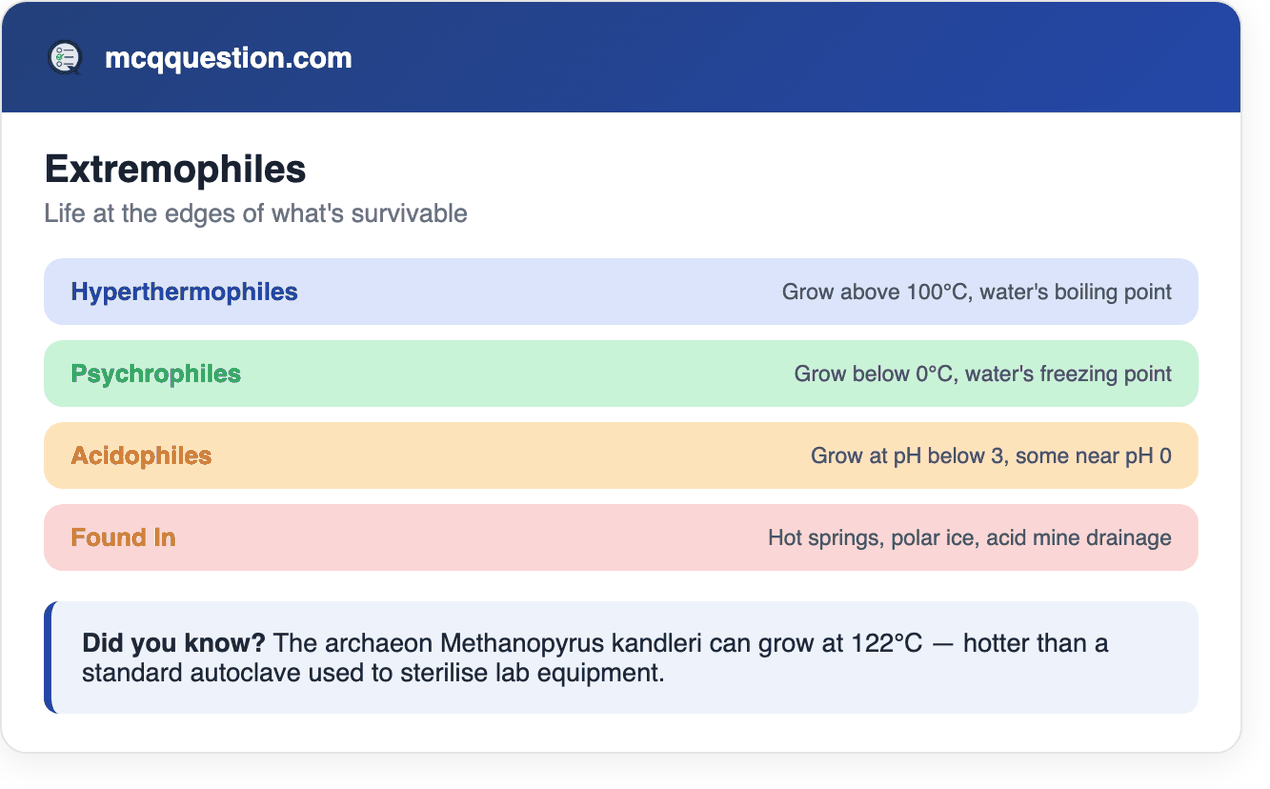
Extremophiles
Life at the edges of what’s survivable
HyperthermophilesGrow above 100°C, water’s boiling point
PsychrophilesGrow below 0°C, water’s freezing point
AcidophilesGrow at pH below 3, some near pH 0
Found InHot springs, polar ice, acid mine drainage
Did you know? The archaeon Methanopyrus kandleri can grow at 122°C — hotter than a standard autoclave used to sterilise lab equipment.
🏛️ Must Know
What Extremophiles Are
- Life Beyond Normal Limits Extremophiles are microorganisms — mostly bacteria and archaea — that thrive in conditions once thought too extreme to support life, from boiling acid pools to permanently frozen ice.
- Hyperthermophiles These microbes grow at temperatures above water’s boiling point (100°C). The archaeon Methanopyrus kandleri, found near deep-sea hydrothermal vents, can grow at 122°C.
- Psychrophiles These microbes grow at temperatures below water’s freezing point (0°C), surviving in polar ice, permafrost, and cold deep-sea habitats by preventing ice crystals from destroying their cells.
- Acidophiles These microbes thrive in highly acidic environments with a pH below 3 — some, like Picrophilus species, can even grow near pH 0, more acidic than battery acid.
🏘️ Good to Know
Other Extreme Adaptations
- Halophiles These microbes flourish in extremely salty environments, such as salt flats and hypersaline lakes, where salt concentrations would dehydrate most other organisms.
- Barophiles Also called piezophiles, these organisms thrive under the crushing pressure of the deep ocean, sometimes thousands of metres below the surface.
- Polyextremophiles Some organisms are adapted to more than one extreme condition at once — a “thermoacidophile,” for example, tolerates both high heat and high acidity simultaneously.
⚡ Great to Know
Why Extremophiles Matter Beyond Biology
- Grand Prismatic Spring’s Colours The rainbow rings around Yellowstone’s Grand Prismatic Spring come from pigmented thermophilic microbial mats, with different species dominating at different temperature zones from the scalding centre outward.
- Industrial Enzymes Heat-stable enzymes from hyperthermophiles, like Taq polymerase from Thermus aquaticus, made possible the PCR technique used throughout modern genetics and diagnostics.
- Clues for Astrobiology Because extremophiles prove life can survive in conditions once thought impossible, they shape scientists’ search for life on other worlds, including icy moons and Mars.
Test Yourself

.jpg)
📝 Previous Year Question
UPSC CSP 2023 — Extremophile Microorganism Statements
- UPSC 2023 All three statements are correct. Hyperthermophiles grow above the boiling point of water, psychrophiles grow below the freezing point, and acidophiles grow at pH below 3 — all genuine, documented extremophile categories. See UPSC CSP 2023 GS Paper I, Q18.
Beyond the answer
Browse all general-science topics →
📚 Keep reading
UPSC CSP 2026 — General Studies Paper I (Full Question Paper)UPSC CSP 2023 — General Studies Paper I (Full Question Paper)UPSC CSP 2025 — General Studies Paper I (Full Question Paper)UPSC CSP 2024 — General Studies Paper I (Full Question Paper)UPSC CSP 2021 — General Studies Paper I (Full Question Paper)❓ Practice this topic
Besides livestock cloning, what is SCNT technology also being explored for?Roughly how many SCNT attempts did it take to produce Dolly the sheep as a live birth?Which animal was the first mammal successfully cloned via Somatic Cell Nuclear Transfer?In Somatic Cell Nuclear Transfer, what happens to the nucleus of the egg cell used?🎲 Take a General Science Quiz
Leave a Reply