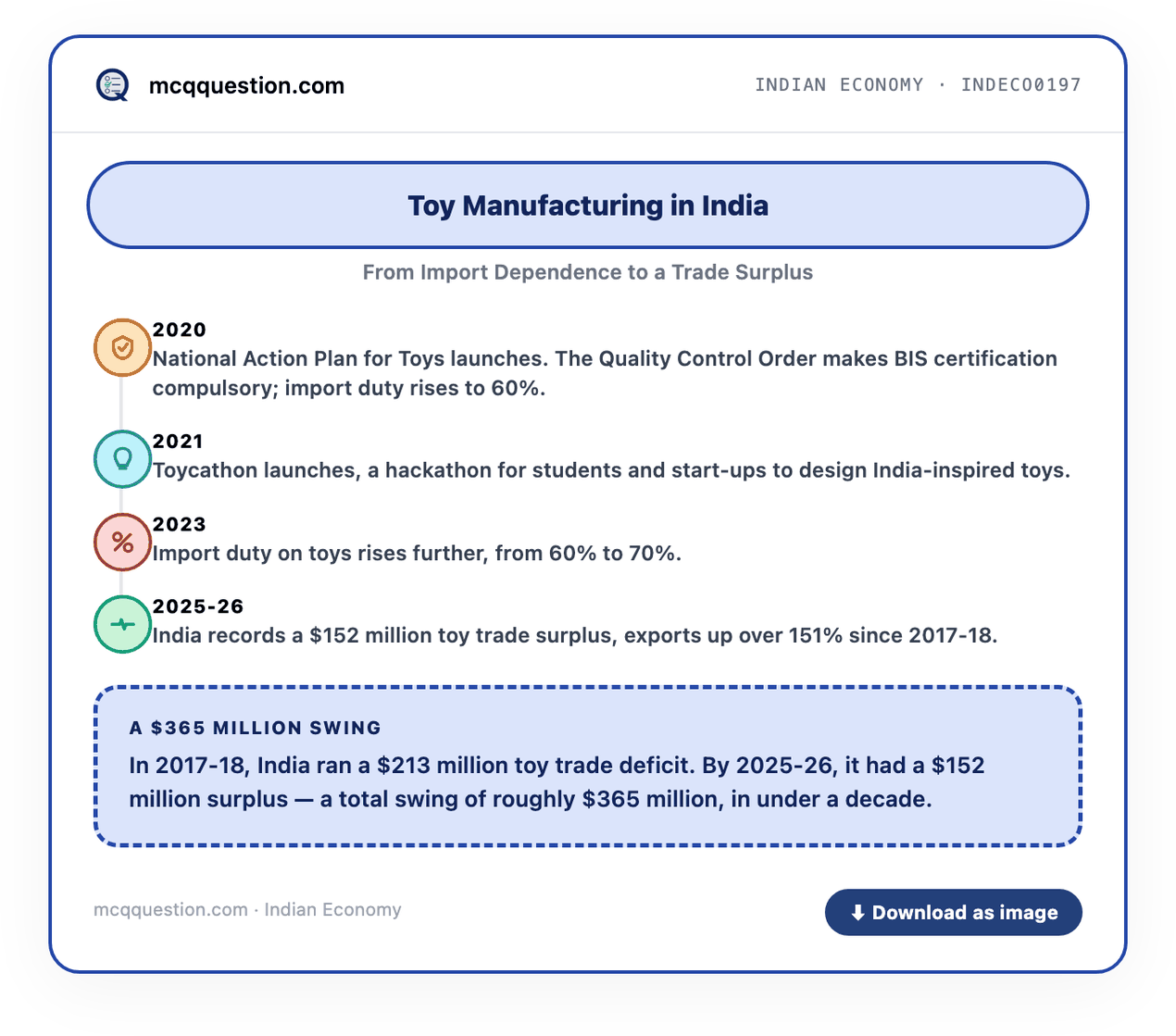
In 2017, India bought far more toys from abroad than it sold. By 2026, that flipped completely, from a $213 million deficit to a $152 million surplus.
 mcqquestion.com
Indian Economy · IndEco0197
Toy Manufacturing in India
From Import Dependence to a Trade Surplus
2020
National Action Plan for Toys launches. The Quality Control Order makes BIS certification compulsory; import duty rises to 60%.
2021
Toycathon launches, a hackathon for students and start-ups to design India-inspired toys.
2023
Import duty on toys rises further, from 60% to 70%.
2025-26
India records a $152 million toy trade surplus, exports up over 151% since 2017-18.
A $365 Million Swing
In 2017-18, India ran a $213 million toy trade deficit. By 2025-26, it had a $152 million surplus — a total swing of roughly $365 million, in under a decade.
Must Know
- India’s toy exports rose from $152.7 million in 2017-18, to $384.7 million in 2025-26. That is growth of over 151%.
- Over the same period, India’s toy trade flipped from a $213 million deficit to a $152 million surplus.
- This turnaround followed the National Action Plan for Toys (NAPT), launched in 2020. It aimed to build domestic manufacturing and restrict low-quality imports.
- A central tool was the Quality Control Order (QCO) for Toys, 2020. It made Bureau of Indian Standards (BIS) certification compulsory, for both domestic and imported toys.
- Import duties on toys rose sharply too: from 20% to 60% in 2020, then to 70% in 2023.
Good to Know
- Imports of traditional and educational toys fell by 66%, over the same period, as domestic manufacturing filled the gap.
- Employment in the toy sector more than doubled. It rose from 8,685 workers in 2018-19, to 17,693 in 2023-24, under NIC Code 324 (Games and Toys).
- The United States is India’s largest toy export market. Exports there more than quadrupled, from $26.7 million to about $111.9 million, over the same period.
- GST on toys was cut, from 12% to 5%, making them cheaper for domestic buyers.
- Free Trade Agreements with the UAE, Australia, the UK, and others give Indian toys zero-duty access to those markets.
Test Yourself

Great to Know
- Toycathon, launched in 2021, is a hackathon-style initiative. Students, designers, and start-ups design new toys inspired by Indian culture and folklore.
- In 2025, the government held the first Electronic Toy Hackathon (e-Toycathon), focused specifically on electronic and educational toys.
- The e-Toys Lab, run by MeitY at C-DAC, Noida, trains young engineers in electronic toy design. This includes candidates from SC/ST and North-Eastern backgrounds.
- Several traditional toys carry Geographical Indication (GI) tags, including Channapatna Toys, Thanjavur Dolls, and Indore’s Leather Toys. GI-tagged toys are exempt from the mandatory BIS certification.
- The One District One Product (ODOP) initiative has identified more than 10 districts with strong toy and doll export potential.
Current Affairs
- 27 July 2026: Commerce Minister Piyush Goyal announced a dedicated Toy Sector Task Force, targeting a 5% share of the global toy market by 2032.
- The task force will work on 6 areas: global value chain integration, manufacturing capability, value-chain bottlenecks, workforce skilling, design and innovation, and ease of doing business.
- Goyal also launched the Toy Sector Playbook, a roadmap for manufacturers, startups, MSMEs, and investors, covering quality standards, IP, and export opportunities.
- DPIIT said India’s toy ecosystem now has over 21,000 MSMEs, 770+ DPIIT-recognised toy startups, nearly 50 toy clusters, and 1,800+ BIS licensees.
- 7 July 2026: PIB published a detailed backgrounder on India’s toy industry. It confirmed the sector’s $152 million trade surplus for 2025-26, up from a $213 million deficit in 2017-18. (Source: PIB)
- 4 to 7 July 2026: The Toy Biz International B2B Exhibition, one of India’s largest toy trade fairs, was held at Bharat Mandapam, New Delhi. (Source: PIB)
- April 2026: The Bureau of Indian Standards (BIS) held a “Manak Manthan” session, on IS 9873 (Part 1):2025, covering the mechanical and physical safety of toys. (Source: PIB)
Beyond the answer
Browse all indian-economy topics →
📚 Keep reading
IndEco0317 — Non-Farm Primary Activities: Physiographic Links in IndiaIndEco0316 — High-Value Crop Selection: Factors Guiding Indian FarmersIndEco0315 — Fiscal Health Index: Assessing India's State Fiscal PerformanceIndEco0314 — Aspirational Districts Programme: Transformation StrategiesIndEco0313 — Industrial Corridors in India: Significance and Characteristics❓ Practice this topic
🎲 Take a Indian Economy Quiz
Leave a Reply