India makes more cement than any country except China. Every road, bridge, and housing scheme depends on it. But the same kilns that build modern India also make cement one of the world’s biggest sources of carbon dioxide.

 MCQ Questions
Must Know.
India’s Cement Industry at a Glance.
Scale and Output.
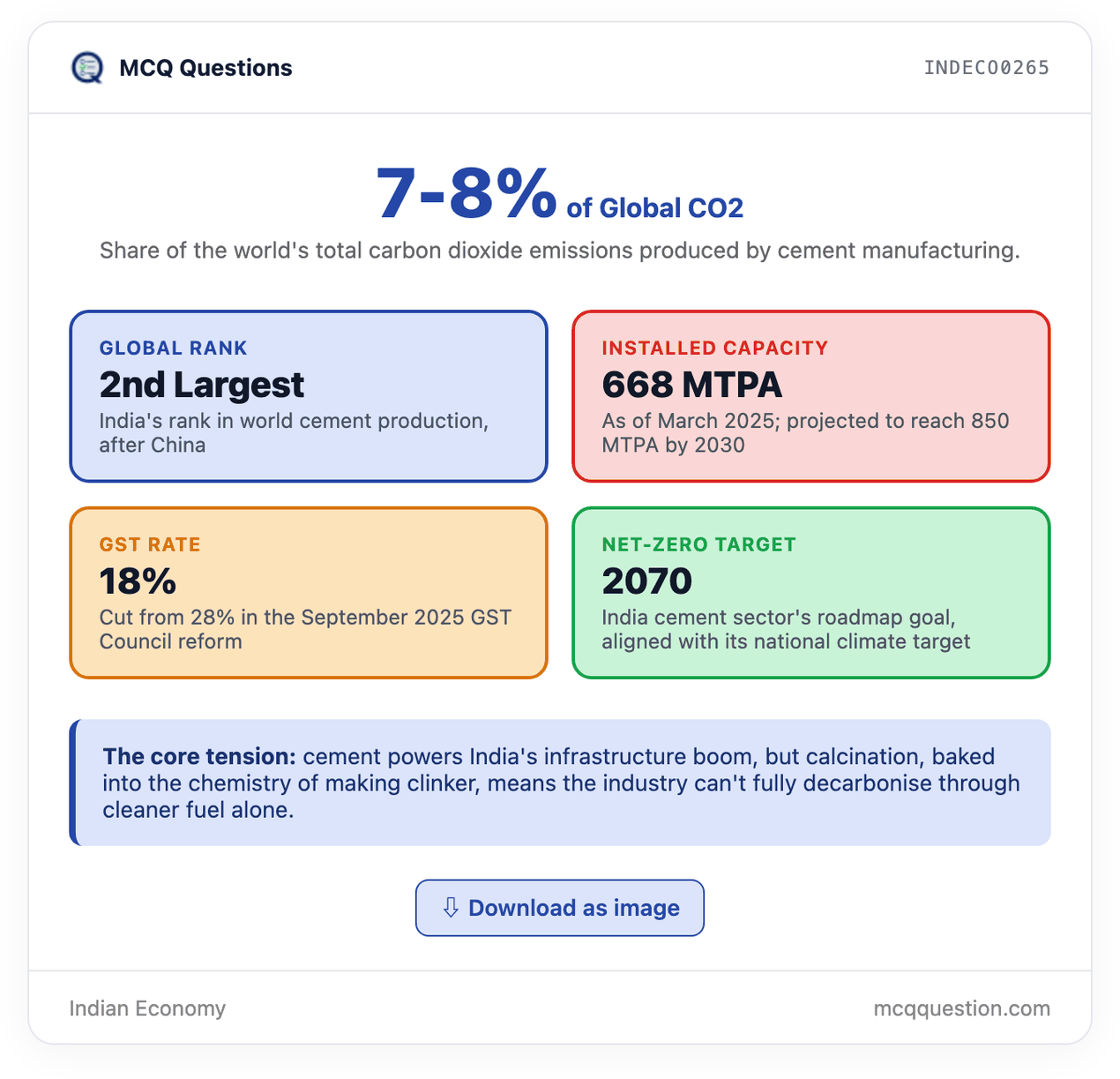
- Global Rank. India is the world’s second-largest cement producer, after China. It holds over 8% of global installed capacity.
- Installed Capacity. India’s installed cement capacity stood at around 668 million tonnes per year as of March 2025. Industry estimates put it closer to 690 million tonnes today.
- Actual Production. India produced about 491 million tonnes of cement in FY26, up over 8% from the previous year.
- Future Growth. Capacity is projected to reach 850 million tonnes per year by 2030. Industry bodies expect it to cross 1,350 million tonnes by 2050.
- Per-Capita Use. India’s per-capita cement consumption is around 290 kg a year. The global average is nearly double, at about 540 kg.
- Private-Sector Dominance. Roughly 98% of India’s cement capacity sits with private companies, not the state. The top 20 firms produce about 70% of total output.
Who Makes India’s Cement.
The Major Companies.
- UltraTech Cement. India’s market leader, with around 28% market share. It crossed 200 million tonnes of capacity in April 2026 and plans further expansion.
- Ambuja Cements. Crossed 100 million tonnes of capacity in FY25. It aims for 140 million tonnes by FY28, partly through acquiring Penna Cement.
- ACC Limited. Adani Group bought Ambuja Cements and ACC from Holcim in 2022. The two firms’ boards approved a full ACC-Ambuja merger in December 2025.
- Shree Cement. A major northern-India player, with capacity of around 53.5 million tonnes.
- Dalmia Bharat. A leading southern and eastern producer, expanding toward 75 million tonnes of capacity by FY28.
- JK Cement and Others. JK Cement, Ramco Cements, India Cements, and Nuvoco Vistas round out the top tier. JSW Cement, a newer entrant, listed on the stock exchange in August 2025.
Good to Know.
Where Cement Plants Cluster.
Following the Limestone.
- Raw-Material Pull. Limestone is heavy and low in value per tonne. Moving it long distances is costly, so plants locate near limestone deposits instead of near their final markets.
- Major Clusters. Large integrated plants concentrate heavily in Andhra Pradesh, Rajasthan, and Tamil Nadu. Madhya Pradesh, Karnataka, Gujarat, and Chhattisgarh are also major producing states.
- Finished-Goods Shipping. Once limestone becomes cement, it is far more valuable per tonne of weight. It is then shipped out from these clusters to construction markets nationwide.
From Limestone to Cement.
The Manufacturing Process.
- Limestone. The main raw material, making up roughly 80 to 90% of the feed mix. It supplies the calcium carbonate cement needs.
- Silica-Bearing Clay. Mixed with limestone to supply silica and alumina. This is a physical blending step. It does not by itself release carbon dioxide.
- Kiln and Clinker. The blended raw mix is heated in a rotary kiln to about 1450°C. This produces clinker, the semi-finished intermediate that gives cement its strength.
- Gypsum and Grinding. Cooled clinker is ground together with gypsum, which controls how fast the final cement sets.
- Blended Substitutes. Fly ash from thermal power plants and slag from steel plants can replace part of the clinker. This is how India makes Portland Pozzolana Cement (PPC) and Portland Slag Cement (PSC).
Policy Behind the Push.
Government Support and Demand Drivers.
- PAT Scheme. The Perform, Achieve, Trade scheme, run under the National Mission for Enhanced Energy Efficiency, sets energy-saving targets for cement plants. The sector beat its Cycle I target by over 81%.
- Tradeable Certificates. Plants that save more energy than required earn Energy Saving Certificates. These can be traded to plants that fall short of their own targets.
- GST Rate Cut. The GST Council cut cement’s tax rate from 28% to 18% in September 2025. Industry had sought this cut for years, arguing it would improve project viability.
- Infrastructure Demand. Government infrastructure programmes, including PM Gati Shakti and rural and urban housing missions, are major demand drivers for domestic cement consumption.
Previous Year Question.
This topic was asked as a statement-based question in UPSC CSP 2025, GS Paper I, on cement industry carbon dioxide emissions, silica-bearing clay, and clinker production. View this question.
Test Yourself.

Great to Know.
Cement’s Carbon Problem.
Why Cement Emits So Much CO2.
- Global Share. Cement manufacturing produces about 7 to 8% of the world’s total carbon dioxide emissions. Global output was around 1.6 billion tonnes of CO2 in 2022.
- Calcination Is the Main Source. Heating limestone in the kiln breaks calcium carbonate down into lime and carbon dioxide. This chemical step, called calcination, causes roughly 50 to 60% of the industry’s emissions.
- Fuel Combustion Adds More. Most of the remaining emissions come from burning fuel to heat the kiln to around 1450°C. This is separate from the calcination reaction itself.
- A Structural Problem. Calcination emissions happen even in an efficient, well-run kiln. This is why cement stays emissions-intensive even as plants improve their energy efficiency.
India’s Path to Net Zero.
Cutting Emissions in Practice.
- Blended Cements Cut Clinker Use. Replacing part of the clinker with fly ash or slag lowers emissions. Portland Pozzolana Cement cuts emissions around 27% versus plain cement, and Portland Slag Cement around 39%.
- Alternative Fuels. Many plants now co-process waste, such as refuse-derived fuel and biomass, as kiln fuel instead of coal. This displaces some fossil-fuel combustion emissions.
- India’s Roadmap. A decarbonisation roadmap for India’s cement sector, prepared with the Global Cement and Concrete Association and TERI, targets net-zero CO2 by 2070. This lines up with India’s own national climate target, not the global industry’s separate 2050 goal.
- Carbon Capture Pilots. UltraTech is running a carbon-capture pilot with IIT Madras and BITS Pilani Goa at its Reddipalayam plant in Tamil Nadu, funded partly by the Department of Science and Technology.
- Dalmia Bharat’s Pledge. Dalmia Bharat has pledged to become carbon-negative by 2040. It is building a large carbon-capture facility at its Chennai plant with UK-based Carbon Clean Solutions.
Related reading: for how cement fits into India’s broader industrial base, see IndEco0005 — Industry. For the government’s wider approach to manufacturing, see IndEco0038 — Evolution of India’s Industrial Policy.
Beyond the answer
Browse all indian-economy topics →
📚 Keep reading
UPSC CSP 2025 — General Studies Paper I (Full Question Paper)UPSC CSP 2021 — General Studies Paper I (Full Question Paper)EnvEco0053 — India's Climate Change Policy: LT-LEDS, NDCs, and the Path to Net-ZeroEnvEco0078 — Carbon MarketsEnvEco0029 — Fly Ash❓ Practice this topic
Atal Innovation Mission is set up under theD0231 — Which statement about India's fisheries sector is correct?D0230 — Why is the Rann of Kutch important for non-farm primary activity?D0229 — Which pairing of a non-farm primary activity with its physiographic setting is correct?🎲 Take a Indian Economy Quiz
Leave a Reply