In one 12-month stretch, India signed or activated trade deals with the UK, four European nations, Oman, and the EU. This article covers India’s major recent international treaties and agreements.

Timeline
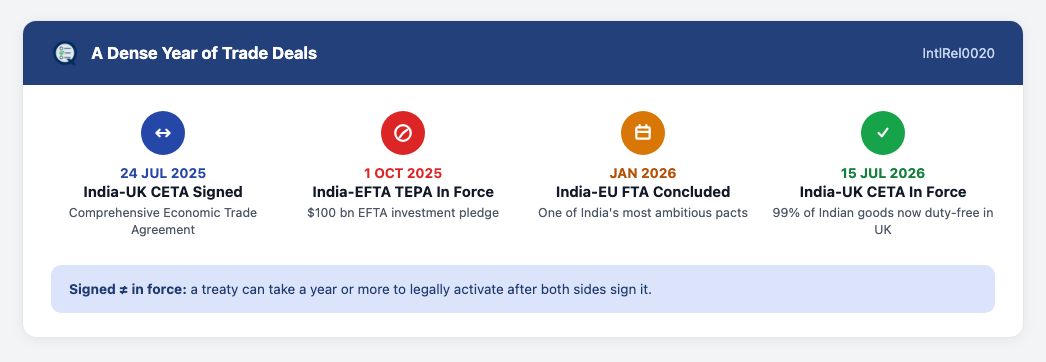
- 24 July 2025: India signs its Comprehensive Economic and Trade Agreement (CETA) with the UK.
- 1 October 2025: The India-EFTA Trade and Economic Partnership Agreement enters into force.
- January 2026: India concludes a Free Trade Agreement with the EU.
- 15 July 2026: The India-UK CETA comes into force.
Must Know
- India signed its Comprehensive Economic and Trade Agreement (CETA) with the UK on 24 July 2025; it came into force on 15 July 2026.
- The India-EFTA Trade and Economic Partnership Agreement (with Switzerland, Norway, Iceland, Liechtenstein) entered into force on 1 October 2025, with EFTA committing $100 billion in investment over 15 years.
- India concluded a Free Trade Agreement with the EU in January 2026, one of its most ambitious trade pacts to date.
- India also signed a CEPA with Oman (December 2025) and an FTA with New Zealand (27 April 2026).
Good to Know
- Under the UK CETA, 99% of Indian goods entering the UK, and 90% of UK goods entering India, become duty-free or see reduced tariffs.
- The UK deal is projected to add £25.5 billion a year to bilateral trade in the long run.
- FY2025-26 saw an unusually dense cluster of trade deals — UK, EFTA, Oman, EU, New Zealand — marking a major expansion of India’s trade outreach.
- “Signed” and “entered into force” are different milestones. The EFTA TEPA was signed in March 2024 but only took legal effect in October 2025.
Test Yourself

Great to Know
- India’s recent FTA wave targets both mature markets (UK, EU) and smaller specialised economies (EFTA, Oman, New Zealand) — a strategy of diversifying trade partners rather than relying on any single bloc.
- These bilateral trade deals work differently from India’s push for UN, IMF, and World Bank reform. FTAs are negotiated one-on-one on India’s own terms; institutional reform needs consensus among many other states.
- The gap between signing and entry into force, often a year or more, reflects the parliamentary ratification and legal-review process each side must complete. A treaty isn’t law until both sides finish this.
- For India’s parallel push to reshape multilateral institutions, see IntlRel0019 — International Organisations (UN System, WTO, IMF, World Bank).
Current Affairs
- On 20 July 2026, India joined the WTO Agreement on Fisheries Subsidies (AFS). It became the 123rd WTO member to accept the pact. (Source: PIB)
- Commerce Secretary Rajesh Agrawal handed India’s Instrument of Acceptance to WTO Director-General Ngozi Okonjo-Iweala, in Geneva. (Source: PIB)
- The AFS, adopted in June 2022, is the WTO’s first multilateral agreement with an environmental sustainability objective. It bans subsidies linked to illegal fishing and overfished stocks. (Source: PIB)
- India and Costa Rica held their First Joint Economic and Trade Committee (JETCO) meeting, launching a formal bilateral trade-cooperation mechanism between the two countries. (Source: PIB)
Beyond the answer
Browse all international-relations topics →
📚 Keep reading
IntlRel0056 — India's Free Trade AgreementsIntlRel0042 — India-Britain Relations: From Empire to CETAUPSC CSP 2025 — General Studies Paper I (Full Question Paper)Economy0009 — The WTO and International Trade RulesIndEco0010 — Foreign Trade of India❓ Practice this topic
D0416 — Which event, eight years after Panchsheel, is often cited as the irony of the India-China framework of peaceful coexistence?D0415 — The principles of Panchsheel gained wider resonance at which 1955 gathering of newly independent Asian and African states?D0414 — The Five Principles of Panchsheel were primarily associated with which two leaders of India and China?D0413 — Which of the following is one of the Five Principles of Panchsheel?🎲 Take a International Relations Quiz
Leave a Reply