India now has free trade agreements, under various names, with partners across South Asia, Southeast Asia, and the wider world. This article pulls together the full network into one comparative view — what’s in force, what’s signed but not yet active, and what’s still being negotiated.
 mcqquestion.com
International Relations · IntlRel0056
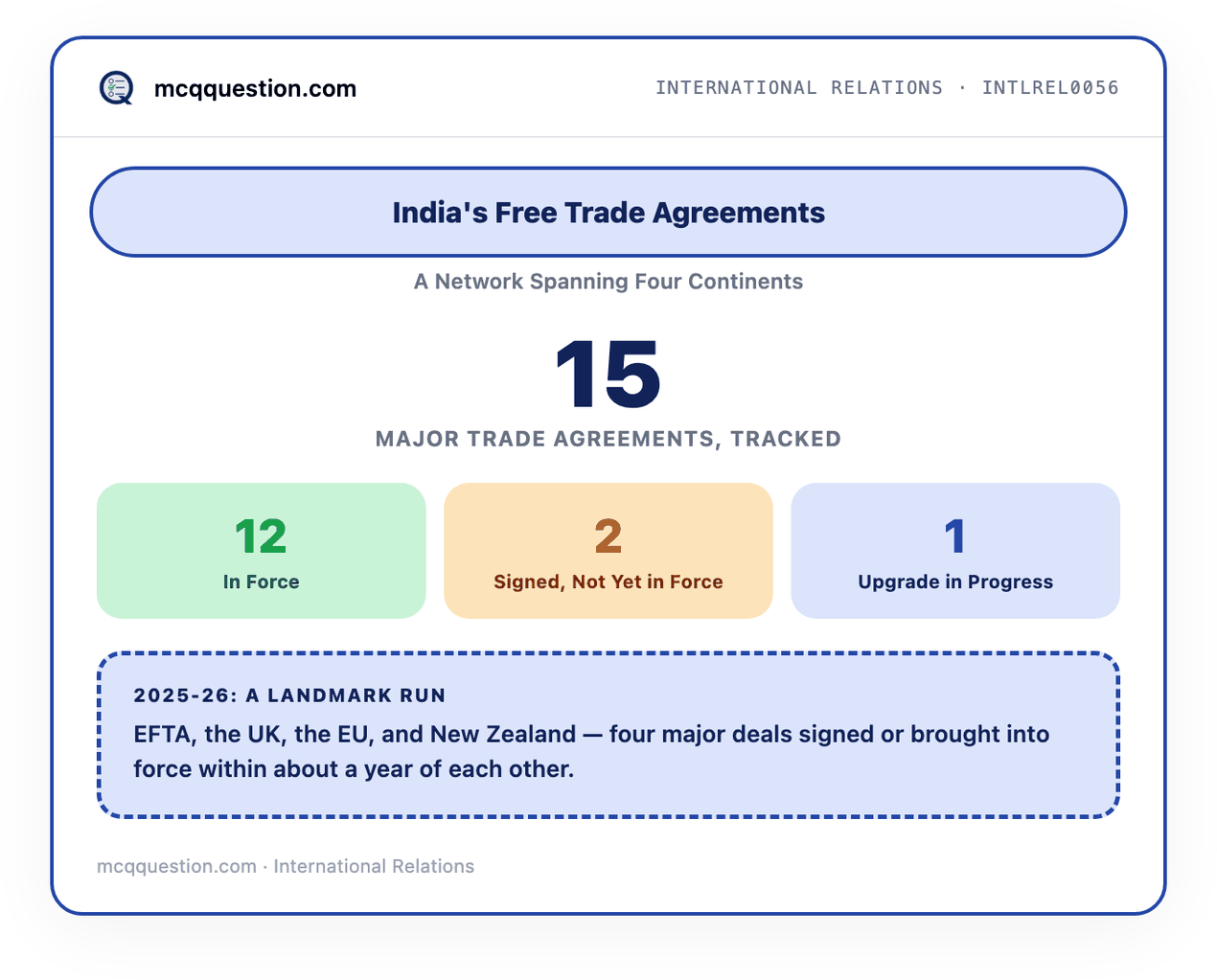
India’s Free Trade Agreements
A Network Spanning Four Continents
15
Major Trade Agreements, Tracked
12
In Force
2
Signed, Not Yet in Force
1
Upgrade in Progress
2025-26: A Landmark Run
EFTA, the UK, the EU, and New Zealand — four major deals signed or brought into force within about a year of each other.
Must Know
- SAFTA, signed in January 2004 and in force since January 2006, covers all eight SAARC members. See IntlRel0005 — India and International Economic Institutions for its wider context.
- The India-Sri Lanka Free Trade Agreement, signed in 1998, has been fully implemented since 2000.
- The India-Nepal Treaty of Trade, most recently revised in 2009, gives Nepal unilateral duty-free access to India. It was last automatically renewed in October 2023.
- The India-Bhutan Agreement on Trade, Commerce and Transit has been in force in its current form since July 2017.
- The ASEAN-India Trade in Goods Agreement (AITIGA), signed in 2010, is the trade pillar of the wider ASEAN-India FTA. See IntlRel0049 — ASEAN-India Relations and the AITIGA Trade Agreement.
- The India-Japan Comprehensive Economic Partnership Agreement (CEPA) was signed on 16 February 2011. See IntlRel0046 — India-Japan Relations.
- The original India-Korea CEPA has been in force since 2010, and is now being upgraded.
- India’s CECPA with Mauritius, signed in February 2021, was India’s first trade pact with an African nation.
- The India-UAE CEPA, in force since May 2022, was negotiated in just 88 days.
- The India-Australia Economic Cooperation and Trade Agreement (ECTA) has been in force since December 2022. See IntlRel0051 — India-Australia Relations.
- The India-EFTA Trade and Economic Partnership Agreement (TEPA) came into force on 1 October 2025.
- The India-UK Comprehensive Economic and Trade Agreement (CETA) was signed on 24 July 2025, and came into force on 15 July 2026. See IntlRel0042 — India-Britain Relations: From Empire to CETA.
Good to Know
- Two major agreements are signed but not yet in force: the India-New Zealand FTA, and the India-EU FTA.
- The India-New Zealand FTA was signed on 27 April 2026, after negotiations launched in March 2025 and concluded that December. See IntlRel0054 — India-New Zealand Relations.
- The India-EU FTA was concluded and signed on 27 January 2026, at Hyderabad House, after nearly two decades of on-and-off talks.
- It is not yet legally binding, and remains subject to formal ratification on both sides.
- India and Korea are separately negotiating a CEPA “upgrade,” distinct from the original 2010 agreement still in force.
- These agreements go by different names — FTA, CEPA, CECPA, CETA, ECTA, TEPA — but all broadly aim to cut tariffs and expand trade access.
Test Yourself

Great to Know
- “Signed” and “in force” are different things. The UK CETA took almost a year to move from one to the other.
- The India-Bhutan trade agreement is due for renewal in 2026, since its current term runs only until this year.
- An Economic and Technology Co-operation Agreement (ETCA), meant to upgrade the older Sri Lanka FTA, has been proposed but not yet concluded.
- Since mid-2025, India has moved through an unusually dense run of major trade deals. EFTA, the UK, the EU, and New Zealand all landed within about a year.
- The EU FTA is already shaping bilateral ties with individual member states. See IntlRel0061 — India-Finland Relations, where it featured directly in a July 2026 ministerial visit.
- The same EU FTA push featured in IntlRel0065 — India-Spain Relations too, reaffirmed at the two countries’ October 2024 summit.
- For the bloc-level relationship behind this FTA, see IntlRel0066 — India-EU Relations, covering the Trade and Technology Council and the wider strategic partnership.
Current Affairs
- On 21 July 2026, MoS Jitin Prasada told the Lok Sabha the government is expanding its FTA network, to diversify India’s export markets. This included a new push on CEPAs and CECAs, not just FTAs. (Source: PIB)
- He cited the Export Promotion Mission (EPM), launched in 2025. It carries a Rs 25,060 crore outlay, for FY 2025-26 to FY 2030-31. (Source: PIB)
- The EPM runs through two sub-schemes: NIRYAT PROTHSAHAN, for trade finance support, and NIRYAT DISHA, for trade enablers. (Source: PIB)
- Other measures include the Districts as Export Hubs (DEH) initiative, and simplified courier export rules. The Rs 10 lakh per-consignment limit on courier exports was removed. (Source: PIB)
- On 15 July 2026, the India-UK CETA came into force, making about 99% of Indian goods entering the UK duty-free.
- On 25-27 May 2026, India and Korea held their 12th round of talks to upgrade the India-Korea CEPA, in New Delhi.
- On 27 April 2026, India and New Zealand signed their Free Trade Agreement, at Bharat Mandapam, New Delhi.
- On 27 January 2026, India and the EU concluded and signed their Free Trade Agreement, at Hyderabad House, New Delhi.
Beyond the answer
Browse all international-relations topics →
📚 Keep reading
UPSC CSP 2016 — General Studies Paper I (Full Question Paper)UPSC CSP 2017 — General Studies Paper I (Full Question Paper)IntlRel0054 — India-New Zealand RelationsUPSC CSP 2015 — General Studies Paper I (Full Question Paper)IntlRel0049 — ASEAN-India Relations and the AITIGA Trade Agreement❓ Practice this topic
D0416 — Which event, eight years after Panchsheel, is often cited as the irony of the India-China framework of peaceful coexistence?D0415 — The principles of Panchsheel gained wider resonance at which 1955 gathering of newly independent Asian and African states?D0414 — The Five Principles of Panchsheel were primarily associated with which two leaders of India and China?D0413 — Which of the following is one of the Five Principles of Panchsheel?🎲 Take a International Relations Quiz
Leave a Reply