India and Japan established diplomatic relations in 1952, through one of the first peace treaties Japan signed after World War II. That relationship has grown into a Special Strategic and Global Partnership, spanning defence, trade, and cutting-edge technology.
 mcqquestion.com
International Relations · IntlRel0046
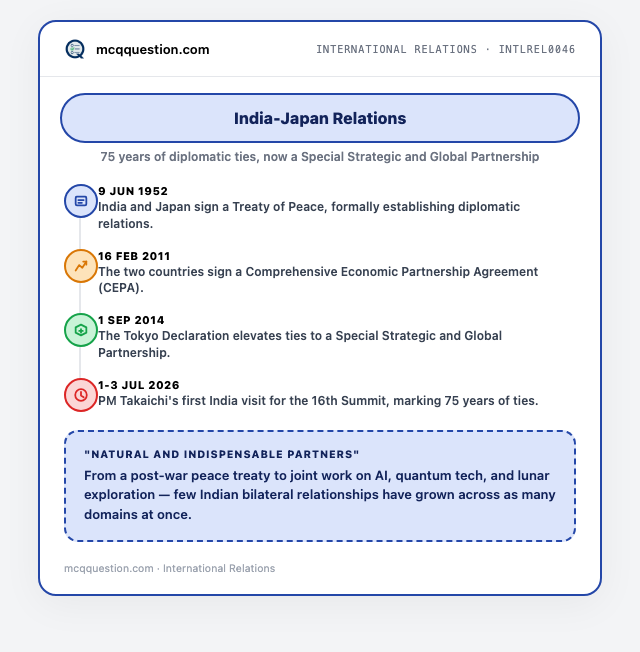
India-Japan Relations
75 years of diplomatic ties, now a Special Strategic and Global Partnership
9 Jun 1952
India and Japan sign a Treaty of Peace, formally establishing diplomatic relations.
16 Feb 2011
The two countries sign a Comprehensive Economic Partnership Agreement (CEPA).
1 Sep 2014
The Tokyo Declaration elevates ties to a Special Strategic and Global Partnership.
1-3 Jul 2026
PM Takaichi’s first India visit for the 16th Summit, marking 75 years of ties.
“Natural and indispensable partners”
From a post-war peace treaty to joint work on AI and lunar exploration, few Indian bilateral relationships span so many domains at once.
Must Know
- India and Japan signed a Treaty of Peace on 9 June 1952, formally establishing diplomatic relations. It was one of the first peace treaties Japan signed after the Second World War.
- The relationship has been upgraded in stages since then: a Global Partnership in 2000, then a Strategic and Global Partnership in 2006. It reached Special Strategic and Global Partnership status in 2014.
- That 2014 upgrade came via the Tokyo Declaration, signed by Prime Ministers Shinzo Abe and Narendra Modi on 1 September 2014.
- The two countries signed a Comprehensive Economic Partnership Agreement (CEPA) on 16 February 2011. It entered into force on 1 August 2011.
- Japanese Prime Minister Takaichi Sanae made her first official visit to India from 1 to 3 July 2026. This was for the 16th India-Japan Annual Summit, held in New Delhi.
- This summit marked 75 years of diplomatic relations, marked as the “India-Japan Year of Shared Horizons.”
- Defence ties run through a “2+2” Ministerial dialogue (foreign and defence ministers of both countries). The fourth round is set for Tokyo by the end of 2026.
- The Mumbai-Ahmedabad High Speed Rail, built with Japanese Shinkansen technology, is the flagship connectivity project. India targets commercial operations on priority sections in 2027.
Good to Know
- At the 16th Summit, the two countries adopted a new India-Japan Joint Declaration on Economic Security Cooperation. It targets semiconductors, critical minerals, information technology, clean energy, and pharmaceuticals.
- This built on an Economic Security Initiative launched at the 15th Summit, held in Tokyo in August 2025.
- That same 15th Summit set a target of ¥10 trillion in Japanese investment into India over ten years. The 2026 summit reviewed progress toward that goal.
- On defence, the navies completed the JAIMEX 25 exercise, and Japan took part in India’s International Fleet Review 2026, held at Visakhapatnam.
- The two sides reached an agreement in principle on the remaining technical details of the UNICORN defence project (Unified Complex Radio Antenna).
- Japan affirmed its support for India’s membership of the International Energy Agency (IEA).
- They launched the India-Japan Cooperative Biogas for Growth (CBG) Initiative, supporting India’s target of 1,000 biogas and organic fertiliser plants.
- Both sides reaffirmed support for the clean ammonia project in Odisha, and adopted a separate Joint Statement on Energy Resilience. This builds on ACME Group’s own July 2026 green-ammonia and green-methanol offtake deals with Japan. See EnvEco0021 — The National Green Hydrogen Mission for details.
- They held their inaugural India-Japan AI Strategic Dialogue, and adopted a Joint Statement on AI cooperation.
- On science, they noted progress on LUPEX (Lunar Polar Exploration), a joint mission between ISRO and Japan’s space agency, JAXA. They also signed a Letter of Intent on quantum technology cooperation.
- People-to-people ties are also growing. Visitors between the two countries crossed 540,000 in 2025, alongside programmes like Nihongo Partners (Japanese language education).
- An India-Japan Governors’ Network now links several Indian states with Japanese prefectures directly, outside the two national governments.
Test Yourself

Great to Know
- The two Prime Ministers described India and Japan as “natural and indispensable partners.” That framing reflects overlapping strategic interests, not just growing trade.
- Bilateral cooperation is explicitly designed to reinforce the wider Quad grouping (India, Japan, the US, and Australia), rather than sit apart from it.
- The relationship spans both large physical infrastructure, like bullet trains and metro lines, and emerging technology areas like AI, quantum computing, and lunar exploration. Few of India’s other bilateral partnerships cover such a wide span at once.
- Japan’s connectivity support to India’s North Eastern Region ties into India’s own Act East Policy. It aims to link the region toward the Bay of Bengal and Southeast Asia.
- For how this fits into India’s wider trade network, see IntlRel0056 — India’s Free Trade Agreements.
Current Affairs
- On 13 July 2026, India and Japan held their 8th Defence Policy Dialogue in Tokyo. Defence Secretary Rajesh Kumar Singh led the Indian side, and Vice Minister Kano Koji led Japan’s. (Source: PIB)
- Both sides discussed defence industrial collaboration, cyber security, space, and maritime cooperation. They reaffirmed commitment to the India-Japan Special Strategic and Global Partnership. (Source: PIB)
- At the 16th Summit, India and Japan pledged mutual support for each other’s candidature for a permanent UN Security Council seat. This came as part of the G4 grouping. (Source: PIB, 16th India-Japan Annual Summit Joint Statement, 2 Jul 2026)
- They also agreed to mutually support each other’s candidature for non-permanent UNSC seats. This covers the 2028-29 and 2033-34 terms. (Source: PIB, 16th India-Japan Annual Summit Joint Statement, 2 Jul 2026)
- Both leaders strongly condemned cross-border terrorism from Pakistan, specifically citing the 22 April 2025 Pahalgam attack and the 10 November 2025 Delhi incident. They called for action against UN-listed groups including Lashkar-e-Tayyiba, Jaish-e-Mohammad, ISIS, and Al Qaeda. (Source: PIB, 16th India-Japan Annual Summit Joint Statement, 2 Jul 2026)
- They reaffirmed commitment to an early Quad Leaders’ Summit. Japan also welcomed India’s plan to host the 4th UN World Conference on Disaster Risk Reduction, in 2030. (Source: PIB, 16th India-Japan Annual Summit Joint Statement, 2 Jul 2026)
- Prime Minister Takaichi invited Prime Minister Modi to visit Japan next year for the 17th Annual Summit, which Modi accepted. (Source: PIB, 16th India-Japan Annual Summit Joint Statement, 2 Jul 2026)
Beyond the answer
Browse all international-relations topics →
📚 Keep reading
IntlRel0025 — PM Modi's Foreign VisitsIntlRel0049 — ASEAN-India Relations and the AITIGA Trade AgreementUPSC CSP 2016 — General Studies Paper I (Full Question Paper)IntlRel0051 — India-Australia RelationsUPSC CSP 2025 — General Studies Paper I (Full Question Paper)❓ Practice this topic
D0416 — Which event, eight years after Panchsheel, is often cited as the irony of the India-China framework of peaceful coexistence?D0415 — The principles of Panchsheel gained wider resonance at which 1955 gathering of newly independent Asian and African states?D0414 — The Five Principles of Panchsheel were primarily associated with which two leaders of India and China?D0413 — Which of the following is one of the Five Principles of Panchsheel?🎲 Take a International Relations Quiz
Leave a Reply