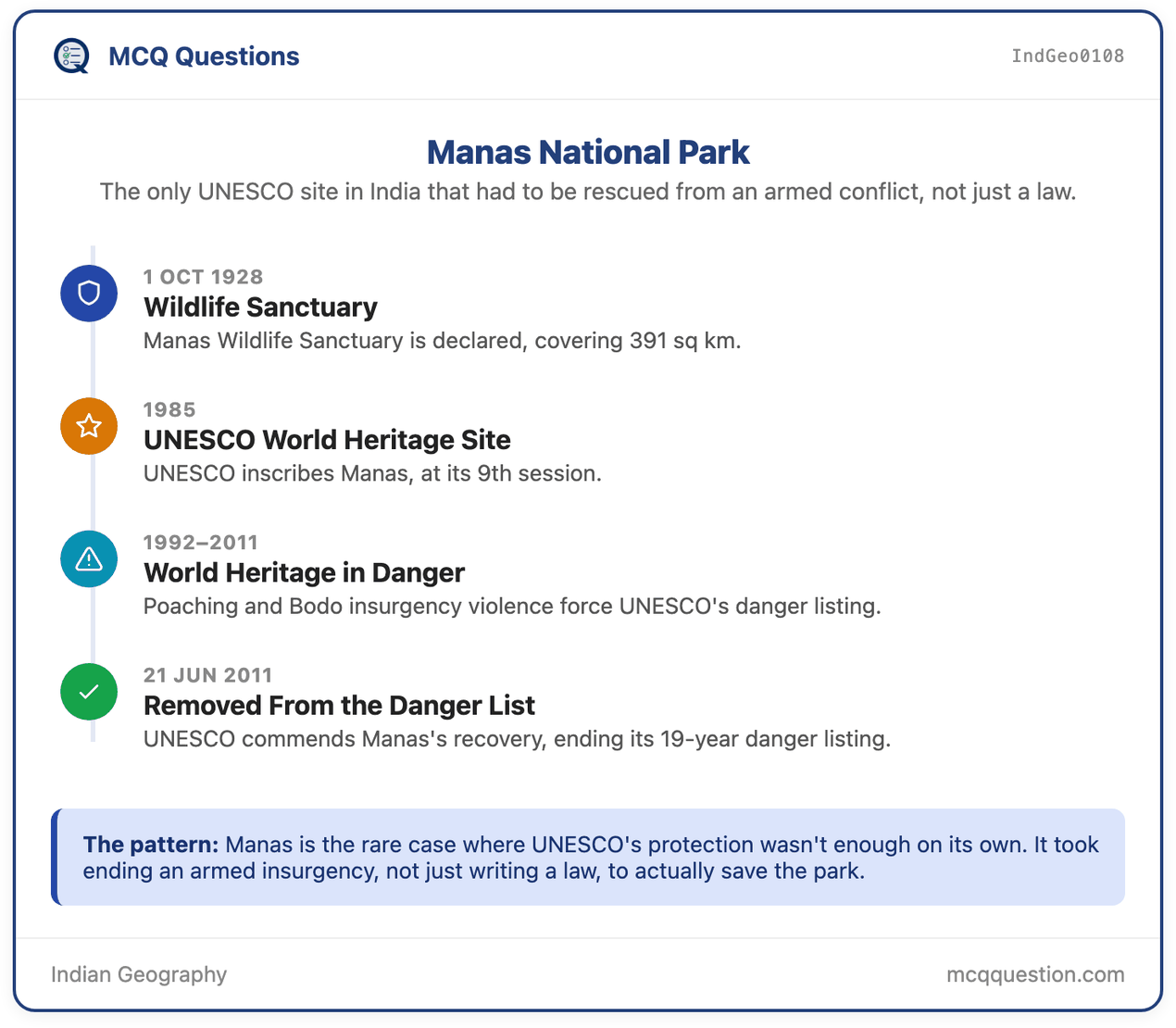
Manas earned UNESCO protection in 1985. Seven years later, UNESCO put it on its danger list instead — not for lack of legal protection, but because an armed insurgency was tearing through the park itself. Manas is the rare case where a law alone couldn’t save a park; ending a conflict could.


 MCQ Questions
IndGeo0108
Manas National Park
The only UNESCO site in India that had to be rescued from an armed conflict, not just a law.
1 OCT 1928
Wildlife Sanctuary
Manas Wildlife Sanctuary is declared, covering 391 sq km.
1985
UNESCO World Heritage Site
UNESCO inscribes Manas, at its 9th session.
1992–2011
World Heritage in Danger
Poaching and Bodo insurgency violence force UNESCO’s danger listing.
21 JUN 2011
Removed From the Danger List
UNESCO commends Manas’s recovery, ending its 19-year danger listing.
The pattern: Manas is the rare case where UNESCO’s protection wasn’t enough on its own. It took ending an armed insurgency, not just writing a law, to actually save the park.
Indian Geographymcqquestion.com
Timeline
- 1 October 1928: Manas Wildlife Sanctuary is declared, covering 391 sq km.
- 1973: Manas becomes a Project Tiger reserve, Assam‘s first and India’s fifth.
- 1985: UNESCO declares Manas a World Heritage Site, at its 9th session.
- 1989: Manas Biosphere Reserve is declared.
- 1990: Three reserve forests are added, formally creating Manas National Park.
- 1992–2011: Poaching and insurgency violence force UNESCO to list Manas as World Heritage in Danger; it is removed on 21 June 2011.
Must Know
- Manas National Park sits in Chirang and Baksa districts, Assam, in the Bodoland Territorial Region, on the Bhutan border.
- It is named after the Manas River, a major tributary of the Brahmaputra.
- It was declared Manas Wildlife Sanctuary on 1 October 1928, covering 391 sq km.
- It became a Project Tiger reserve in 1973, Assam’s first, and India’s fifth.
- UNESCO declared it a World Heritage Site in 1985.
- It was formally declared a National Park in 1990, after three reserve forests were added to it.
- Its current area covers 850 sq km.
- Manas holds the world’s only known population of pygmy hogs.
Good to Know
- The park’s land was part of the Kingdom of Bhutan until the Duar War of 1865, when it was ceded to British India.
- Before 1928, the area held two reserve forests, used as a royal hunting ground by the Cooch Behar royal family.
- Manas Biosphere Reserve was declared in 1989.
- In 1992, UNESCO placed Manas on its List of World Heritage in Danger. Heavy poaching and Bodo insurgency-linked violence had devastated the park through the 1980s and 1990s.
- Insurgents surrendered in 2003, and cooperation grew through the newly formed Bodoland Territorial Council.
- Manas was removed from the Danger List on 21 June 2011, and commended for its recovery.
- The Greater One-horned Rhinoceros, locally extinct in Manas by the 1990s, was reintroduced from 2006, under the Indian Rhino Vision 2020 programme.
- Manas also shelters the Assam roofed turtle, hispid hare, golden langur, red panda, and wild water buffalo.
- It borders Royal Manas National Park in Bhutan, forming one contiguous transboundary protected landscape.
Test Yourself

Great to Know
- Manas’s tiger population grew from just 10 in 2010, to 30 by 2020, and roughly 57 adults by 2023. This reflects a sustained recovery after the insurgency years.
- Manas’s recovery story is unusual among India’s parks. UNESCO’s protection alone wasn’t enough; real change needed the underlying conflict to end first. See Kaziranga National Park for a contrasting, conflict-free conservation story.
- Manas joins Gir, Corbett, Sundarbans, and Bandipur in India’s growing cluster of century-plus-old, single-flagship-species conservation histories.
- Assam alone holds 80% of the world’s Greater One-horned Rhinoceros population, split across Kaziranga, Manas, Orang, and Pobitora.
Current Affairs
- 17 June 2026: Assam Chief Minister Himanta Biswa Sarma announced zero rhino and tiger poaching in Manas National Park, for three consecutive years. Forest Minister Jayanta Mallabaruah credited sustained patrols and community engagement for the milestone. (Source: ANI)
Leave a Reply