Taraknath Palit
Taraknath Palit gave away his life savings to fund a science professorship. He never got to see who filled it. Three years after his death, a young physicist named C.V. Raman took the post, and went on to win India’s first Nobel Prize in science.
- How did a barrister become one of Calcutta’s great philanthropists?
- How did one donation end up funding a Nobel Prize?
- Why did Palit fall out with the National Council of Education?
- How did two donors create two campuses of one college?
- Why does the Palit Professor of Physics chair still matter today?
- Exam Angle
How did a barrister become one of Calcutta’s great philanthropists?
A successful legal career in Calcutta gave Taraknath Palit the fortune he would later give away entirely to fund Indian science.
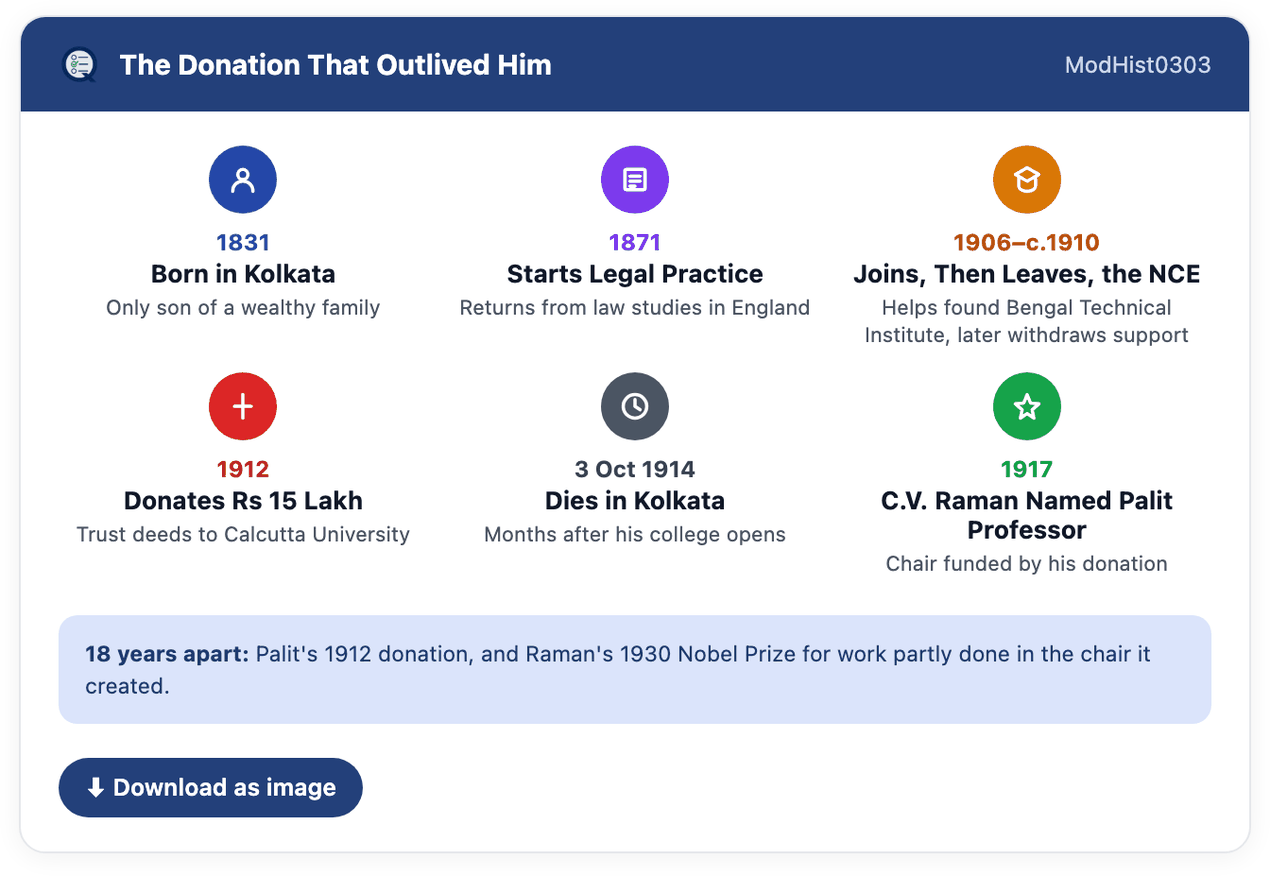
Sir Taraknath Palit (1831–1914) was a Bengali barrister and philanthropist. He was the only son of the wealthy Kalisankar Palit.
He studied at Hindu School in Kolkata, then travelled to England to study law.
He returned to India in 1871, and built a successful legal practice as a barrister in Calcutta.
The British government knighted him on 1 January 1913. He died the following year, on 3 October 1914.
Source: standard biographical record of Sir Taraknath Palit.
Pause and decide · 1 of 8
Taraknath Palit built his fortune as a successful barrister in Calcutta, after studying law in England. True or false?
True. He returned to India in 1871 and was later knighted on 1 January 1913, the year before his death.


How did one donation end up funding a Nobel Prize?
Palit’s 1912 gift came with a firm condition — Indian teachers only — and it eventually put C.V. Raman in the chair where he made his Nobel-winning discovery.
In June and October 1912, Palit executed two trust deeds. Together they donated Rs 15 lakh, his entire life savings, to Calcutta University.
The money was earmarked specifically for science education, going toward building and endowing new science departments.
Palit attached one firm condition to the gift: teachers hired in Physics and Chemistry had to be of Indian origin.
If no suitable Indian candidate was available, the university had to train one, funding higher studies abroad until an Indian could fill the post.
The donation created the Palit Professor of Physics chair. C.V. Raman became its first holder in 1917, and later discovered the Raman Effect while holding it, winning the 1930 Nobel Prize in Physics.
Source: standard record of Palit’s 1912 trust deeds and the Palit Professor of Physics chair.
Pause and decide · 2 of 8
Palit’s 1912 donation came with a firm condition: Physics and Chemistry teachers hired using the gift had to be of Indian origin. True or false?
True. If no suitable Indian candidate was available, the university had to fund one’s higher studies abroad instead, until an Indian could fill the post.
Why did Palit fall out with the National Council of Education?
Palit’s first major philanthropic project ended in a falling-out, years before he redirected his fortune to Calcutta University instead.
Before turning to Calcutta University, Palit backed a different project. In June 1906, he helped found the Society for the Promotion of Technical Education.
That society set up the Bengal Technical Institute. It focused narrowly on technical education and industrial research, unlike the broader National Council of Education.
He worked alongside Rashbehari Ghosh, Bhupendra Nath Bose, and Nilratan Sircar, all prominent Bengali reformers of the Swadeshi era.
Palit later fell out with the National Council of Education. By around 1909–10 he had withdrawn his support and redirected his philanthropy toward Calcutta University instead.
In 1910, the Bengal Technical Institute merged into the National Council of Education anyway. That combined institution eventually evolved into Jadavpur University after independence.
Source: standard record of the Society for the Promotion of Technical Education and the Bengal Technical Institute, 1906-10.
Pause and decide · 3 of 8
Palit’s Bengal Technical Institute work stayed his main philanthropic project for the rest of his life, right up to his 1914 death. True or false?
False. He fell out with the National Council of Education by around 1909-10 and redirected his philanthropy toward Calcutta University instead, which is where his lasting legacy actually lies.
How did two donors create two campuses of one college?
Palit’s donation was not the whole story — a second lawyer-philanthropist made a complementary gift, and together they funded two separate campuses of the same college.
Sir Rashbehari Ghosh, another lawyer-philanthropist, made a separate but complementary donation. It went to the same University College of Science that Palit’s gift created, not to a different institution.
Together, Palit and Ghosh donated close to Rs 25 lakh. Vice-Chancellor Sir Asutosh Mukherjee used this combined gift to found the college on 27 March 1914.
Palit’s donation funded the college’s Ballygunge campus. It is formally named Taraknath Palit Siksha Prangan, and is still informally called Ballygunge Science College.
Ghosh’s donation funded the Rajabazar campus instead. It is formally named Rashbehari Siksha Prangan, and both campuses remain part of Calcutta University today.
Palit died just months after his college formally opened. He never lived to see the Palit Professorship actually filled.
Source: standard record of the University College of Science’s founding, 1912-14.
Pause and decide · 4 of 8
Rashbehari Ghosh’s donation went to a separate, unrelated institution from the one Palit’s gift created. True or false?
False. Ghosh’s donation went to the same University College of Science that Palit’s gift created — together they donated close to Rs 25 lakh, funding the Rajabazar and Ballygunge campuses respectively.
Why does the Palit Professor of Physics chair still matter today?
The college Palit’s fortune built trained some of India’s greatest scientists, and the chair he endowed is still a recognised academic post more than a century later.
Palit’s donation is a clear example of Swadeshi-era philanthropy shaping India’s scientific future. It happened years before independence, and long after the donor’s own death.
The college’s first batch of teachers included Acharya Prafulla Chandra Ray, C.V. Raman, and Sisir Kumar Mitra, all of whom became towering names in Indian science.
The legendary 1915 M.Sc. batch at the college included Satyendranath Bose and Meghnad Saha, both later internationally recognised physicists in their own right.
The Palit Professor of Physics chair remains a recognised academic post at Calcutta University today. It still carries the name of the man who funded it over a century ago.
A scholarship in Palit’s name was also introduced in 1913, the same year the British government knighted him.
Source: standard record of the Palit Professor of Physics chair and its early faculty and students.
Pause and decide · 5 of 8
The college’s founding faculty and its 1915 M.Sc. batch together included C.V. Raman, Prafulla Chandra Ray, Satyendranath Bose, and Meghnad Saha. True or false?
True. Ray, Raman, and Sisir Kumar Mitra were among the first teachers, while Bose and Saha were part of the legendary 1915 M.Sc. batch.
Pause and decide · 6 of 8
Taraknath Palit died just months after his college formally opened, and never lived to see the Palit Professorship actually filled. True or false?
True. The college opened on 27 March 1914, and Palit died on 3 October that same year — three years before C.V. Raman became the first Palit Professor of Physics.
Exam Angle: What to Expect
No Previous Year Question in this site’s index has directly tested this yet — here is what examiners are likely to probe.
Common Trap: examiners could easily swap Taraknath Palit for Rashbehari Ghosh, or vice versa, in a match-the-following question. Remember: Palit funded the Ballygunge campus, and Ghosh funded the Rajabazar campus.
Institution Confusion: Palit is sometimes wrongly linked only to Jadavpur University because of his early Bengal Technical Institute work. His larger, lasting legacy is actually Calcutta University’s science college, not Jadavpur.
Linked Topic: questions on the Swadeshi Movement’s National Education Movement often mention Palit as a founding donor. Pair this article with the Swadeshi Movement and National Council of Education topics for full context.
Chain of Facts: a tricky question could test the Palit-to-Raman-to-Nobel Prize chain. Palit’s 1912 donation, Raman’s 1917 appointment, and his 1930 Nobel Prize are three linked, separately testable dates.
Source: standard exam-angle analysis of Taraknath Palit’s philanthropic legacy.
Pause and decide · 7 of 8
Taraknath Palit’s larger, lasting legacy is Calcutta University’s science college, even though he is sometimes wrongly linked only to Jadavpur University. True or false?
True. His early Bengal Technical Institute work eventually fed into Jadavpur University, but his lasting philanthropic legacy is the science college his 1912 donation created.
Pause and decide · 8 of 8
Palit’s 1912 donation, Raman’s appointment as Palit Professor, and Raman’s Nobel Prize all happened in the same year. True or false?
False. These are three separately testable dates: the donation in 1912, Raman’s appointment in 1917, and his Nobel Prize in 1930 — eighteen years apart from the donation.
Check your understanding
Answer the eight checks above. You will see each explanation after choosing.
Primary sources
- Standard record of Sir Taraknath Palit’s life and philanthropy, and the University College of Science, 1906-1917.
Practice what you learned
Question 1 of 1
Leave a Reply