598 Years of the Ahom Kingdom
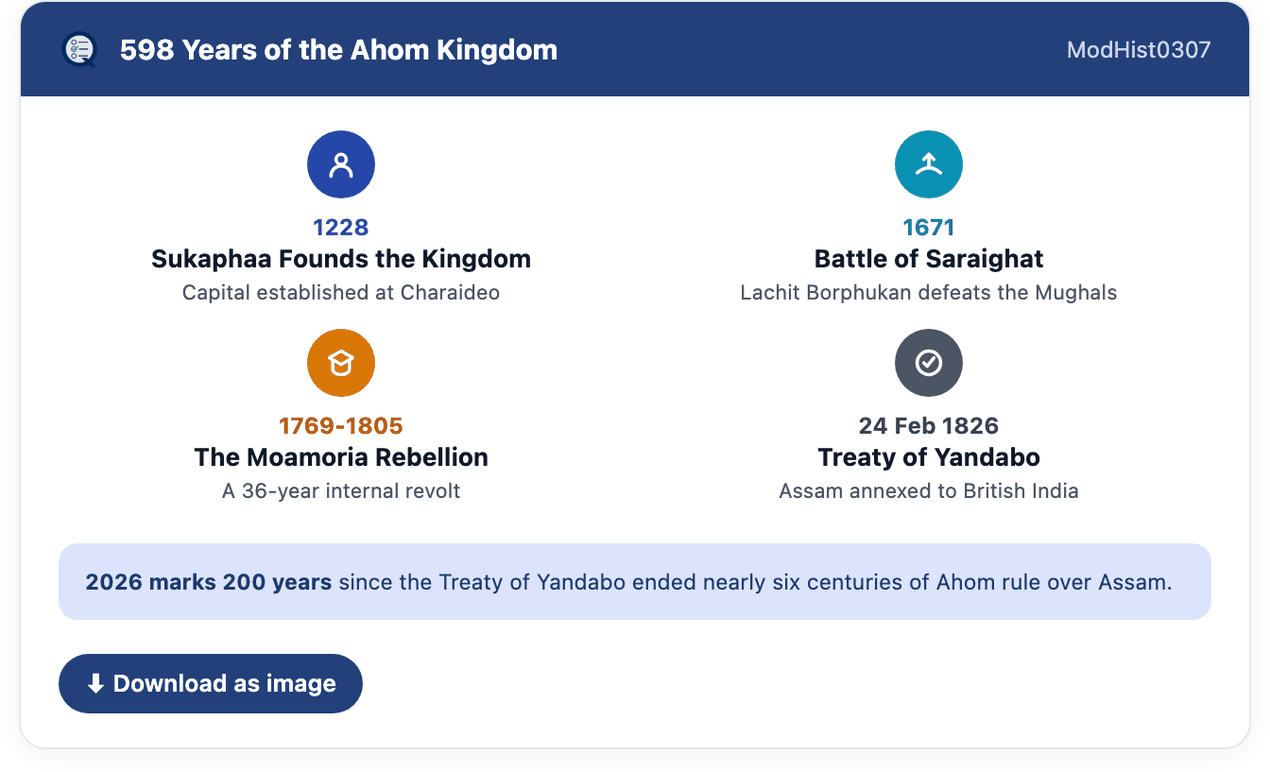
Mughal armies had swallowed most of North India. One kingdom in the Brahmaputra Valley fought them to a standstill, on water, and kept its independence for another two centuries. The Ahom Kingdom ruled Assam from 1228 to 1826, almost 600 unbroken years under one dynasty. It survived a Mughal invasion, an internal revolt that killed half its people, and three Burmese invasions before the British finally took over.
- How did Sukaphaa found a kingdom that lasted 600 years?
- How did Lachit Borphukan defeat a much larger Mughal army?
- How did the Paik system run a kingdom without a bureaucracy?
- How did a 36-year revolt bring the kingdom to its knees?
- What do Rang Ghar and Talatal Ghar reveal about Ahom power?
- Why did the Moidams become a UNESCO World Heritage Site?
- Exam Angle
How did Sukaphaa found a kingdom that lasted 600 years?
A small band of Tai migrants under Sukaphaa built one of Indian history’s longest-ruling dynasties, gradually adopting Hinduism and the Assamese language along the way.
Chaolung Sukaphaa founded the Ahom Kingdom in 1228, in the Brahmaputra Valley of present-day Assam.
He arrived from Mong Mao with three queens, two sons, and a group of nobles and soldiers.
Sukaphaa set up his capital at Charaideo, near present-day Sivasagar district.
The Ahoms were originally a Tai people. Over the centuries, they adopted Hinduism and the Assamese language.
The kingdom lasted almost 600 years, one of the longest-ruling dynasties in Indian history.
Source: standard record of the Ahom Kingdom’s founding, 1228.
Pause and decide · 1 of 8
Sukaphaa and the Ahoms were originally a Tai people, who gradually adopted Hinduism and the Assamese language over the centuries. True or false?
True. Sukaphaa arrived from Mong Mao in 1228 with three queens, two sons, and a group of nobles and soldiers, and set up his capital at Charaideo.


How did Lachit Borphukan defeat a much larger Mughal army?
Fighting on his own terms, with river terrain and naval guerrilla tactics, an outnumbered Ahom general permanently ended Mughal ambitions in Assam.
The battle was fought in 1671, on the Brahmaputra River near present-day Guwahati.
Ahom general Lachit Borphukan commanded the defence against a much larger Mughal force.
The Mughal army was led by Raja Ram Singh I of Amber, serving the Mughal empire.
Lachit used naval guerrilla tactics on the river, despite being heavily outnumbered.
The Ahoms won decisively, permanently ending serious Mughal attempts to conquer Assam.
Source: standard record of the Battle of Saraighat, 1671.
Pause and decide · 2 of 8
Lachit Borphukan’s Ahom army outnumbered the Mughal forces at the Battle of Saraighat in 1671. True or false?
False. The Ahoms were heavily outnumbered by Raja Ram Singh I’s much larger Mughal force, but won decisively using naval guerrilla tactics on the Brahmaputra River.

How did the Paik system run a kingdom without a bureaucracy?
Instead of collecting cash taxes, the Ahom state organised nearly every adult male into a rotating labour system that supplied soldiers, farmers, and craftsmen alike.
The Paik system was the Ahom kingdom’s core administrative and labour structure.
Every adult male aged 16 to 50 was registered as a paik, owing service to the state instead of paying cash tax.
Paiks worked in small groups called gots. One member served at a time while the others farmed his land.
A Bora oversaw 20 paiks, a Saikia oversaw 100, and a Hazarika oversaw 1,000. Bigger commands went to a Phukan (6,000 paiks), a Rajkhowa (a territorial governor), or a Barua (a superintending officer).
This system supplied the kingdom’s soldiers, farmers, and craftsmen, without a large standing bureaucracy.
Beyond the paik work-teams, wider Ahom society was organised into clans called khels, each often controlling several villages and holding land under village-community consent, not royal will alone.
Ahom historians wrote buranjis, chronicles first composed in the Ahom language and later in Assamese, a rare tradition of sustained local historical writing.
Hinduism became the kingdom’s predominant religion under Sib Singh (1714-1744), though Ahom kings kept practising their older traditional beliefs alongside it.
Source: standard record of the Ahom Paik administrative system.
Pause and decide · 3 of 8
Under the Paik system, adult males owed the Ahom state labour service instead of paying cash tax. True or false?
True. Paiks worked in rotating groups called gots, and this system supplied the kingdom’s soldiers, farmers, and craftsmen without a large standing bureaucracy.
How did a 36-year revolt bring the kingdom to its knees?
An internal religious revolt over heavy labour demands killed roughly half the kingdom’s population and left it too weak to resist foreign invasion.
The Moamoria Rebellion (1769-1805) was a prolonged internal revolt that badly weakened Ahom central authority.
Moamoria followers of the Mayamara Vaishnavite sect rose up against heavy paik demands and royal persecution.
The 36-year revolt killed roughly half the kingdom’s population and wrecked its economy.
One rebel-held tract, Bengmara, broke away as the semi-independent Matak Rajya, paying tribute but self-ruled.
That internal weakness left the kingdom exposed. Three separate Burmese invasions struck Assam between 1817 and 1826.
Source: standard record of the Moamoria Rebellion, 1769-1805.
Pause and decide · 4 of 8
The 36-year Moamoria Rebellion left the Ahom Kingdom so weakened that three separate Burmese invasions followed between 1817 and 1826. True or false?
True. The rebellion, which killed roughly half the kingdom’s population, also saw one rebel-held tract, Bengmara, break away as the semi-independent Matak Rajya.
What do Rang Ghar and Talatal Ghar reveal about Ahom power?
A royal sports pavilion and a seven-storey underground palace complex show the scale and sophistication of the Ahom state at its height.
Rang Ghar, near Sivasagar, served as a royal pavilion for watching sports like buffalo fights.
King Rudra Singha first built it in wood and bamboo. Pramatta Singha rebuilt it in brick between 1744 and 1751. Historians count it among the oldest surviving amphitheatres in Asia.
Talatal Ghar and Kareng Ghar, built in 1765 under Rajeswar Singha, formed a seven-storeyed palace.
Three storeys sat underground. Secret tunnels linked it to the Dikhow River and to the Garhgaon Palace, 16 kilometres away.
The complex served as royal court, administrative office, and military headquarters at once.
Source: standard record of Rang Ghar and Talatal Ghar, 1744-1765.
Pause and decide · 5 of 8
Talatal Ghar and Kareng Ghar’s seven-storey palace complex was built entirely above ground. True or false?
False. Three of its seven storeys sat underground, with secret tunnels linking it to the Dikhow River and to the Garhgaon Palace, 16 kilometres away.
Why did the Moidams become a UNESCO World Heritage Site?
Centuries-old royal burial mounds near Charaideo became India’s 43rd World Heritage Site, and the first cultural heritage site from Northeast India.
Moidams are earthen mound burials the Tai-Ahom built for their royals and nobles, near Charaideo.
Ahom rulers raised these mounds over roughly 600 years, from the 13th to the 19th century.
Each mound covers a hollow vault of brick, stone, or earth, topped by a shrine inside an octagonal wall.
India nominated the Moidams in 2023. UNESCO inscribed them on 26 July 2024, at its 46th World Heritage Committee session in New Delhi.
They became India’s 43rd World Heritage Site and Assam’s third, and the first cultural heritage site from Northeast India.
Source: standard record of the Moidams’ 2024 UNESCO World Heritage inscription.
Pause and decide · 6 of 8
The Moidams became the first cultural heritage site from Northeast India to be inscribed on the UNESCO World Heritage List. True or false?
True. UNESCO inscribed them on 26 July 2024, making them India’s 43rd World Heritage Site and Assam’s third.
Exam Angle: UPSC CSP 2026 — What Were the Moidams?
UPSC’s 2026 Prelims, GS Paper I, asked which statement about the Moidams is correct, out of four options.
The choices tested whether Moidams were fortresses, recreation centres, burial grounds, or battle-drill centres.
Only one statement was correct: the Moidams were burial grounds of Ahom royals and nobles.
The other three options borrowed real Ahom-era buildings’ functions, like Rang Ghar’s entertainment role, and wrongly pinned them on the Moidams.
Keep the two apart: Rang Ghar and Talatal Ghar were for the living; the Moidams were for the dead.
Source: UPSC CSP 2026, GS Paper I, Q37.
Pause and decide · 7 of 8
UPSC CSP 2026’s question on the Moidams tested whether they were fortresses, recreation centres, burial grounds, or battle-drill centres — and the correct answer was that they served an entertainment function. True or false?
False. The correct answer was burial grounds — the entertainment role actually belongs to Rang Ghar, a common trap in this exact question.
Pause and decide · 8 of 8
The Ahom Kingdom ruled Assam for almost 600 unbroken years, from 1228 until the 1826 Treaty of Yandabo. True or false?
True. It survived a Mughal invasion, the 36-year Moamoria Rebellion, and three Burmese invasions before the British finally took over.
Check your understanding
Answer the eight checks above. You will see each explanation after choosing.
Primary sources
- Standard record of the Ahom Kingdom, 1228-1826, and the 2024 Moidams UNESCO inscription.
- UPSC CSP 2026, GS Paper I, Q37.
Practice what you learned
Question 1 of 1
Leave a Reply