This law didn’t just ban bonded labour. It cancelled every existing bonded labourer’s debt, in one stroke, across the entire country. Nearly fifty years later, the government’s own figures show rescues have been falling, not rising.

Timeline
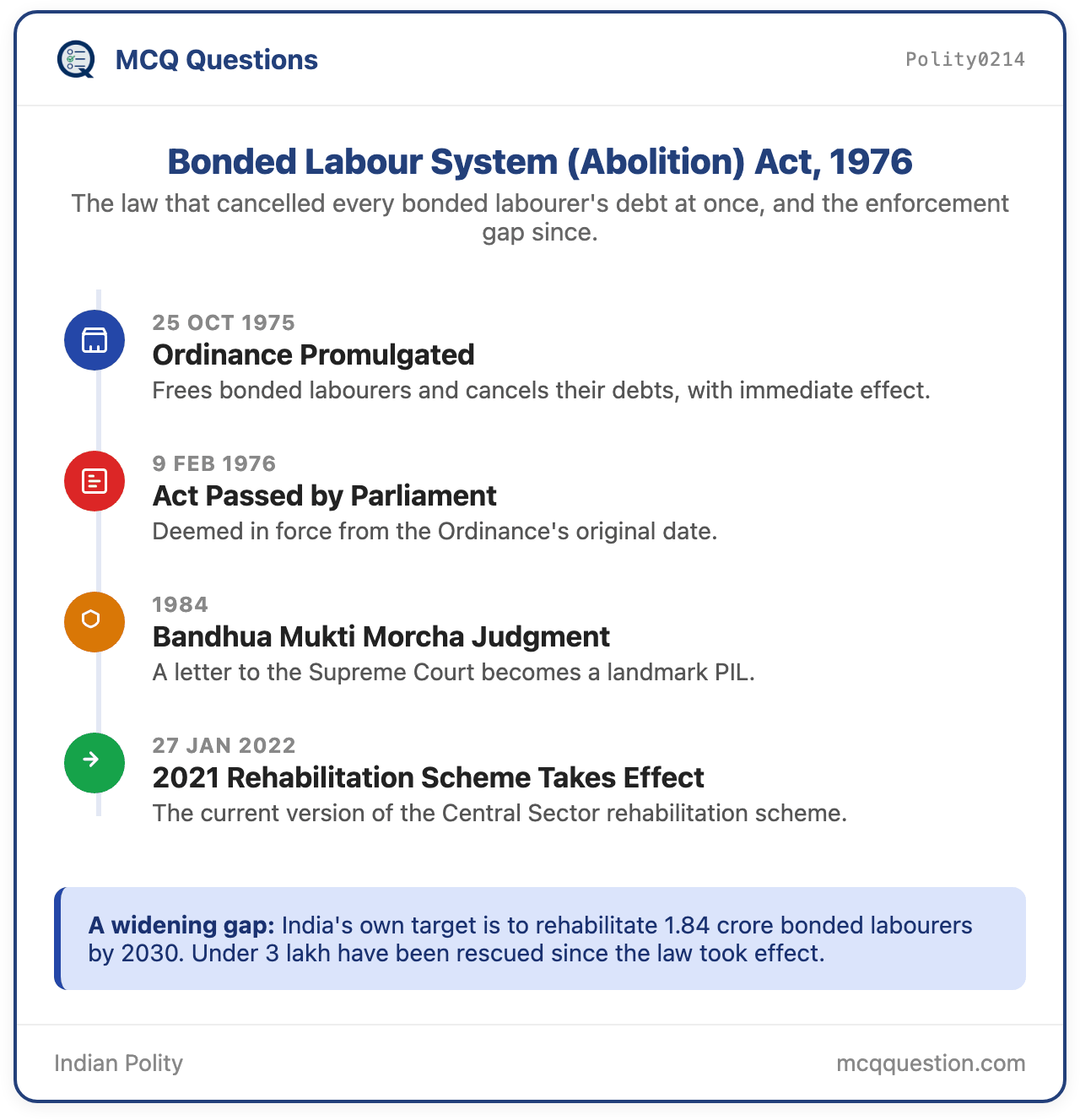
- 25 October 1975: The Bonded Labour System (Abolition) Ordinance is promulgated, freeing bonded labourers and cancelling their debts.
- 9 February 1976: Parliament enacts the Bonded Labour System (Abolition) Act, deemed in force from the Ordinance’s original date.
- 1984: The Supreme Court decides Bandhua Mukti Morcha v. Union of India, a landmark case on bonded labour in Faridabad’s stone quarries.
- 27 January 2022: The Central Sector Scheme for Rehabilitation of Bonded Labourer, 2021 takes effect, the current version of the rehabilitation scheme.
Must Know
- The Bonded Labour System (Abolition) Act, 1976 abolishes bonded labour across India. It freed every bonded labourer at the time, and cancelled all their outstanding debts.
- It gives statutory force to Article 23 of the Constitution, which prohibits trafficking in human beings, begar, and other forms of forced labour.
- The Act was first promulgated as an Ordinance on 25 October 1975. Parliament formally enacted it on 9 February 1976, but the law is deemed to have taken effect from the Ordinance’s date.
- The Act makes bonded labour a cognizable offence, punishable with imprisonment and fines.
- Under Section 13, every State Government must set up a Vigilance Committee in each district and sub-division. These committees advise on implementation, and support the social and economic rehabilitation of freed labourers.
- Since 1978, the government has reported 297,038 bonded labourers rescued, as of February 2025.
Good to Know
- Rescued bonded labourers receive financial rehabilitation assistance. This is ₹1 lakh for adult male beneficiaries, and ₹2 lakh for women and children, including those rescued from forced begging. Cases of extreme deprivation qualify for ₹3 lakh. District Administration also provides immediate cash assistance of up to ₹30,000.
- The rehabilitation scheme itself has been revised repeatedly. It launched in May 1978, then was updated in 2016. It now runs as the Central Sector Scheme for Rehabilitation of Bonded Labourer, 2021, effective from 27 January 2022.
- Annual rescue numbers have fallen sharply in recent years: 673 in 2022-23, 468 in 2023-24, and just 246 in 2024-25 (as of January 2025).
- A March 2025 Parliamentary Standing Committee report flagged this decline. It also noted that rehabilitation assistance is released only on demand from States and Union Territories, which can slow disbursal.
- India’s own stated target is far larger than what has been achieved so far. The goal is to rehabilitate 1.84 crore bonded labourers by 2030.
Current Affairs
- On 10 July 2026, the National Human Rights Commission (NHRC) heard 86 cases of alleged bonded labour in brick kilns across Haryana, online, chaired by Justice V. Ramasubramanian. (Source: PIB)
- The NHRC found that in most cases, officials had not properly examined records, leaving them without credible evidence to confirm bonded labour. Haryana’s Chief Secretary and Labour Commissioner assured the Commission that all 86 cases would be reviewed and reported on. (Source: PIB)
- Justice Ramasubramanian called for a dedicated helpline, backed by proper employment records, to help track bonded labour cases. He also directed officials to follow the Standard Operating Procedure for Identification and Rescue of Bonded Labourers. The Ministry of Labour and Employment had issued it on 14 May 2026. (Source: PIB)
Test Yourself

Great to Know
- This Act gives statutory teeth to Article 23, one of the six Fundamental Rights. See Polity0002 — Fundamental Rights of Indian Citizens, where the Right against Exploitation is covered as part of the wider Fundamental Rights framework.
- Bandhua Mukti Morcha v. Union of India began as a simple letter to Justice Bhagwati, not a formal petition. The Supreme Court treated it as a writ petition, and appointed a fact-finding commission. It also held that anyone shown doing forced labour is presumed a bonded labourer, unless the employer or State proves otherwise. See Polity0083 — Judicial Activism in India.
- The gap between ambition and outcome is stark. India’s target is to rehabilitate 1.84 crore bonded labourers by 2030. Yet under 3 lakh have been rescued since the law took effect, nearly 50 years ago.
- A law making bonded labour illegal is not the same as a system that reliably finds and frees bonded labourers. The falling annual rescue numbers suggest enforcement, not the law itself, is where the real gap now lies.
Beyond the answer
Browse all indian-polity-and-constitution topics →
📚 Keep reading
Polity0244 — Article 123: President's Ordinance-Making PowerModHist0351 — The Founding of the Hind Mazdoor SabhaPolity0357 — The Governor: Office, Powers and ImmunitiesUPSC CSP 2025 — General Studies Paper I (Full Question Paper)UPSC CSP 2016 — General Studies Paper I (Full Question Paper)❓ Practice this topic
Which of the following Acts, receiving presidential assent on 24 December 2023, replaced the Indian Telegraph Act 1885, the Wireless Telegraphy Act 1933 and the Telegraph Wires (Unlawful Possession) Act 1950?Under Article 61 of the Constitution, by what majority must the resolution preferring the charge of impeachment against the President be passed in each House of Parliament?Which Article of the Constitution provides that it shall be the endeavour of every State to provide adequate facilities for instruction in the mother tongue at the primary stage to children belonging to linguistic minority groups?In which situation can a State Governor issue an ordinance under Article 213 of the Constitution?🎲 Take a Indian Polity And Constitution Quiz
Leave a Reply