Not every drought is the same kind of problem. This article covers the four recognised types, and how one can trigger the next.

Must Know
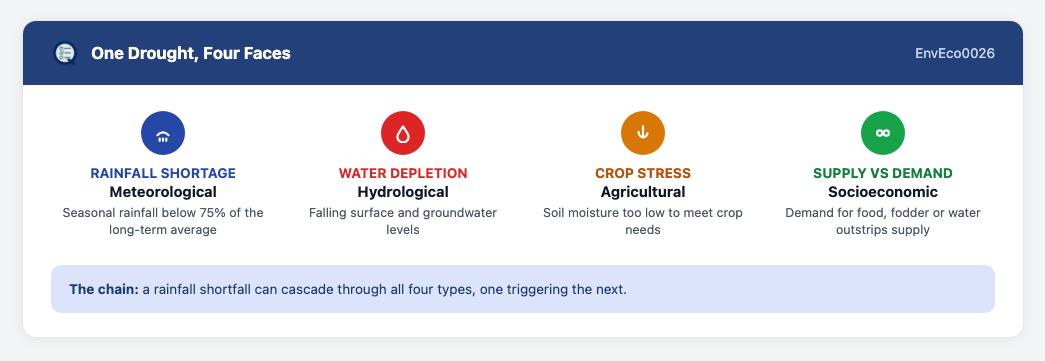
- Meteorological drought means seasonal rainfall falls below 75% of the long-term average, per the India Meteorological Department’s definition.
- The IMD grades it further. A rainfall deficit of 26-50% counts as moderate drought; a deficit beyond 50% counts as severe drought.
- Hydrological drought follows when prolonged low rainfall depletes surface and groundwater supplies below normal levels.
- Agricultural drought sets in when soil moisture drops below what crops need. It is usually triggered by the meteorological and hydrological types before it.
- Socioeconomic drought occurs when demand for water, food or fodder outstrips supply, because of a weather-driven shortfall.
Good to Know
- The IMD also declares drought based on monsoon timing, not just rainfall totals. A 2-week delay in monsoon onset, or a 2-week early withdrawal, both count as drought indicators.
- Consecutive dry spells within an otherwise normal monsoon season can also trigger a drought declaration, even without an overall seasonal rainfall deficit.
- These four types usually cascade in sequence. A meteorological shortfall causes hydrological depletion, which then causes agricultural stress, which finally causes socioeconomic strain.
Test Yourself

Great to Know
- Separating these four types matters for policy. A region can face meteorological drought without agricultural drought, if stored groundwater or irrigation absorbs the shortfall.
- Socioeconomic drought is the only type defined by economics rather than physical measurement. It depends on how supply and demand interact, not on a rainfall or soil-moisture threshold alone.
- The cascading relationship explains why early rainfall monitoring matters. Catching a meteorological shortfall early can help prevent it from escalating into agricultural or socioeconomic drought.
- Irrigation infrastructure and groundwater reserves act as buffers between drought types. They can delay, or sometimes prevent, a meteorological shortfall from becoming a full agricultural crisis.
Beyond the answer
Browse all environment-and-ecology topics →
📚 Keep reading
UPSC CSP 2025 — General Studies Paper I (Full Question Paper)UPSC CSP 2020 — General Studies Paper I (Full Question Paper)IndEco0255 — Agricultural Income Tax Exemption in IndiaIndEco0294 — NSSO Situation Assessment Survey of Agricultural HouseholdsUPSC CSP 2018 — General Studies Paper I (Full Question Paper)❓ Practice this topic
D0306 — Consider the following statements: 1. NCAP is a statutory programme backed by a dedicated law. 2. City action plans under NCAP are tracked on the PRANA portal. 3. The Graded Response Action Plan stages emergency measures for Delhi-NCR by AQI level. How many of the statements are correct?D0305 — Which statement best describes a 'non-attainment city' under NCAP?D0304 — What was the original target set by NCAP for reducing PM2.5 and PM10 concentrations by 2024?D0303 — Which ministry anchors the National Clean Air Programme?🎲 Take a Environment And Ecology Quiz
Leave a Reply